You are using an outdated browser and your browsing experience will not be optimal. Please update to the latest version of Microsoft Edge, Google Chrome or Mozilla Firefox. Install Microsoft Edge

March 25, 2022

Trade Dress Case Results in Record Damages in Thailand

Managing Intellectual Property

Trade dress, which refers to the visual appearance of a product and packaging, as well as the product’s placement at its point-of-sale (store layout), was at the center of an infringement case that recently obtained the highest damages award ever given for a trademark case in Thailand.

Trade dress is an important branding consideration because it can create a commercial impression and enable the public to recognize the original source of goods and services, distinct from other traders. Trade dress comes in many different forms, but only a few of them find solid protection in Thailand, and only through creative use of existing intellectual property protections. For instance, a unique packaging design in the form of an unfolded paper box could be eligible for trademark registration. A distinctive product configuration or external design of a container might be eligible for registration as a three-dimensional trademark, or even as a design patent if it features lines or colors giving a special appearance to a novel product that has an industrial application. In addition, a product’s configuration could be subject to copyright protection as a “sculpture work” if it shows a figure with tangible volume.

However, in Thailand, trade dress does not yet receive explicit recognition under the country’s Trademark Law—unlike in some other jurisdictions whose trademark laws permit the registration of trade dress. The protection and enforcement of trade dress in the form of “store layout” in particular has been a constant challenge in Thailand, given the lack of explicit laws and precedence. Consequently, brand owners may have a hard time protecting their trade dress in relation to their creative and unique store layout designs, despite a great deal of effort and financial investment.

But now this appears to be changing: In December 2021, Tilleke & Gibbins successfully secured a precedent judgment on the store layout form of trade dress from the Central Intellectual Property and International Trade Court (IP&IT Court).

Precedent Trade Dress Case for Store Layout

The popular Thai bubble-tea chain Fire Tiger is a successful business of Ruay Sabai Sabai Co., Ltd., a Thailand-based food and beverage company. Fire Tiger is a pioneer in the use of eye-catching trade dress in the industry. For use in all Fire Tiger stores, Ruay Sabai Sabai designed a gold-colored sculpture of a tiger’s head featuring a wide-open mouth as a product-serving channel as part of a store design that resembles a tiger cage. They also developed Fire Tiger’s logos, unique menu designs, and other creative marketing ideas to support their bubble-tea business. These distinctive creations were deployed in Fire Tiger branches and quickly gained consumer recognition and media attention.
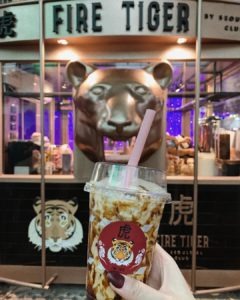
Ruay Sabai Sabai operates over 15 Fire Tiger stores in Thailand and has expanded their franchise business in Southeast Asia, with further outlets soon to open in Europe and North America. Fire Tiger’s various marks have been registered in Thailand and overseas, and their tiger-head sculpture has also been recorded with the Copyright Office of the Department of Intellectual Property.

In 2019, Ruay Sabai Sabai became aware of a competing chain of bubble-tea stores using a similar trade name and trademark containing the word “fire” plus the name of another animal. Moreover, the competitor’s stores were using a similar gold-colored sculpture of an animal head with an open mouth in a golden cage for their product-serving channel, and the menu designs and marketing ideas also showed similarities to those of Fire Tiger. The competitor expanded rapidly, amassing over 200 franchise licensees throughout Thailand within a short period. Ruay Sabai Sabai’s attempts to contact the competitor to resolve the dispute amicably all went ignored, so in view of the damage they sustained, Ruay Sabai Sabai filed a civil lawsuit against the competitor with the IP&IT Court on November 30, 2020.

The litigation process took just over a year, and on December 23, 2021, the IP&IT Court announced its judgment, concluding that the competitor’s use of the word “fire” along with an animal name as its store name and in naming its bubble-tea products (in Thai and English languages), beverage cups bearing an animal head in the same position as on Fire Tiger’s cups, and an animal-head sculpture with an open mouth as a serving channel could cause the general public to understand that the competitor’s bubble-tea stores originated from Fire Tiger, or that the competing bubble-tea products are derived from the same source.

Since the competitor was the same type of business as Fire Tiger, the court believed that the actions noted above would deceive the public into believing that the competitor’s goods or business, including the franchise businesses, are associated with Fire Tiger. This constitutes infringement as passing off under the Trademark Act, and the court agreed that the infringement caused damage to Ruay Sabai Sabai.

The IP&IT Court awarded damages of THB 10 million (approximately USD 303,000) with interest to Ruay Sabai Sabai, together with monthly damages of THB 100,000 (approximately USD 3,030) from the filing date of the complaint until the competitor ceases its passing-off actions. The amounts awarded by the IP&IT Court in this case are the highest handed down for a trademark case in Thailand.

Protection of New Types of IP in Thailand

The judgment in the Fire Tiger case confirms that trade dress in the form of store layout can be protected in Thailand. Even in the absence of explicit legislation in the Thai Trademark Act governing trade dress protections in Thailand, the IP&IT Court recognizes the efforts and financial investment of IP owners and is open to interpreting the law in concurrence with international standards by making use of the existing laws offering protection to brand owners. It is hoped that this case will act as a precedent in many more cases, giving IP owners more comprehensive protection over their creative output and investment in their IP assets.

This article first appeared in Managing Intellectual Property.

RELATED INSIGHTS​ 

July 27, 2026
Tilleke & Gibbins’ intellectual property specialists have authored the Thailand chapter of Trade Secrets 2026 from Chambers and Partners. This global guide examines the legal frameworks governing trade secret protection, enforcement, and litigation across jurisdictions worldwide. The Thailand chapter provides a comprehensive overview of the country’s legal regime for protecting confidential business information, covering the legal framework, trade secret misappropriation, litigation procedures, remedies, and dispute resolution. Some topics covered include: Protectable trade secrets Reasonable measures to maintain secrecy Employee confidentiality Trade secret licensing Civil and criminal remedies Litigation procedures and injunctions Damages and other remedies Mediation and arbitration The guide also examines practical issues relating to safeguarding trade secrets, defending against allegations of misappropriation, and managing trade secret disputes in Thailand. Chambers and Partners’ Global Practice Guides provide in-house counsel with authoritative commentary on practical legal issues affecting business, enabling readers to compare legislation and procedures across multiple jurisdictions. The Thailand chapter of Trade Secrets 2026 is available as a PDF through the button below. The full guide can be accessed for free on the Chambers and Partners website.
July 27, 2026
In March 2025, Thailand’s Central Intellectual Property and International Trade Court (IP&IT Court) issued a landmark judgment in favor of Luckin Coffee, China’s leading retail coffee chain. The judgment marked a significant turnaround following earlier trademark litigation involving Luckin Coffee from 2021 to 2023 that had generated widespread public attention and raised questions about the protection available to legitimate foreign brand owners in Thailand. In a significant subsequent development, Thailand’s Court of Appeal for Specialized Cases has now affirmed the IP&IT Court’s judgment in its entirety. The appellate decision brings clarity to one of Thailand’s most closely watched trademark disputes. Significantly, this is the first case in Thailand to formally recognize the trademark squatting principle. The Court of Appeal confirmed that Luckin Coffee has a better right to the disputed mark and ordered cancellation of the defendants’ trademark registration—a key application of the “better right” doctrine. The court also upheld the substantial damages awarded at first instance, providing important guidance on assessing harm from systematic trademark squatting. Award-Winning Judgment Affirmed in Its Entirety The significance of the first-instance judgment extended beyond the outcome for Luckin Coffee. The IP&IT Court judgment was subsequently recognized in the IP&IT Court’s Distinguished Judgment Awards in 2025, reflecting the complexity, novelty, and legal significance of the issues considered in the case. The defendants nevertheless appealed the judgment, challenging several key aspects of the IP&IT Court’s decision. Luckin Coffee continued to entrust Tilleke & Gibbins as their sole attorney to pursue the case at the appellate level. After considering the defendants’ appeal and Luckin Coffee’s submissions in response, the Court of Appeal affirmed the first-instance judgment in its entirety. The judgment was announced on July 8, 2026. Better Right to the Marks The Court of Appeal confirmed Luckin Coffee’s superior rights. The orders include cancellation
July 24, 2026
As food innovation continues to accelerate, manufacturers are increasingly introducing ingredients derived from new sources, produced using novel technologies, or lacking a significant history of human consumption. While these innovations create new opportunities for the food industry, they also raise important questions regarding consumer safety. For this reason, many jurisdictions, including Thailand, the European Union, Australia and New Zealand, Canada, and Singapore, require a premarket safety assessment for novel food ingredients before they can be placed on the market. The objective of this assessment is to ensure that each ingredient is safe for its intended use and level of consumption, does not present toxicological, allergenic, microbiological, or nutritional concerns, and will not mislead consumers. Scientific authorities typically evaluate the ingredient’s identity, manufacturing process, composition, specifications, anticipated dietary exposure, toxicological information, nutritional impact, and history of use before determining whether it can be marketed. Against this background, the Thai Food and Drug Administration (FDA) recently took an important step toward improving regulatory transparency by publishing, for the first time, a consolidated public list of substances that have successfully completed the Thai FDA’s safety assessment process, including substances determined to be novel foods and those determined not to fall within the novel food category. The list identifies the approved substances, the corresponding manufacturers or importers, approval dates, and the approved conditions of use. Although the publication does not change the existing legal framework governing novel food approvals, it provides businesses with greater visibility into the Thai FDA’s regulatory precedents and the types of substances that have previously been accepted through the safety assessment process. The full announcement is available on the Thai FDA’s website. As the list is now publicly available, it also provides useful insight into the types of substances that have successfully completed the Thai FDA’s safety assessment process.
July 24, 2026
Indonesia has updated its fee framework for intellectual property (IP)-related government services, with implications for IP owners, licensees, lenders, digital platforms, and businesses operating in the country. Government Regulation No. 30 of 2026 on Types and Tariffs of Non-Tax State Revenue Applicable to the Ministry of Law (GR 30/2026) was promulgated on July 2, 2026, and will take effect on August 1, 2026. Key Takeaways GR 30/2026, which replaces the relevant IP service fees under Government Regulation No. 45 of 2024, reorganizes the fee schedule into separate categories for copyright, industrial designs, patents, layout designs of integrated circuits, trade secrets, trademarks, geographical indications, IP enforcement, and other categories. The most commercially relevant changes include a new copyright recordation tariff exemption for songs and music, higher fees for several trademark and geographical indication services, new IP enforcement service fees, and a new fee type for registration of fiduciary security over IP rights objects. In addition, this is the first major update for trademark fees in approximately 10 years. GR 30/2026 is significant not only as a fee update but also as a further indication of Indonesia’s increasing recognition of IP as a financeable commercial asset. By expressly assigning fees to the registration of fiduciary security over IP rights objects, the regulation places IP-backed collateral filings within the Ministry of Law’s administrative service framework. While GR 30/2026 does not create a new secured-transactions regime, this development is relevant for lenders, borrowers, and IP owners structuring financing arrangements secured by trademarks, patents, copyrights, industrial designs, or other registrable IP rights in Indonesia. Copyright: New Fee Exemption for Songs and Music Recordation For copyright, GR 30/2026 creates a fee-exempt category for recordation of works or related-rights products for songs or music, while maintaining a separate category for other works and related-rights products. It