
You are using an outdated browser and your browsing experience will not be optimal. Please update to the latest version of Microsoft Edge, Google Chrome or Mozilla Firefox. Install Microsoft Edge

August 25, 2025

The Impact of Recent Franchise Regulation Changes in Indonesia

Indonesia’s current regulations on franchises, as stipulated under Government Regulation No. 35/2024 on Franchising and its implementing regulation, Ministry of Trade (MOT) Regulation No. 71/2019 regarding Implementation of Franchising, highlight fundamental changes in franchise registration. These changes have introduced additional complexities and challenges in the franchise registration procedure, making it more difficult for franchise owners to navigate the process.

New procedure

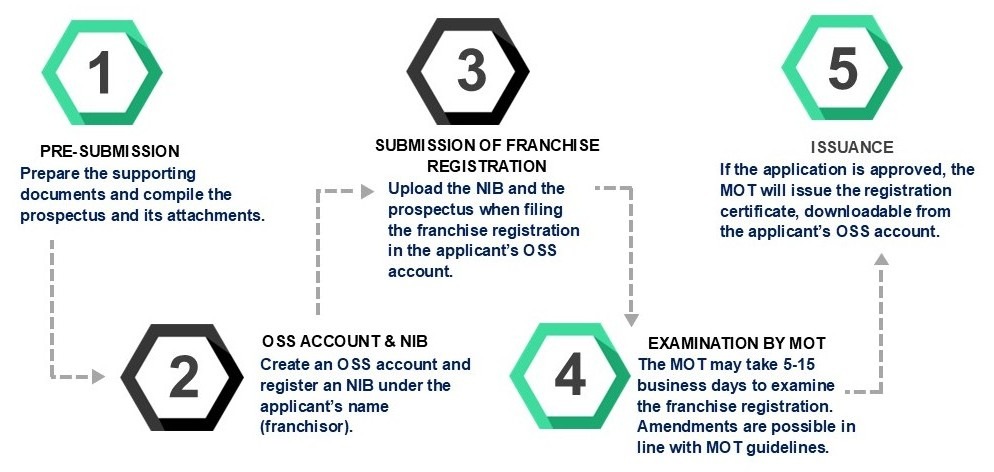
Franchise applications are still submitted through the Online Single Submission (OSS) portal of the Capital Investment Coordinating Board (BKPM). However, the new procedure requires each applicant, including foreign franchisors, to have an OSS account and a business registration number (NIB) issued by BKPM. An application for franchise registration must be submitted under the applicant’s own account—submissions can no longer be made through the account of a consultant.

Once a franchise application is submitted, the authority will distribute the submission to the MOT—the authorized ministry for franchise registration. Any notification or decision upon the registration made by the MOT will be available in the OSS system. Applicants should regularly monitor the status of the franchise application because no notifications will be sent to applicants to alert them of any deficiency.

Here is the summary of the new procedure for franchisors:
Notable Requirements

The disclosure document, or prospectus, is the key focus for the MOT in examining a franchise registration for a franchisor. This document is subject to thorough scrutiny by the MOT to ensure that all mandatory information meets the requirements set in the franchise regulations.

The current regulations specifically require that the mandatory clause “business system” in the prospectus cover operational standards and procedures, which should include human resource management, administration, operational management, standard operating methods, business location selection, business premises design, employee requirements, and marketing strategies.

Other clauses that are equally important to pay attention to are:

  • Identity of the franchisor: The identity should be in line with the IP owner. If not, a license agreement will be required.
  • Business legality of the franchisor: The business license must be attached to the prospectus.
  • Profit statements for the last two years: Audited financial report showing profit and loss.

Impact

The requirement for franchisors and franchisees to have an OSS account introduces additional steps and expenses in the franchise registration process. This requirement can be particularly burdensome for franchise business actors, as franchise registration is often facilitated by third parties, such as consultants. The new regulation mandates that the registration be submitted under the franchisor’s own account, which can be especially challenging for franchisees located overseas.

Ideally, creating an OSS account would be an option rather than a compulsion—this would ease the registration process for franchise business owners. Additionally, the OSS system should be made easier to navigate.

Nonetheless, the requirements stand for now, and business operators should take note of the additional steps that apply to them.


RELATED INSIGHTS​ 

October 26, 2021
Parallel imports—branded goods imported into a domestic market and sold there without the consent of the intellectual property (IP) owner—pose a unique challenge for IP owners. In contrast to counterfeit goods, parallel imported goods are manufactured by or under the license of the IP owner and formulated or packaged for a particular jurisdiction and then imported into a different jurisdiction without the authorization of the IP owner. Intellectual property laws and perspectives on parallel import vary throughout Southeast Asia. The distinct legal landscape in each nation should be carefully navigated in consultation with legal experts to ensure brand protection to the fullest degree. This guide provides insight into the legal frameworks relating to parallel imports in Cambodia, Indonesia, Laos, Myanmar, Thailand, and Vietnam. Each section examines the relevant laws and regulations that pertain to parallel imports and explores the remedies available to IP owners in each country. Finally, the guide presents some strategies to combat parallel importation and maximize IP protection in Southeast Asia. The full guide can be downloaded through the button below.   This guide was prepared with the assistance of Tilleke & Gibbins interns Christian Pederson and Keoni Williams.
October 26, 2021
Attorneys from Tilleke & Gibbins in Vietnam have written the Vietnam chapter of the newly released Fashion Law 2021, a guide to law surrounding the business of fashion in jurisdictions around the world. The guide covers 18 key jurisdictions for the global fashion industry, offering insights into local legal frameworks surrounding vital issues such as brand enforcement and protection, e-commerce and marketing, and sustainability considerations. The Vietnam chapter of Fashion Law 2021 provides detailed information on the following topics: Trademarks, designs, copyright, and other intellectual property types such as patents and trade secrets. Strategic local contractual arrangements for manufacturing, distributing, and advertising fashion products. Overview and application of online marketing regulations and consumer protection regulations in Vietnam. The most relevant unfair competition rules for fashion businesses, and local courts’ interpretation and enforcement of the rules. ESG (environmental, social, and governance) concerns and sustainability issues for the fashion industry. Customs monitoring and local import and export guards against counterfeit products. The full Vietnam chapter is available for free on the Global Legal Post website, or it can be downloaded as a PDF through the button below. Tilleke & Gibbins also contributed the Thailand chapter to the guide.
October 26, 2021
Attorneys from Tilleke & Gibbins’ Bangkok office have written the Thailand chapter of the newly released Fashion Law 2021, a guide to law surrounding the business of fashion in jurisdictions around the world. The guide covers 18 key jurisdictions for the global fashion industry, offering insights into local legal frameworks surrounding vital issues such as brand enforcement and protection, e-commerce and marketing, and sustainability considerations. The Thailand chapter of Fashion Law 2021 provides detailed information on the following topics: Trademarks, designs, copyright, and other intellectual property types, as well as the main intellectual property legal tools available to protect fashion products in Thailand. Strategic local contractual arrangements for manufacturing, distributing, and advertising fashion products. Overview and application of online marketing regulations and consumer protection regulations in Thailand. The most relevant unfair competition rules for fashion businesses and local courts’ interpretation and enforcement of the rules. ESG (environmental, social, and governance) concerns and sustainability issues for the fashion industry. Customs monitoring and local import and export guards against counterfeit products. Frequently asked questions and common concerns regarding fashion business operations in Thailand. The full Thailand chapter is available for free on the Global Legal Post website, or it can be downloaded as a PDF through the button below. Tilleke & Gibbins also contributed the Vietnam chapter to the guide.
October 25, 2021
Michael Ramirez, a counsel in Tilleke & Gibbins’ dispute resolution group in Bangkok, has updated the firm’s contribution to the Global Attorney-Client Privilege Guide, published by Lex Mundi. The newly expanded guide provides information on what constitutes attorney-client privilege in over 70 countries around the world. The Thailand section of the guide contains in-depth information on the function and applications of attorney-client privilege in Thailand (or, as explained in the guide, an equivalent concept enshrined in Thai law), including coverage of the following topics: Privilege in corporations Common interest doctrine Litigation funding Crime-fraud exception Work product doctrine/litigation privilege Other privileges including mediation, accountant-client and settlement negotiation The interactive guide features expert contributions by Lex Mundi member firms from jurisdictions worldwide. Readers can browse the contributions, generate country-specific reports, and compare attorney-client privilege in multiple jurisdictions. For more information, please visit the Lex Mundi website.