
You are using an outdated browser and your browsing experience will not be optimal. Please update to the latest version of Microsoft Edge, Google Chrome or Mozilla Firefox. Install Microsoft Edge

August 25, 2025

The Impact of Recent Franchise Regulation Changes in Indonesia

Indonesia’s current regulations on franchises, as stipulated under Government Regulation No. 35/2024 on Franchising and its implementing regulation, Ministry of Trade (MOT) Regulation No. 71/2019 regarding Implementation of Franchising, highlight fundamental changes in franchise registration. These changes have introduced additional complexities and challenges in the franchise registration procedure, making it more difficult for franchise owners to navigate the process.

New procedure

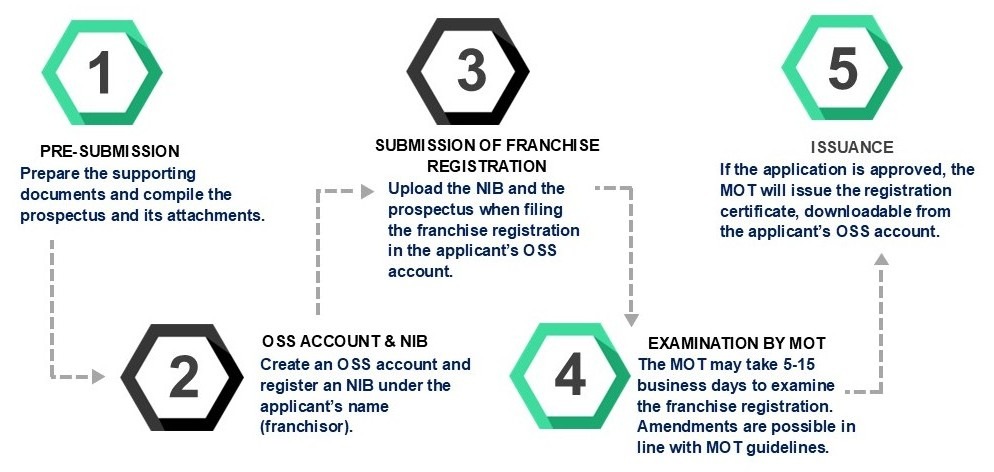
Franchise applications are still submitted through the Online Single Submission (OSS) portal of the Capital Investment Coordinating Board (BKPM). However, the new procedure requires each applicant, including foreign franchisors, to have an OSS account and a business registration number (NIB) issued by BKPM. An application for franchise registration must be submitted under the applicant’s own account—submissions can no longer be made through the account of a consultant.

Once a franchise application is submitted, the authority will distribute the submission to the MOT—the authorized ministry for franchise registration. Any notification or decision upon the registration made by the MOT will be available in the OSS system. Applicants should regularly monitor the status of the franchise application because no notifications will be sent to applicants to alert them of any deficiency.

Here is the summary of the new procedure for franchisors:
Notable Requirements

The disclosure document, or prospectus, is the key focus for the MOT in examining a franchise registration for a franchisor. This document is subject to thorough scrutiny by the MOT to ensure that all mandatory information meets the requirements set in the franchise regulations.

The current regulations specifically require that the mandatory clause “business system” in the prospectus cover operational standards and procedures, which should include human resource management, administration, operational management, standard operating methods, business location selection, business premises design, employee requirements, and marketing strategies.

Other clauses that are equally important to pay attention to are:

  • Identity of the franchisor: The identity should be in line with the IP owner. If not, a license agreement will be required.
  • Business legality of the franchisor: The business license must be attached to the prospectus.
  • Profit statements for the last two years: Audited financial report showing profit and loss.

Impact

The requirement for franchisors and franchisees to have an OSS account introduces additional steps and expenses in the franchise registration process. This requirement can be particularly burdensome for franchise business actors, as franchise registration is often facilitated by third parties, such as consultants. The new regulation mandates that the registration be submitted under the franchisor’s own account, which can be especially challenging for franchisees located overseas.

Ideally, creating an OSS account would be an option rather than a compulsion—this would ease the registration process for franchise business owners. Additionally, the OSS system should be made easier to navigate.

Nonetheless, the requirements stand for now, and business operators should take note of the additional steps that apply to them.


RELATED INSIGHTS​ 

February 9, 2023
Vietnam’s Ministry of Finance is drafting a circular on determining the origin of imported and exported goods. This circular, a draft version of which has been released for public comment (“Draft Circular”), consolidates prevailing regulations and guidelines on determining the origin of imported and exported goods that are stipulated in the following legal documents, which the Draft Circular would replace when it comes into effect: Circular No. 38/2018/TT-BTC dated April 20, 2018, of the Ministry of Finance regulating the determination of origin of imported and exported goods, as amended by Circular No. 62/2019/TT-BTC dated September 5, 2019, of the Ministry of Finance; Circular No. 47/2020/TT-BTC dated May 27, 2020, regulating the time to submit documents proving the origin of goods and form of the documents proving the origin of imported goods applied during the Covid-19 pandemic; and Circular No. 07/2021/TT-BTC dated January 25, 2021, regulating the time to submit documents proving the origin of imported goods under the EU-Vietnam Free Trade Agreement (EVFTA). Generally speaking, the Draft Circular does not increase the administrative procedures for importers and exporters, but rather seeks to codify the recent practices implemented by the customs authorities. The Draft Circular focuses on providing comprehensive guidance for importing/exporting companies when carrying out administrative procedures to certify the origins of imported and exported goods to be in line with current trade practices and international commitments under new-generation free trade agreements. In particular, the Draft Circular supplements guidelines on declaring origins and submitting Certificates of Origin (C/Os) of imported goods under the EVFTA and the Regional Comprehensive Economic Partnership Agreement (RCEP). The Draft Circular also provides some new guidelines to facilitate exports (and imports) and overcome some obstacles and issues when implementing the prevailing regulations. For example, the submission of C/Os online, which was only applicable during the
January 31, 2023
Thailand has issued a regulation on advertising content—including language-related requirements—securing the right of consumers to clear and fair advertising. The Committee on Advertisement, a subcommittee of the Consumer Protection Board under the Consumer Protection Act B.E. 2560 (2017) (the CPA), laid out the rules in Notification Re: Guidelines on Use of Advertisement Statements by Confirming Facts that are Difficult to Prove and Guidelines on Proof of Advertisement Statements B.E. 2565 (2022). The notification, which repeals and replaces two previous guidelines on the same subject matter, was published in the Government Gazette on January 13, 2023, and took effect the following day. Under the CPA, advertisements must not be false or exaggerative. If the Committee on Advertisement suspects an advertisement of breaching this restriction, the business operator may have to provide proof of the claims in their advertisement. This new notification clarifies the criteria for determining whether advertisements are false, exaggerative, or unfair to consumers, and also outlines the procedure and evidence for proof of the advertisement at issue. Mandated Content The notification requires that advertisements fulfill several requirements: Advertising statements must be in Thai; must be easily seen, heard, or read; and must not be misleading. If the advertisement is in a foreign language, the Thai translation must also be made available. The notification additionally sets detailed requirements for different types of advertisement media. The primary purpose of the advertisement must be to give consumers clear and sufficient understanding. For example, if an advertisement claims that services will be provided free, the services must not be conditional on any fees, so consumers understand correctly that they do not have to pay any fee for the services. Descriptions mentioned in advertisements—such as quantity, volume, size, number, or ingredients or elements—must reflect the actual products or services sold to the consumers.
January 16, 2023
The January–March 2023 issue of Asia Franchise & Business Opportunities magazine features an article by two franchising specialists in Tilleke & Gibbins’ Bangkok office. Written by Alan Adcock, partner, and Sher Hann Chua, consultant, the article provides a summary of the legislative developments of 2022 most relevant to franchisors and franchisees. The update looks especially at amendments to Thailand’s unfair trade practices in franchising, as well as the far-reaching Personal Data Protection Act, which is reshaping the way businesses—including franchises—are handling the personal data of customers, partners, and employees. The article is accompanied by a Chinese-language summary of the developments. The full article can be read online in the January–March 2023 issue of Asia Franchise & Business Opportunities.
December 22, 2022
Rules for franchising in Indonesia were first published in 1997 through a government regulation and a ministerial decree, which was subsequently amended several times. The franchising regulations currently in effect are Government Regulation No. 42 of 2007 concerning Franchises and Regulation issued by the Minister of Trade No. 71 of 2019 concerning the Implementation of Franchising (MOT No. 71 of 2019). Franchises in Indonesia must meet certain criteria that distinguish them from other types of businesses, and franchising must be based on a franchise agreement governed by Indonesian law. Prior to entering into a franchise agreement, a franchisor must provide a prospectus (disclosure document) to the prospective franchisee at least two weeks before the execution of the franchise agreement so that the prospective franchisee has sufficient time to review the reputation and goodwill of the franchisor through the prospectus. The prospectus must contain various details about the franchise business, its management, its operations, and other relevant aspects. Both local and foreign franchisors must obtain a franchise registration certificate—referred to as an STPW—from the Ministry of Trade before offering their franchises to prospective franchisees. The franchisee is also required to obtain an STPW. The STPW for the franchisor is the proof of prospectus registration, while the STPW for the franchisee is the proof of registration of the franchise agreement. Franchisors and franchisees who have STPWs are required to submit reports on franchise business activities to the Ministry of Trade’s director of business development and distribution by the end of June each year. Up to three written warnings will be served on a franchisor or franchisee who does not comply with the registration requirements. A fine of up to IDR 100 million (approx. USD 6,400) will be imposed if the franchisor or franchisee fails to respond to the warnings. MOT No.