
You are using an outdated browser and your browsing experience will not be optimal. Please update to the latest version of Microsoft Edge, Google Chrome or Mozilla Firefox. Install Microsoft Edge

August 25, 2025

The Impact of Recent Franchise Regulation Changes in Indonesia

Indonesia’s current regulations on franchises, as stipulated under Government Regulation No. 35/2024 on Franchising and its implementing regulation, Ministry of Trade (MOT) Regulation No. 71/2019 regarding Implementation of Franchising, highlight fundamental changes in franchise registration. These changes have introduced additional complexities and challenges in the franchise registration procedure, making it more difficult for franchise owners to navigate the process.

New procedure

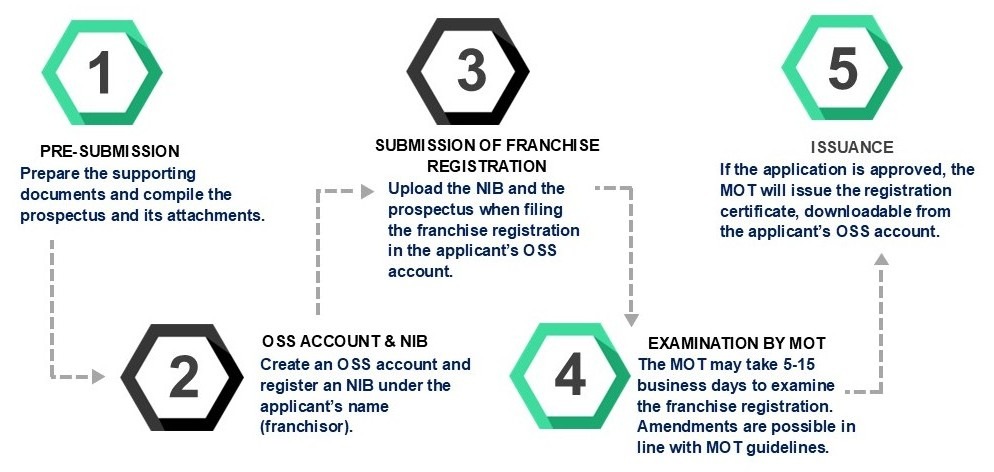
Franchise applications are still submitted through the Online Single Submission (OSS) portal of the Capital Investment Coordinating Board (BKPM). However, the new procedure requires each applicant, including foreign franchisors, to have an OSS account and a business registration number (NIB) issued by BKPM. An application for franchise registration must be submitted under the applicant’s own account—submissions can no longer be made through the account of a consultant.

Once a franchise application is submitted, the authority will distribute the submission to the MOT—the authorized ministry for franchise registration. Any notification or decision upon the registration made by the MOT will be available in the OSS system. Applicants should regularly monitor the status of the franchise application because no notifications will be sent to applicants to alert them of any deficiency.

Here is the summary of the new procedure for franchisors:
Notable Requirements

The disclosure document, or prospectus, is the key focus for the MOT in examining a franchise registration for a franchisor. This document is subject to thorough scrutiny by the MOT to ensure that all mandatory information meets the requirements set in the franchise regulations.

The current regulations specifically require that the mandatory clause “business system” in the prospectus cover operational standards and procedures, which should include human resource management, administration, operational management, standard operating methods, business location selection, business premises design, employee requirements, and marketing strategies.

Other clauses that are equally important to pay attention to are:

  • Identity of the franchisor: The identity should be in line with the IP owner. If not, a license agreement will be required.
  • Business legality of the franchisor: The business license must be attached to the prospectus.
  • Profit statements for the last two years: Audited financial report showing profit and loss.

Impact

The requirement for franchisors and franchisees to have an OSS account introduces additional steps and expenses in the franchise registration process. This requirement can be particularly burdensome for franchise business actors, as franchise registration is often facilitated by third parties, such as consultants. The new regulation mandates that the registration be submitted under the franchisor’s own account, which can be especially challenging for franchisees located overseas.

Ideally, creating an OSS account would be an option rather than a compulsion—this would ease the registration process for franchise business owners. Additionally, the OSS system should be made easier to navigate.

Nonetheless, the requirements stand for now, and business operators should take note of the additional steps that apply to them.


RELATED INSIGHTS​ 

November 12, 2025
Thailand’s Customs Department has announced the cancellation of the longstanding de minimis exemption, which waives import duties on goods valued at THB 1,500 or less, as of January 1, 2026. This policy shift will directly impact e-commerce, logistics, and retail sectors, and will have wide-ranging implications for any company involved in cross-border trade with Thailand. Background Under current regulations, imported goods with a customs value (cost, insurance, and freight, or “CIF”) of THB 1,500 or less are exempt from import duties. This has been a cornerstone of the cross-border e-commerce model, allowing for the duty-free import of millions of small parcels. Under the new policy effective January 1, 2026, all imported goods, regardless of value, will be subject to assessment for import duties upon entry into Thailand. The stated rationale for this change is to create fair competition for Thai small and medium-sized enterprises (SMEs), which must pay VAT and other costs on their goods, putting them at a price disadvantage against foreign sellers who utilize the de minimis loophole. Business Implications This policy change will create new costs, compliance burdens, and operational challenges. For foreign e-commerce sellers and platforms: The most direct impact will be the addition of import duties to low-value items. Assuming the costs are passed on to the consumer, the higher prices and potentially more complex or slower customs clearance processes could lead to increased cart abandonment and reduced consumer demand. Businesses should review their pricing models and develop a clear strategy for calculating, declaring, and paying these new duties. For logistics providers and customs brokers: The administrative burden will be considerable. Carriers that previously handled millions of nondutiable parcels will now be required to process them for duty assessment and collection. This may necessitate new IT systems and streamlined processes to avoid delays at
October 24, 2025
Thailand currently lacks a specific franchise act. Consequently, the legality of any franchise agreement is determined by its compliance with various existing laws, such as the Civil and Commercial Code, the Trademark Act B.E. 2534 (1991) (as amended), and the Unfair Contract Terms Act B.E. 2530 (1997). Thailand is a freedom-to-contract jurisdiction. This allows for a high degree of flexibility and autonomy in contractual arrangements, provided that the terms do not violate any laws or public policy and do not fall under the scope of unfair contract terms. Given this, the requirement for fairness in franchise agreement terms often leads to uncertainty, but decisions from the Trade Competition Commission of Thailand (TCCT) can provide guidance on whether specific contentious terms are in fact fair.  One issue worth examining in this light is the inclusion of terms on nonrefundable franchise fees and strict purchasing conditions. Franchise Fee: Unfair to Refuse Refund? Nonrefundable franchise fees represent a significant upfront investment for franchisees, often becoming a point of contention if the franchise relationship deteriorates or the franchisor ceases operations. Their fairness and enforceability are frequently scrutinized by regulatory bodies like the TCCT, highlighting the critical balance between contractual freedom and franchisee protection. Faced with one such case, the TCCT considered whether it was unfair for the franchisor to refuse to refund the franchise fee after the franchisor ceased operations.  The franchisee had entered into a service agreement on August 2, 2021, and begun operating on October 9, 2021. However, by November 21, 2023, the franchisee was notified that the system would be shut down for maintenance, and by December 26, 2023, the franchisor announced the cessation of operations due to financial losses. The franchisee then requested a refund of the franchise fee. Unfortunately for the franchisee, the TCCT found that the franchisor’s
October 3, 2025
On September 26, 2025, the Contract Committee under Thailand’s Consumer Protection Board issued a regulation that aims to standardize contracts and enhance consumer protection within the beauty and wellness industry. The Notification on Prescribing the Beauty Service Business as a Contract-Controlled Business B.E. 2568 (2025), which takes effect on January 24, 2026, requires business operators to use a prescribed standard contract in Thai and adhere to strict mandatory provisions and prohibitions. These regulations apply to operators across all in-person and online service channels, including via digital platforms. “Beauty services business” is defined as the provision of services under an agreement allowing consumers to receive a series of treatments, either over a set number of sessions or within a set period. This includes massage, spa, other methods for cleanliness, beauty, or care of facial or body skin, and weight control and body shaping—including services offered electronically. The law excludes surgery, liposuction, and medical treatments performed by licensed practitioners. The notification establishes the following key requirements: Mandatory contract and formatting. All contracts with consumers must use the standard contract form, in Thai, with clear, readable text (minimum font size of 2 millimeters, no more than 11 characters per inch), and include all essential terms from the annexed form. Contract execution. Contracts must be made in duplicate, with one copy given to the consumer at signing. For agreements concluded through electronic channels, the process must comply with the Electronic Transactions Act and use the same required terms. Digital platforms. Business operators who provide services facilitated through a digital platform as an intermediary are ultimately responsible for ensuring the consumer receives a compliant contract. Prohibited clauses. The law prohibits clauses that limit or exclude liability for damages to life, body, health, mind, or property resulting from breach of contract or a wrongful act;
September 16, 2025
Thailand has enacted amended alcohol control legislation that significantly tightens restrictions on marketing and advertising, strengthens enforcement, and creates mechanisms to support the country’s tourism objectives. The Alcoholic Beverage Control Act (No. 2) B.E. 2568 (2025), published in the Government Gazette on September 9, 2025, will take effect on November 8, 2025. Key aspects of the new law are outlined below. Continuation of Sales-Hour Restrictions Sales-hour restrictions remain in effect, though now under an updated regulatory pathway. Alcohol sales are permitted only between 11:00 a.m. and 2:00 p.m. and between 5:00 p.m. and midnight, with exceptions for airport terminals, entertainment venues under the Entertainment Place Act 1966, and hotels. Despite earlier discussions about relaxing these hours, no changes have been implemented under the new law. Enhanced Seller Responsibilities Sellers are now expressly permitted to check identification cards to verify purchaser age and may assess the condition of intoxicated customers. The assessment conditions will be announced in a forthcoming notification from the director of the Department of Disease Control. Sellers who willfully or negligently violate the law and cause damage to life, health, or property face possible penalties. Alcohol Vending Machines Permitted The law allows alcohol to be sold in vending machines that can verify buyer information and comply with rules, procedures, and conditions to be prescribed by the Alcoholic Beverage Control Committee. This means the industry must await the committee’s implementing regulations before deploying such machines. Expanded Marketing and Advertising Restrictions The amended law introduces a new suite of advertising restrictions, including more detailed and expansive definitions involving marketing and promotions. “Marketing communication” is broadly defined to include any direct or indirect act of publicizing, presenting, or disseminating information about alcoholic beverages through advertising, public relations, sales promotions, sponsorships, or any other means that may induce or encourage the