
You are using an outdated browser and your browsing experience will not be optimal. Please update to the latest version of Microsoft Edge, Google Chrome or Mozilla Firefox. Install Microsoft Edge

August 25, 2025

The Impact of Recent Franchise Regulation Changes in Indonesia

Indonesia’s current regulations on franchises, as stipulated under Government Regulation No. 35/2024 on Franchising and its implementing regulation, Ministry of Trade (MOT) Regulation No. 71/2019 regarding Implementation of Franchising, highlight fundamental changes in franchise registration. These changes have introduced additional complexities and challenges in the franchise registration procedure, making it more difficult for franchise owners to navigate the process.

New procedure

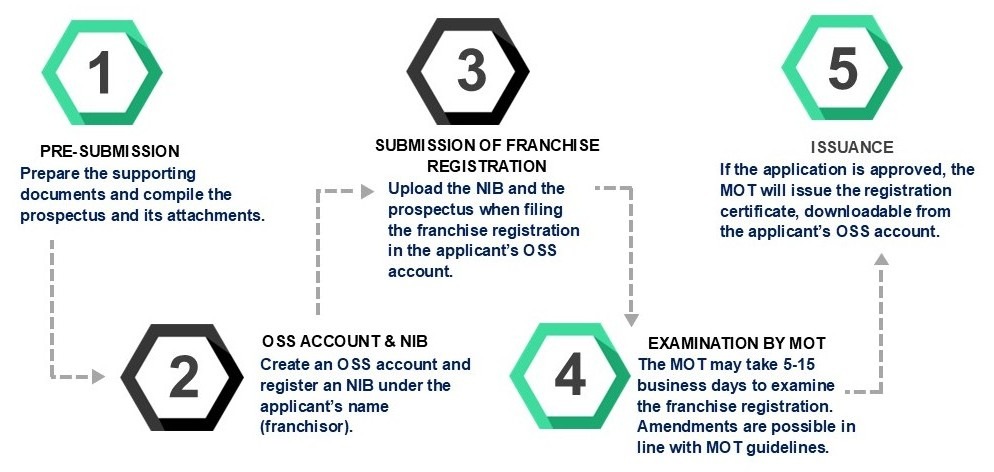
Franchise applications are still submitted through the Online Single Submission (OSS) portal of the Capital Investment Coordinating Board (BKPM). However, the new procedure requires each applicant, including foreign franchisors, to have an OSS account and a business registration number (NIB) issued by BKPM. An application for franchise registration must be submitted under the applicant’s own account—submissions can no longer be made through the account of a consultant.

Once a franchise application is submitted, the authority will distribute the submission to the MOT—the authorized ministry for franchise registration. Any notification or decision upon the registration made by the MOT will be available in the OSS system. Applicants should regularly monitor the status of the franchise application because no notifications will be sent to applicants to alert them of any deficiency.

Here is the summary of the new procedure for franchisors:
Notable Requirements

The disclosure document, or prospectus, is the key focus for the MOT in examining a franchise registration for a franchisor. This document is subject to thorough scrutiny by the MOT to ensure that all mandatory information meets the requirements set in the franchise regulations.

The current regulations specifically require that the mandatory clause “business system” in the prospectus cover operational standards and procedures, which should include human resource management, administration, operational management, standard operating methods, business location selection, business premises design, employee requirements, and marketing strategies.

Other clauses that are equally important to pay attention to are:

  • Identity of the franchisor: The identity should be in line with the IP owner. If not, a license agreement will be required.
  • Business legality of the franchisor: The business license must be attached to the prospectus.
  • Profit statements for the last two years: Audited financial report showing profit and loss.

Impact

The requirement for franchisors and franchisees to have an OSS account introduces additional steps and expenses in the franchise registration process. This requirement can be particularly burdensome for franchise business actors, as franchise registration is often facilitated by third parties, such as consultants. The new regulation mandates that the registration be submitted under the franchisor’s own account, which can be especially challenging for franchisees located overseas.

Ideally, creating an OSS account would be an option rather than a compulsion—this would ease the registration process for franchise business owners. Additionally, the OSS system should be made easier to navigate.

Nonetheless, the requirements stand for now, and business operators should take note of the additional steps that apply to them.


RELATED INSIGHTS​ 

October 14, 2021
As part of its membership in Lex Mundi, Tilleke & Gibbins has published an updated edition of its Guide to Doing Business in Thailand for 2021. This guide outlines all of the key factors for starting and operating a business in the Thai market. Issues covered include: Investment incentives Financial facilities Exchange controls Import and export regulations Structures for doing business Requirements for the Establishment of a Business Operation of the Business Cessation or Termination of the Business Labor legislation, relations, and supply Tax Immigration requirements This publication is part of Lex Mundi’s Guides to Doing Business series prepared by member firms in more than 100 jurisdictions worldwide. The guides serve as a useful resource when planning an international business strategy or researching a new market.
August 26, 2021
The Ministry of Health of Vietnam recently issued Circular No. 10/2021/TT-BYT dated June 30, 2021, stipulating the list of substances prohibited from use in the production and trading of health supplements (“Circular 10”). Circular 10 will come into effect on September 1, 2021. Accordingly, substances found on the following lists will be prohibited from use in health supplements: The list of drugs and drug materials prohibited from importation and production found in Annex V of Decree No. 54/2017/ND-CP of the Government dated May 8, 2017, guiding the implementation of Law on Pharmacy (Decree 54). Lists promulgated with Decree No. 73/2018/ND-CP of the Government dated May 15, 2018, stipulating the list of narcotic substances and precursors, including: List I: Narcotic substances banned from use in healthcare and daily life, the use of which for analysis, testing, scientific research, and criminal investigation is subject to permission by competent authorities. List II: Narcotic substances restricted from analysis, testing, scientific research, criminal investigation, or healthcare as regulated by competent authorities. List III: Narcotic substances permitted in analysis, testing, scientific research, criminal investigation, healthcare, and veterinary medicine as regulated by competent authorities. List IVA: Essential precursors involved in forming the structure of narcotic substances. The list of narcotic active ingredients found in Annex I of Circular No. 20/2017/TT-BYT of the Ministry of Health, detailing articles of the Law on Pharmacy and Decree 54 related to drugs and drug materials under special control. The list of toxic drugs and toxic drug materials under Circular No. 06/2017/TT-BYT of the Ministry of Health dated May 3, 2017. Lists under Circular No. 42/2017/TT-BYT of the Ministry of Health dated November 13, 2017, stipulating the lists of toxic herbal materials, including: Annex I: List of toxic herbal materials of plant origin. Annex II: List of toxic herbal materials of
August 26, 2021
In April 2021, the Vietnamese government made public a draft decree to amend Decree No. 43/2017/ND-CP of the Government dated April 14, 2017, on goods labeling (“Decree 43”), which is the primary legislation in Vietnam on the labeling requirements for domestically circulating goods and imported goods. Some noteworthy differences between the draft and the current Decree 43 include the following: 1. Original labels for imported products For imported goods, the draft adds a requirement on compulsory information for original labels, which is not mentioned in Decree 43. In particular, the original product label for goods being imported to circulate on the Vietnam market must contain the following compulsory information in a foreign language or in Vietnamese before customs clearance: Product name; Name and address of the entities responsible for the products; Product origin or place where the final production stage to complete the product was conducted. (If this information is not presented on the original product label, it must be included in the import documents accompanying the product.) 2. Vietnamese labels for imported products Under the draft, if it is impossible to determine the product origin under rules/guidance on determining product origin in Vietnam, it is acceptable to instead indicate on the product label the place(s) where the final production stage to complete the product was conducted. 3. Nutritional information for food Instead of being optional information as mentioned in Decree 43, “nutritional value” is compulsory information on labels for some food products under the draft. The Ministry of Health will have a roadmap for carrying out nutritional labeling and will provide appropriate guidance to manufacturers and importers, as well as issue regulations on types of food that are partially or entirely exempt from declaration of nutritional value. The draft has not yet been finalized and is subject to