You are using an outdated browser and your browsing experience will not be optimal. Please update to the latest version of Microsoft Edge, Google Chrome or Mozilla Firefox. Install Microsoft Edge

October 3, 2025

Thailand’s Evolving Website Blocking for IP Protection

Asia IP

In Thailand, the rise in online intellectual property infringement has prompted authorities to strengthen enforcement efforts, including the use of website-blocking orders under Section 20(3) of the Computer Crime Act B.E. 2560 (2017) (CCA). This provision authorizes the Ministry of Digital Economy and Society (MDES), with court approval, to block or remove computer data that constitutes a criminal offence under IP law. Since its implementation, the procedure has undergone several developments, which is an encouraging sign of progress.

Website-blocking procedure

In practice, website-blocking orders under Section 20(3) of the CCA are primarily used for copyright and trademark infringement. While such orders are legally applicable to patent infringement, their use remains challenging due to the difficulty of proving infringement through administrative procedures.

The website-blocking procedure begins when an IP owner identifies online infringing content. For copyright infringement, which is considered a compoundable offence, the IP owner is required to first file a police report with the specialized police unit known as the Economic Crime Suppression Division (ECD) prior to filing the website-blocking application with the Department of Intellectual Property (DIP). For trademark infringement cases, the application can be filed directly with the DIP without a prior police report.

The DIP reviews the evidence and, if infringement is confirmed, forwards it to the MDES for further consideration. If the case is deemed valid, the MDES requests a court order to block the infringing website. Once granted, the MDES notifies the internet service providers (ISPs) to block access to the specified website.
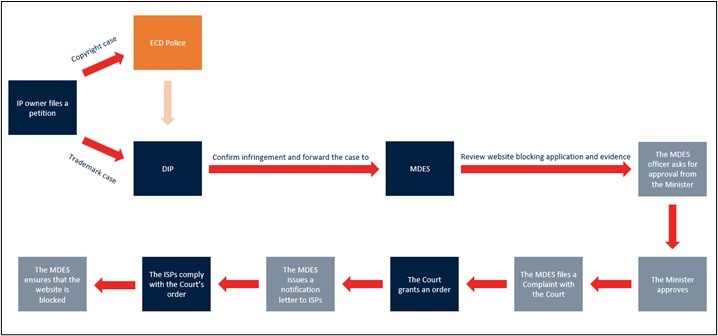

Website blocking procedure in Thailand

Recent advancements in website-blocking actions

Seamless collaboration through digital integration. Thailand has made significant progress in digitizing its website-blocking procedures to improve efficiency and transparency. At present, all website-blocking applications and supporting evidence must be submitted in electronic format. These systems have significantly reduced processing times while enhancing transparency and traceability, resulting in more efficient and accountable website-blocking procedures.

For copyright infringement cases, the ECD accepts soft copies of evidence when filing a police report. Similarly, the DIP requires electronic submission of both the website-blocking application and supporting evidence. Once submitted, the DIP reviews the case and forwards it to the WebD platform, a shared digital system developed by the MDES. This platform enables faster processing, centralized tracking and improved coordination between the DIP and MDES.

To further streamline enforcement, Thailand’s Criminal Court has launched a specialized Technology Crime Division to handle online offences, including IP infringement. When requesting a court order to block infringing websites, the MDES files the complaint electronically with this division, significantly accelerating issuance. After the court grants the order, the MDES uses its SUSPEND system, a platform designed to dispatch and track notification letters and court orders, to notify ISPs.

With the adoption of electronic systems across all stages of the procedure mentioned earlier, processing time from the initial filing stage to receiving the court order has significantly improved.

Addressing redirection with dynamic website blocking. Dynamic blocking is a recent judicial development in Thailand, introduced to address the recurring issue of infringing content being quickly moved to new or redirected domains. This approach is particularly relevant given the widespread use of mirror and redirect sites, which have historically reduced the effectiveness of static-blocking orders.

In cases where infringing content is reintroduced through redirected domains, Thailand’s Criminal Court has thoughtfully included provisions for dynamic blocking in its orders. This means that if the same infringing computer data is disseminated again via a new or redirected domain, the original court order can be extended to cover them.

Thanks to this provision, enforcement agencies can rely on the original domain’s court order to request the blocking of redirected domains that host the same infringing content. The request for dynamic blocking can be submitted to the MDES permanent secretary for consideration. Upon approval, the MDES notifies the ISPs to comply with the court order to block access to the redirected domains.

Moving ahead: AI-powered enforcement

In its latest initiative, the MDES has introduced an AI-powered system to enhance the detection of infringing content online. The system automatically scans websites and compiles a report listing suspected infringing URLs, which is then sent to the DIP and IP owners for verification. Once the IP owners confirm the infringement, they can proceed with the website-blocking action.

While the AI-powered system promises to enhance detection, its effectiveness depends on the accuracy of the technology and the capacity of authorities and rights holders to verify and act on the reports. Ongoing monitoring and refinement will be essential to ensure the system’s reliability and to minimize the risks of incorrect detections or unintended blocking. This initiative has recently been implemented, and its effectiveness remains to be seen.

Thailand’s approach to website blocking for IP enforcement has evolved rapidly, with significant improvements in digital integration, judicial innovation and inter-agency collaboration. However, challenges remain, including persistent online infringement, the need for ongoing technological adaptation and the importance of balancing enforcement with due process and transparency.

This article was first published in September 2025 by Asia IP.

RELATED INSIGHTS​ 

July 27, 2026
In March 2025, Thailand’s Central Intellectual Property and International Trade Court (IP&IT Court) issued a landmark judgment in favor of Luckin Coffee, China’s leading retail coffee chain. The judgment marked a significant turnaround following earlier trademark litigation involving Luckin Coffee from 2021 to 2023 that had generated widespread public attention and raised questions about the protection available to legitimate foreign brand owners in Thailand. In a significant subsequent development, Thailand’s Court of Appeal for Specialized Cases has now affirmed the IP&IT Court’s judgment in its entirety. The appellate decision brings clarity to one of Thailand’s most closely watched trademark disputes. Significantly, this is the first case in Thailand to formally recognize the trademark squatting principle. The Court of Appeal confirmed that Luckin Coffee has a better right to the disputed mark and ordered cancellation of the defendants’ trademark registration—a key application of the “better right” doctrine. The court also upheld the substantial damages awarded at first instance, providing important guidance on assessing harm from systematic trademark squatting. Award-Winning Judgment Affirmed in Its Entirety The significance of the first-instance judgment extended beyond the outcome for Luckin Coffee. The IP&IT Court judgment was subsequently recognized in the IP&IT Court’s Distinguished Judgment Awards in 2025, reflecting the complexity, novelty, and legal significance of the issues considered in the case. The defendants nevertheless appealed the judgment, challenging several key aspects of the IP&IT Court’s decision. Luckin Coffee continued to entrust Tilleke & Gibbins as their sole attorney to pursue the case at the appellate level. After considering the defendants’ appeal and Luckin Coffee’s submissions in response, the Court of Appeal affirmed the first-instance judgment in its entirety. The judgment was announced on July 8, 2026. Better Right to the Marks The Court of Appeal confirmed Luckin Coffee’s superior rights. The orders include cancellation
July 24, 2026
As food innovation continues to accelerate, manufacturers are increasingly introducing ingredients derived from new sources, produced using novel technologies, or lacking a significant history of human consumption. While these innovations create new opportunities for the food industry, they also raise important questions regarding consumer safety. For this reason, many jurisdictions, including Thailand, the European Union, Australia and New Zealand, Canada, and Singapore, require a premarket safety assessment for novel food ingredients before they can be placed on the market. The objective of this assessment is to ensure that each ingredient is safe for its intended use and level of consumption, does not present toxicological, allergenic, microbiological, or nutritional concerns, and will not mislead consumers. Scientific authorities typically evaluate the ingredient’s identity, manufacturing process, composition, specifications, anticipated dietary exposure, toxicological information, nutritional impact, and history of use before determining whether it can be marketed. Against this background, the Thai Food and Drug Administration (FDA) recently took an important step toward improving regulatory transparency by publishing, for the first time, a consolidated public list of substances that have successfully completed the Thai FDA’s safety assessment process, including substances determined to be novel foods and those determined not to fall within the novel food category. The list identifies the approved substances, the corresponding manufacturers or importers, approval dates, and the approved conditions of use. Although the publication does not change the existing legal framework governing novel food approvals, it provides businesses with greater visibility into the Thai FDA’s regulatory precedents and the types of substances that have previously been accepted through the safety assessment process. The full announcement is available on the Thai FDA’s website. As the list is now publicly available, it also provides useful insight into the types of substances that have successfully completed the Thai FDA’s safety assessment process.
July 24, 2026
Indonesia has updated its fee framework for intellectual property (IP)-related government services, with implications for IP owners, licensees, lenders, digital platforms, and businesses operating in the country. Government Regulation No. 30 of 2026 on Types and Tariffs of Non-Tax State Revenue Applicable to the Ministry of Law (GR 30/2026) was promulgated on July 2, 2026, and will take effect on August 1, 2026. Key Takeaways GR 30/2026, which replaces the relevant IP service fees under Government Regulation No. 45 of 2024, reorganizes the fee schedule into separate categories for copyright, industrial designs, patents, layout designs of integrated circuits, trade secrets, trademarks, geographical indications, IP enforcement, and other categories. The most commercially relevant changes include a new copyright recordation tariff exemption for songs and music, higher fees for several trademark and geographical indication services, new IP enforcement service fees, and a new fee type for registration of fiduciary security over IP rights objects. In addition, this is the first major update for trademark fees in approximately 10 years. GR 30/2026 is significant not only as a fee update but also as a further indication of Indonesia’s increasing recognition of IP as a financeable commercial asset. By expressly assigning fees to the registration of fiduciary security over IP rights objects, the regulation places IP-backed collateral filings within the Ministry of Law’s administrative service framework. While GR 30/2026 does not create a new secured-transactions regime, this development is relevant for lenders, borrowers, and IP owners structuring financing arrangements secured by trademarks, patents, copyrights, industrial designs, or other registrable IP rights in Indonesia. Copyright: New Fee Exemption for Songs and Music Recordation For copyright, GR 30/2026 creates a fee-exempt category for recordation of works or related-rights products for songs or music, while maintaining a separate category for other works and related-rights products. It
July 21, 2026
Thailand’s Ministry of Digital Economy and Society (MDES) published a notification establishing an expedited court-ordered takedown mechanism for online content in cases of “urgent necessity.” The notification, which was issued on July 17, 2026, under the Computer Crime Act B.E. 2550 (2007), as amended, took effect the following day. It significantly expands the categories of content subject to rapid government-initiated removal. Content Categories Subject to Takedown The notification defines “urgent necessity” (section 20, paragraph 5, of the Computer Crime Act) as circumstances where any delay in suppressing computer data may impact national security, religion, the monarchy, good morals, social culture, or public order. In this regard, it establishes four broad categories of content: Computer Crime Act offenses. National security offenses. IP and other criminal offenses, where it is contrary to public order or good morals and a competent officer has requested its suppression. Content contrary to public order or good morals, a broad residual category encompassing 14 subcategories approved by the Computer Data Screening Committee. The fourth category is the most expansive. Its 14 subcategories include: Content defaming, mocking, satirizing, or devaluing the monarchy. Online gambling advertising or facilitation. Offering illegal firearms for sale. Offering baraku (hookah) products or e-cigarettes for sale. Offering cannabis inflorescences or processed cannabis products for sale. Advertising or soliciting prostitution. Content inciting violence, hatred, or social division. Unauthorized overseas employment advertising. Offering boiled kratom juice for sale. Online sale or advertising of alcoholic beverages. Content satirizing or degrading Buddhism. Money lending at interest rates exceeding legally prescribed limits. Advertising or disseminating information about surrogacy services. Forgery of documents, cards, or official documents. Enforcement Procedure In cases of urgent necessity, a competent official assigned by the MDES permanent secretary must file a petition with supporting evidence to the court with jurisdiction, requesting an order to