
You are using an outdated browser and your browsing experience will not be optimal. Please update to the latest version of Microsoft Edge, Google Chrome or Mozilla Firefox. Install Microsoft Edge

March 2, 2021

Thailand’s Decriminalization of Cannabis Plants

Informed Counsel

The cannabis plant has fascinated many civilizations, societies, and individuals through the centuries with its unique properties, and many have learned how to benefit from these, finding a variety of therapeutic and industrial uses of the plant that, in turn, enhanced domestic economies worldwide. In Thailand, cannabis plants and their derivatives have been used since ancient times as treatment for many diseases, and the plant forms a key ingredient in many Thai traditional medicinal remedies. However, over the past few decades, cannabis usage was seen to change in a way that became incrementally more abusive, resulting in outright prohibition in almost all countries. Thailand was no exception, and in 1979 the Thai government officially enacted the Narcotics Act forbidding the use of cannabis and listing cannabis plants and their derivatives—most notably marijuana (cannabis with psychoactive properties) and hemp (cannabis with limited or no psychoactive properties)—as category 5 narcotics (i.e., prohibited substances).

Despite these restrictions, many Thais continued to use cannabis illegally, and some urged the government to legalize personal and commercial use of cannabis plants and their derivatives. Eventually, some in the Thai government agreed that it was time to consider steps toward legalization, As a result, the government has been taking action to delist cannabis plants from the list of prohibited narcotics since 2018, when a regulation allowed the cultivation of hemp for industrial and non-commercial purposes, such as household cooking and research and development.

The next significant step came in February 2019, when the Narcotics Act (No. 7) was amended, legalizing medical marijuana within certain limitations. In national elections the following month, the Bhumjaithai political party, whose election campaign included a pledge to decriminalize and legalize cannabis plants, won substantial support in parts of the country and chose to join the coalition government, with the Bhumjaithai party leader assuming control of the Ministry of Public Health (MOPH). Since then, the government, with cooperation from the MOPH and the Food and Drug Administration (FDA), has been working to reclassify cannabis products and to issue new regulatory pathways to accommodate these new “cash crops” to boost the domestic economy. Subsequently, a notification was issued in August 2019 that reclassified certain modern drugs, cosmeceuticals, nutraceuticals, cosmetics, and food containing hemp out of the scope of the Narcotics Act. At the same time, cannabis and hemp legalization were also taking a higher profile in the public sphere. For instance, the issue of cannabis legalization was raised and promoted in the election campaigns of early 2019 by one of the large political parties.

After a long interlude (caused primarily by government focus turning to the COVID-19 pandemic and other emergent priorities), a new MOPH notification was published in the Government Gazette on December 14, 2020, expanding the delisting of cannabis from the Narcotics Act to include nearly all parts of cannabis and hemp plants, as detailed in the table below.
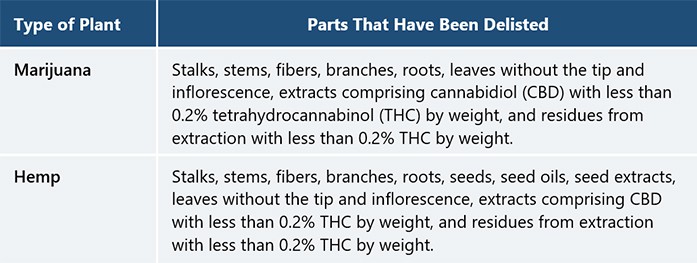
Anyone who wishes to participate in this emerging cannabis industry must be cautious and carefully review the Narcotics Act and its relevant notifications. Although many parts of the cannabis plant were delisted, there some parts remain on the narcotics list (e.g., marijuana seeds, buds, and leaves with cannabis inflorescence or complete cannabis flower head), and the limits on CBD and THC content must be strictly observed.

Importantly, this notification covers only cannabis cultivated in Thailand. Foreign participants are precluded from any participation in an approved cannabis business until a five-year ban on foreign participation—counting from the initial delisting in February 2019—has passed. This means that only the Thai government and its authorized partners have standing to apply for a commercial license until February 20, 2024, which is when foreign parties will be allowed to obtain a commercial cannabis license (subject to any extension or further imposition of restrictions). However, non-commercial licenses (e.g., for research and development) may be issued to Thai applicants.

Despite these limitations, the MOPH notification is another progressive step for driving cannabis research, development, and industry in Thailand. In addition, it delisted other plants that had been classified as category 5 narcotics, including kratom plants (a common plant in Southeast Asia with mild stimulant properties) such as Mitragyna speciosa (Korth.) Havil; opium plants such as Papaver somniferum L. and Papaver bracteatum Lindl.; and fungi of the species Psilocybe cubensis, which contain psilocybin or psilocin. Further notifications on these substances are expected to be issued soon.

The government quickly followed up on the December 14, 2020, notification by publishing another notification on December 30, establishing the criteria for filing applications for licenses to produce, import, export, distribute, and possess hemp (Cannabis sativa) in Thailand. Processing of these applications by the FDA opened on January 29, 2021, for interested Thai citizens and entities under Thai law. Industry operators are now waiting for the Thai FDA’s final promulgation of its own regulations for cannabis licensing to support this development.

Parties interested in entering into this emerging industry should closely monitor the ongoing development of the regulatory regime for cannabis plants in Thailand, as this regime is solidifying rapidly. Those who stay apprised of the situation and remain ready to act when opportunities arise will be able to take full advantage of the new regulatory changes, and in the process will help strengthen a nascent industry in Thailand.

RELATED INSIGHTS​ 

February 22, 2021
Following the recent imposition of sanctions on Myanmar individuals and companies by the US, the UK and Canada have now imposed new sanctions. As with the US sanctions, these new measures impact UK and Canadian citizens and companies, and non-UK and non-Canadian companies and citizens with interests in those jurisdictions. The EU has indicated that it is planning to issue similar sanctions in the near future. New UK Sanctions In addition to the 16 individuals already sanctioned by the UK government, on February 18, 2021, the UK government announced that three individuals have been sanctioned for serious human rights violations and are now subject to asset freezes and travel bans. The full list of Myanmar individuals and companies sanctioned by the UK is available on the website of the Office of Financial Sanctions Implementation. Breaches of UK financial sanctions are criminal offences punishable in the UK by up to 7 years imprisonment and heavy fines. New Canadian Sanctions Also on February 18, timed to coincide with the UK sanctions, new Canadian sanctions were imposed on nine individuals. As with the UK, Canada already had a number of individuals in the Myanmar military on its sanctions list, and the new additions bring the total number of individuals sanctioned by Canada to 54. All assets of these individuals in Canada are now frozen, and they are banned from travelling to Canada. Canadian businesses or entities may not do business with any of the 54 individuals. Full details of the impact of the sanctions are available on the Government of Canada’s website, as is a database of the Myanmar individuals and companies subject to them. Breach of Canadian sanctions carries with it up to 5 years’ imprisonment in Canada and/or a large fine. Other Countries The EU is reportedly drawing up sanctions
February 18, 2021
As you will no doubt know, on February 1, 2021, the Myanmar military declared a state of emergency in Myanmar for a period of one year. State Counsellor Daw Aung Sang Su Kyi was detained, as were the president and various significant political and civil leaders. Min Aung Hlaing, commander-in-chief of the Tatmadaw (Myanmar armed forces) has installed himself as chairman of the State Administration Council, the current administration. New sanctions The reaction of the Biden administration has been swift. On February 10, 2021, President Biden issued Executive Order 14014, which provides bases to impose sanctions on individuals and companies deemed by the US to, among other things: operate in the defense sector of Myanmar; be responsible for policies that undermine democratic processes in Myanmar; have taken actions to undermine democratic processes or institutions, or prohibit, limit, or penalize the exercise of free speech, in Myanmar; or be a spouse or child of the foregoing. On the next day, February 11, the US Office of Foreign Assets Control (OFAC), imposed sanctions under the new executive order on ten individuals—including General Min Aung Hlaing—and three companies, including Cancri Gems & Jewelry Co, Myanmar Imperial Jade Co, and Myanmar Ruby Enterprise.  All such individuals and companies have now been designated on the US list of specially designated nationals (SDNs). Effect of sanctions As a result of such sanctions, the property of these individuals or companies that is located in the US or is under the possession or control of US companies and citizens is frozen, and US companies and citizens are generally prohibited from dealing deal with any such property.  Reportedly, roughly USD 1 billion of funds belonging to the individuals and companies blocked on February 11 are located in the US and thus now frozen. The SDN list As many
February 1, 2021
The latest edition of Practical Law’s Life Sciences Global Guide features contributions from Tilleke & Gibbins attorneys in the firm’s Yangon office. One of the sections they have provided for the Myanmar chapter of this Q&A-style guide to life sciences regulatory frameworks worldwide is “Medicinal Product Regulation and Product Liability in Myanmar.” The section includes discussion of a range of regulatory issues related to the marketing and selling of pharmaceutical products, including the following topics: Regulatory overview: Authorities, scope, and general procedures for pharmaceuticals, biologicals, and medical devices and health care IT Pricing, government funding, and reimbursement: National health care system, price regulation, and reimbursement Clinical trials Manufacturing and distribution Marketing: Authorization for marketing medicinal products, parallel imports and cross-border trade in medicines Restrictions on dealings with health care professionals Selling restrictions Advertising and promotion Data privacy Packaging, labeling, and tracking Product safety, quality, and liability Local establishment, representation, and residency requirements Reform The full “Medicinal Product Regulation and Product Liability in Myanmar” section can be accessed on the Practical Law website. Practical Law, produced by Thomson Reuters, is the world’s leading legal know-how resource for business lawyers, publishing a huge range of guides covering hundreds of jurisdictions and practice areas. Tilleke & Gibbins also supplied “Pharmaceutical IP and Competition Law in Myanmar,” which was published in the Life Sciences Global Guide  at the same time.
February 1, 2021
Attorneys from Tilleke & Gibbins in Myanmar have contributed to the latest edition of Practical Law’s online Life Sciences Global Guide. The guide is a Q&A-style overview of the regulatory frameworks for the life sciences industry across multiple jurisdictions worldwide, and this year the Myanmar chapter includes two sections, one of which is “Pharmaceutical IP and Competition Law in Myanmar.” This section runs through the country’s legal and regulatory environment for patents and trademarks—particularly as they relate to pharmaceutical business in the jurisdiction. The section then turns to IP and competition law issues, with questions and answers focusing on how the country’s competition laws and regulations affect the pharmaceutical sector. Readers are also given information on how to properly comply with Myanmar law on competition, including when it comes to licensing of medicines and pharmaceutical technology. The full Pharmaceutical Intellectual Property and Competition Law in Myanmar guide can be accessed on the Practical Law website. Practical Law, produced by Thomson Reuters, is the world’s leading legal know-how resource for business lawyers, publishing a huge range of guides covering hundreds of jurisdictions and practice areas. Tilleke & Gibbins also supplied the “Medicinal Product Regulation and Product Liability in Myanmar,” which Practical Law published in its Life Sciences Global Guide  at the same time.