
You are using an outdated browser and your browsing experience will not be optimal. Please update to the latest version of Microsoft Edge, Google Chrome or Mozilla Firefox. Install Microsoft Edge

March 2, 2021

Thailand’s Decriminalization of Cannabis Plants

Informed Counsel

The cannabis plant has fascinated many civilizations, societies, and individuals through the centuries with its unique properties, and many have learned how to benefit from these, finding a variety of therapeutic and industrial uses of the plant that, in turn, enhanced domestic economies worldwide. In Thailand, cannabis plants and their derivatives have been used since ancient times as treatment for many diseases, and the plant forms a key ingredient in many Thai traditional medicinal remedies. However, over the past few decades, cannabis usage was seen to change in a way that became incrementally more abusive, resulting in outright prohibition in almost all countries. Thailand was no exception, and in 1979 the Thai government officially enacted the Narcotics Act forbidding the use of cannabis and listing cannabis plants and their derivatives—most notably marijuana (cannabis with psychoactive properties) and hemp (cannabis with limited or no psychoactive properties)—as category 5 narcotics (i.e., prohibited substances).

Despite these restrictions, many Thais continued to use cannabis illegally, and some urged the government to legalize personal and commercial use of cannabis plants and their derivatives. Eventually, some in the Thai government agreed that it was time to consider steps toward legalization, As a result, the government has been taking action to delist cannabis plants from the list of prohibited narcotics since 2018, when a regulation allowed the cultivation of hemp for industrial and non-commercial purposes, such as household cooking and research and development.

The next significant step came in February 2019, when the Narcotics Act (No. 7) was amended, legalizing medical marijuana within certain limitations. In national elections the following month, the Bhumjaithai political party, whose election campaign included a pledge to decriminalize and legalize cannabis plants, won substantial support in parts of the country and chose to join the coalition government, with the Bhumjaithai party leader assuming control of the Ministry of Public Health (MOPH). Since then, the government, with cooperation from the MOPH and the Food and Drug Administration (FDA), has been working to reclassify cannabis products and to issue new regulatory pathways to accommodate these new “cash crops” to boost the domestic economy. Subsequently, a notification was issued in August 2019 that reclassified certain modern drugs, cosmeceuticals, nutraceuticals, cosmetics, and food containing hemp out of the scope of the Narcotics Act. At the same time, cannabis and hemp legalization were also taking a higher profile in the public sphere. For instance, the issue of cannabis legalization was raised and promoted in the election campaigns of early 2019 by one of the large political parties.

After a long interlude (caused primarily by government focus turning to the COVID-19 pandemic and other emergent priorities), a new MOPH notification was published in the Government Gazette on December 14, 2020, expanding the delisting of cannabis from the Narcotics Act to include nearly all parts of cannabis and hemp plants, as detailed in the table below.
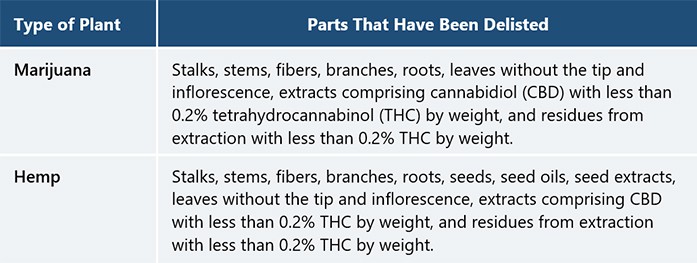
Anyone who wishes to participate in this emerging cannabis industry must be cautious and carefully review the Narcotics Act and its relevant notifications. Although many parts of the cannabis plant were delisted, there some parts remain on the narcotics list (e.g., marijuana seeds, buds, and leaves with cannabis inflorescence or complete cannabis flower head), and the limits on CBD and THC content must be strictly observed.

Importantly, this notification covers only cannabis cultivated in Thailand. Foreign participants are precluded from any participation in an approved cannabis business until a five-year ban on foreign participation—counting from the initial delisting in February 2019—has passed. This means that only the Thai government and its authorized partners have standing to apply for a commercial license until February 20, 2024, which is when foreign parties will be allowed to obtain a commercial cannabis license (subject to any extension or further imposition of restrictions). However, non-commercial licenses (e.g., for research and development) may be issued to Thai applicants.

Despite these limitations, the MOPH notification is another progressive step for driving cannabis research, development, and industry in Thailand. In addition, it delisted other plants that had been classified as category 5 narcotics, including kratom plants (a common plant in Southeast Asia with mild stimulant properties) such as Mitragyna speciosa (Korth.) Havil; opium plants such as Papaver somniferum L. and Papaver bracteatum Lindl.; and fungi of the species Psilocybe cubensis, which contain psilocybin or psilocin. Further notifications on these substances are expected to be issued soon.

The government quickly followed up on the December 14, 2020, notification by publishing another notification on December 30, establishing the criteria for filing applications for licenses to produce, import, export, distribute, and possess hemp (Cannabis sativa) in Thailand. Processing of these applications by the FDA opened on January 29, 2021, for interested Thai citizens and entities under Thai law. Industry operators are now waiting for the Thai FDA’s final promulgation of its own regulations for cannabis licensing to support this development.

Parties interested in entering into this emerging industry should closely monitor the ongoing development of the regulatory regime for cannabis plants in Thailand, as this regime is solidifying rapidly. Those who stay apprised of the situation and remain ready to act when opportunities arise will be able to take full advantage of the new regulatory changes, and in the process will help strengthen a nascent industry in Thailand.

RELATED INSIGHTS​ 

April 22, 2026
A new decree in Vietnam brings significant implementation clarity to the country’s existing extended producer responsibility (EPR) legal framework. An EPR mechanism was first codified in Vietnam in the 2020 Law on Environmental Protection amid ongoing challenges surrounding the collection and treatment of product and packaging waste. The mechanism was progressively detailed through Decree No. 08/2022/ND‑CP and its successive amendments, but the regulatory framework remained insufficiently developed, notably in terms of support mechanisms for waste collection, recycling, and treatment. The newly launched regulations in Decree No. 110/2026/ND-CP (Decree 110), issued on April 1, 2026, and taking effect on May 25, 2026, stipulate fully and clearly the responsibility of manufacturers and importers to recycle products and packaging and to treat waste. Some key provisions of Decree 110 for manufacturers, importers, and related stakeholders are presented below. Subjects of EPR The Law on Environmental Protection assigns responsibility to manufacturers and importers for product and packaging recycling (under Article 54) or waste collection and treatment (under Article 55), depending on the type of products and packaging they produce or import. Decree 110 elaborates on these EPR provisions by specifying the responsible entities and listing out the types of products and packaging subject to recycling and waste treatment responsibilities. Decree 110 clarifies the responsible entities in special cases, such as when products under the same brand are made by multiple manufacturers, when there is a contract manufacturing or entrusted import relationship, and when the manufacturer or importer is part of a corporate group. Notably, exemptions may be applied in some scenarios, such as for manufacturers and importers of products and packaging exclusively for export, temporary import and re-export, or research and testing purposes, as well as for entities with annual revenue from related products not exceeding VND 30 billion. Recycling Responsibilities Decree 110
March 30, 2026
In response to an emerging crisis on food safety, the government of Vietnam promulgated Decree No. 46/2026/ND-CP (Decree 46) on January 26, 2026, and Resolution No. 66.13/2026/NQ-CP (Resolution 66.13) on January 27, 2026, setting out a number of substantive changes to the procedure and strict requirements for the declaration, registration, and importation of food products. Both instruments took effect upon issuance. However, shortly after they entered into force, food businesses encountered significant implementation challenges, particularly with respect to state inspection procedures at the customs clearance stage for imported products. In response, the government issued Resolution No. 09/2026/NQ-CP (Resolution 09) on February 4, 2026, temporarily suspending Decree 46 and Resolution 66.13 until a new effective date of April 16, 2026. Continued Suspension of Implementation of Decree 46 and Resolution 66.13 After considering feedback gathered by the Ministry of Health from food businesses and other stakeholders during the suspension period, the Vietnam Government Office issued a notice on March 20, 2026, agreeing to extend the suspension until the issuance of an amended Law on Food Safety and its guiding decree. Following this notice, on March 22, 2026, the Ministry of Health prepared a draft resolution to implement the notice and replace Resolution 09. Under the draft resolution, the effectiveness of Decree 46 and Resolution No. 66.13 would continue to be suspended until the amended Law on Food Safety takes effect, except for the provisions under Resolution 66.13 allowing flexibility in documents evidencing product efficacy, which would take effect on April 16, 2026, and remain effective until the Law on Food Safety is replaced (but not later than February 28, 2027). Accordingly, for products subject to the registration declaration procedure, such as health supplements, efficacy may be substantiated by either (i) scientific evidence supporting the declared function and effects of the product
February 26, 2026
Laos’ Food and Drug Department (FDD) has been using a new online registration system for drugs since the beginning of the year. The system, which was implemented following the November 2025 issuance of Notice No. 5960/FDD, became the official pathway for submissions on January 1, 2026. Since that date, paper-based registrations have no longer been accepted. This marks a significant advancement in the digitalization of regulatory processes in Laos. As the online system is now the exclusive platform for registration, renewal, and amendments, companies that have not yet aligned their processes to the new system should act promptly to ensure a smooth transition. To assist with this, the FDD will conduct periodic training sessions on the use of the online registration system, which will be delivered either in person or remotely, depending on operator demand. To start using the system, drug and medical device manufacturers, as well as import-export companies, that have not yet registered must submit a formal request identifying the authorized personnel who will access the platform, after which they will be issued user accounts and access codes. Each request must be accompanied by the company’s enterprise registration certificate (incorporation certificate), a copy of the identity card or passport of each designated user, and a scanned copy of their signature. There is no restriction on the number of users per company, allowing flexibility to meet operational needs. Companies that already hold accounts and access codes from the trial phase may continue using them and may apply for additional accounts if needed. Additional Requirements The new system also introduces a standardized format for drug registration numbers. For example, an import drug registration number such as 06 I 4040/15 will be changed to 06-IM-04040-15, and a domestic drug registration number such as 06 L 4040/15 will be changed to
January 21, 2026
Spurred by global geopolitics and Canada’s Indo-Pacific Strategy, which aims to forge deeper ties with ASEAN, Canadian companies have been showing growing interest in Thailand and Southeast Asia in recent years. To understand the opportunities offered by the region, we sat down with Andrew Stoutley, a Toronto native and the chief operating officer of Tilleke & Gibbins, a leading Southeast Asian regional law firm with over 130 years of history in Thailand. Q: Why are Canadian companies looking at Thailand and Southeast Asia right now? A: Two reasons stand out. First, diversification has moved up the agenda. Many Canadian companies want options outside North America due to tariff volatility and policy uncertainty in the United States, as well as questions around the next Canada–United States–Mexico Agreement mandatory joint review. At the same time, the shift of global production from China to Southeast Asia is accelerating, driven by rising costs, geopolitics, and the need to avoid overreliance on a single market. As a result, Canadian companies are looking for a second production base or a regional hub, and Thailand and its neighbors are natural choices given their manufacturing depth, location, and established supply chains. Second, Canada’s own efforts in the region are gaining traction. The Indo-Pacific Strategy has led to more on-the-ground support, including larger trade missions, upgraded diplomatic posts, and new financing options. Export Development Canada (EDC) now has a presence in Bangkok, giving Canadian companies a direct line to financing and insurance in Thailand. There’s also steady progress on trade frameworks like the recently signed Canada–Indonesia Comprehensive Economic Partnership Agreement (which will come into effect pending domestic procedures), ongoing negotiations of a Canada–ASEAN FTA, and the exciting announcement about the launch of negotiations of a Canada–Thailand FTA. Together, these developments have the potential to make it much easier