
You are using an outdated browser and your browsing experience will not be optimal. Please update to the latest version of Microsoft Edge, Google Chrome or Mozilla Firefox. Install Microsoft Edge

March 2, 2021

Thailand’s Decriminalization of Cannabis Plants

Informed Counsel

The cannabis plant has fascinated many civilizations, societies, and individuals through the centuries with its unique properties, and many have learned how to benefit from these, finding a variety of therapeutic and industrial uses of the plant that, in turn, enhanced domestic economies worldwide. In Thailand, cannabis plants and their derivatives have been used since ancient times as treatment for many diseases, and the plant forms a key ingredient in many Thai traditional medicinal remedies. However, over the past few decades, cannabis usage was seen to change in a way that became incrementally more abusive, resulting in outright prohibition in almost all countries. Thailand was no exception, and in 1979 the Thai government officially enacted the Narcotics Act forbidding the use of cannabis and listing cannabis plants and their derivatives—most notably marijuana (cannabis with psychoactive properties) and hemp (cannabis with limited or no psychoactive properties)—as category 5 narcotics (i.e., prohibited substances).

Despite these restrictions, many Thais continued to use cannabis illegally, and some urged the government to legalize personal and commercial use of cannabis plants and their derivatives. Eventually, some in the Thai government agreed that it was time to consider steps toward legalization, As a result, the government has been taking action to delist cannabis plants from the list of prohibited narcotics since 2018, when a regulation allowed the cultivation of hemp for industrial and non-commercial purposes, such as household cooking and research and development.

The next significant step came in February 2019, when the Narcotics Act (No. 7) was amended, legalizing medical marijuana within certain limitations. In national elections the following month, the Bhumjaithai political party, whose election campaign included a pledge to decriminalize and legalize cannabis plants, won substantial support in parts of the country and chose to join the coalition government, with the Bhumjaithai party leader assuming control of the Ministry of Public Health (MOPH). Since then, the government, with cooperation from the MOPH and the Food and Drug Administration (FDA), has been working to reclassify cannabis products and to issue new regulatory pathways to accommodate these new “cash crops” to boost the domestic economy. Subsequently, a notification was issued in August 2019 that reclassified certain modern drugs, cosmeceuticals, nutraceuticals, cosmetics, and food containing hemp out of the scope of the Narcotics Act. At the same time, cannabis and hemp legalization were also taking a higher profile in the public sphere. For instance, the issue of cannabis legalization was raised and promoted in the election campaigns of early 2019 by one of the large political parties.

After a long interlude (caused primarily by government focus turning to the COVID-19 pandemic and other emergent priorities), a new MOPH notification was published in the Government Gazette on December 14, 2020, expanding the delisting of cannabis from the Narcotics Act to include nearly all parts of cannabis and hemp plants, as detailed in the table below.
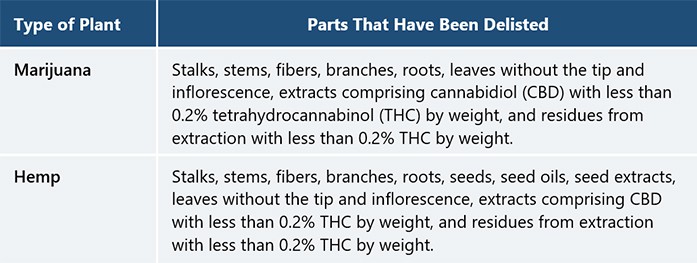
Anyone who wishes to participate in this emerging cannabis industry must be cautious and carefully review the Narcotics Act and its relevant notifications. Although many parts of the cannabis plant were delisted, there some parts remain on the narcotics list (e.g., marijuana seeds, buds, and leaves with cannabis inflorescence or complete cannabis flower head), and the limits on CBD and THC content must be strictly observed.

Importantly, this notification covers only cannabis cultivated in Thailand. Foreign participants are precluded from any participation in an approved cannabis business until a five-year ban on foreign participation—counting from the initial delisting in February 2019—has passed. This means that only the Thai government and its authorized partners have standing to apply for a commercial license until February 20, 2024, which is when foreign parties will be allowed to obtain a commercial cannabis license (subject to any extension or further imposition of restrictions). However, non-commercial licenses (e.g., for research and development) may be issued to Thai applicants.

Despite these limitations, the MOPH notification is another progressive step for driving cannabis research, development, and industry in Thailand. In addition, it delisted other plants that had been classified as category 5 narcotics, including kratom plants (a common plant in Southeast Asia with mild stimulant properties) such as Mitragyna speciosa (Korth.) Havil; opium plants such as Papaver somniferum L. and Papaver bracteatum Lindl.; and fungi of the species Psilocybe cubensis, which contain psilocybin or psilocin. Further notifications on these substances are expected to be issued soon.

The government quickly followed up on the December 14, 2020, notification by publishing another notification on December 30, establishing the criteria for filing applications for licenses to produce, import, export, distribute, and possess hemp (Cannabis sativa) in Thailand. Processing of these applications by the FDA opened on January 29, 2021, for interested Thai citizens and entities under Thai law. Industry operators are now waiting for the Thai FDA’s final promulgation of its own regulations for cannabis licensing to support this development.

Parties interested in entering into this emerging industry should closely monitor the ongoing development of the regulatory regime for cannabis plants in Thailand, as this regime is solidifying rapidly. Those who stay apprised of the situation and remain ready to act when opportunities arise will be able to take full advantage of the new regulatory changes, and in the process will help strengthen a nascent industry in Thailand.

RELATED INSIGHTS​ 

February 9, 2023
Vietnam’s Ministry of Finance is drafting a circular on determining the origin of imported and exported goods. This circular, a draft version of which has been released for public comment (“Draft Circular”), consolidates prevailing regulations and guidelines on determining the origin of imported and exported goods that are stipulated in the following legal documents, which the Draft Circular would replace when it comes into effect: Circular No. 38/2018/TT-BTC dated April 20, 2018, of the Ministry of Finance regulating the determination of origin of imported and exported goods, as amended by Circular No. 62/2019/TT-BTC dated September 5, 2019, of the Ministry of Finance; Circular No. 47/2020/TT-BTC dated May 27, 2020, regulating the time to submit documents proving the origin of goods and form of the documents proving the origin of imported goods applied during the Covid-19 pandemic; and Circular No. 07/2021/TT-BTC dated January 25, 2021, regulating the time to submit documents proving the origin of imported goods under the EU-Vietnam Free Trade Agreement (EVFTA). Generally speaking, the Draft Circular does not increase the administrative procedures for importers and exporters, but rather seeks to codify the recent practices implemented by the customs authorities. The Draft Circular focuses on providing comprehensive guidance for importing/exporting companies when carrying out administrative procedures to certify the origins of imported and exported goods to be in line with current trade practices and international commitments under new-generation free trade agreements. In particular, the Draft Circular supplements guidelines on declaring origins and submitting Certificates of Origin (C/Os) of imported goods under the EVFTA and the Regional Comprehensive Economic Partnership Agreement (RCEP). The Draft Circular also provides some new guidelines to facilitate exports (and imports) and overcome some obstacles and issues when implementing the prevailing regulations. For example, the submission of C/Os online, which was only applicable during the
January 27, 2023
The opening weeks of 2023 have already seen a sharp increase in enforcement against violations of product labeling and advertising rules in Cambodia, in line with a notice issued by the country’s Directorate-General for Consumer Protection, Competition, and Fraud Repression (CCF) last year. Since the Law on Consumer Protection was adopted in 2019, a major legislative push has been seen, with general rules coming out focusing on providing consumers with sufficient information on products and services, for example via product labeling or advertising rules. Then, more detailed regulations were adopted for specific product categories, for example for food products and cosmetics. Khmer language requirements have been a key feature of the recently adopted rules on advertising and labeling. Despite the Khmer language mandates in consumer protection laws and regulations, enforcement and compliance was low. Most products on the market—especially imports—did not comply with the language requirement. In line with the revamped regulatory framework, the CCF has increased its enforcement, enabled by recent substantial budget increases. They have adopted clear implementing regulations for their officers to enforce in a practical yet effective manner, and they have been issuing notices reminding companies to comply with the new rules. A September 2022 notice announced that increased CCF enforcement of product labeling rules would start on January 1, 2023. As noted above, this has already proven to be true, and enforcement is now proceeding in earnest. Companies should take heed of this notice and ensure compliance with the Khmer language requirements (detailed below), as the CCF has shown that it readily acts against violators, from small retailers to large conglomerates. Khmer Language Requirement A sub-decree issued November 4, 2022 requires all commercial advertising of products and services—by any channel—to use Khmer as the primary language. If foreign-language text is used in advertisements, it
January 10, 2023
On January 9, 2023, Vietnam’s National Assembly voted to approve a draft resolution on the continued implementation of policies for the prevention and control of the Covid-19 pandemic. Under this resolution, marketing authorizations (MAs) for the following drugs and medicinal ingredients will be extended to December 31, 2024, allowing continued use in Vietnam: Drugs and medicinal ingredients whose MAs expire from January 1, 2023, to December 12, 2024, and whose extension dossiers have been submitted but have not yet been approved in accordance with the Law on Pharmacy; and Drugs and medicinal ingredients whose MAs have been extended as per Resolution No. 12/2021/UBTVQH15 and have not been extended in accordance with the Law on Pharmacy. The extension does not apply to the following cases: Drugs and medicinal ingredients that have been recalled by the Law on Pharmacy; Drugs with signs of being unsafe for users that have been suspended from circulation/use and sealed for preservation in accordance with the Law on Pharmacy; and Drugs with MAs having a validity term of three years in accordance with the Law on Pharmacy. The Ministry of Health will announce the list of drugs and medicinal ingredients whose MAs are subject to be extended as described above.
November 23, 2022
The delisting of cannabis as a controlled narcotic in Thailand on June 9, 2022, was a breakthrough moment for the industry.  Not only are farmers and others in the industry elated that such a step was taken, it has triggered the establishment of an abundance of cannabis dispensaries in Bangkok and other popular domestic and international tourist destinations in Thailand, including Chiang Mai, Pattaya, Phuket, and many islands. Vulnerable populations, such as children, accessing cannabis has also become a hot-button issue. Thailand’s Ministry of Public Health (MOPH) was initially criticized by some for its policy of allowing cannabis to be sold with few restrictions. On June 17, 2022, the MOPH followed up with the Announcement Re: Controlled Herbs (Cannabis) under the Thai Traditional Medical Knowledge Act, which seemed to implement a viable mechanism to regulate cannabis dispensaries. This announcement contained prohibitions on selling cannabis to vulnerable populations (minors, expectant women, and breastfeeding mothers) and on smoking cannabis in public. Furthermore, the draft Cannabis and Hemp Act includes provisions related to sales and distribution channels and advertisements for particular dispensaries. However, the draft act has been delayed due to disagreements among some political parties during the reading of the legislation, and is unlikely to be implemented in 2022 as had been widely expected.  The tug-of-war among the political parties has caused concerns about whether the country’s recent liberalized cannabis policy will be revisited and cannabis relisted as a narcotic. With this uncertainty over when the draft Cannabis and Hemp Act will be implemented, the MOPH has focused on identifying gaps in current regulation that might allow the misuse of cannabis. The minister of the MOPH has announced that the MOPH announcement of June 17, 2022, will be repealed and replaced by the November 11, 2022, Announcement Re: Controlled Herbs (Cannabis).