
You are using an outdated browser and your browsing experience will not be optimal. Please update to the latest version of Microsoft Edge, Google Chrome or Mozilla Firefox. Install Microsoft Edge

March 2, 2021

Thailand’s Decriminalization of Cannabis Plants

Informed Counsel

The cannabis plant has fascinated many civilizations, societies, and individuals through the centuries with its unique properties, and many have learned how to benefit from these, finding a variety of therapeutic and industrial uses of the plant that, in turn, enhanced domestic economies worldwide. In Thailand, cannabis plants and their derivatives have been used since ancient times as treatment for many diseases, and the plant forms a key ingredient in many Thai traditional medicinal remedies. However, over the past few decades, cannabis usage was seen to change in a way that became incrementally more abusive, resulting in outright prohibition in almost all countries. Thailand was no exception, and in 1979 the Thai government officially enacted the Narcotics Act forbidding the use of cannabis and listing cannabis plants and their derivatives—most notably marijuana (cannabis with psychoactive properties) and hemp (cannabis with limited or no psychoactive properties)—as category 5 narcotics (i.e., prohibited substances).

Despite these restrictions, many Thais continued to use cannabis illegally, and some urged the government to legalize personal and commercial use of cannabis plants and their derivatives. Eventually, some in the Thai government agreed that it was time to consider steps toward legalization, As a result, the government has been taking action to delist cannabis plants from the list of prohibited narcotics since 2018, when a regulation allowed the cultivation of hemp for industrial and non-commercial purposes, such as household cooking and research and development.

The next significant step came in February 2019, when the Narcotics Act (No. 7) was amended, legalizing medical marijuana within certain limitations. In national elections the following month, the Bhumjaithai political party, whose election campaign included a pledge to decriminalize and legalize cannabis plants, won substantial support in parts of the country and chose to join the coalition government, with the Bhumjaithai party leader assuming control of the Ministry of Public Health (MOPH). Since then, the government, with cooperation from the MOPH and the Food and Drug Administration (FDA), has been working to reclassify cannabis products and to issue new regulatory pathways to accommodate these new “cash crops” to boost the domestic economy. Subsequently, a notification was issued in August 2019 that reclassified certain modern drugs, cosmeceuticals, nutraceuticals, cosmetics, and food containing hemp out of the scope of the Narcotics Act. At the same time, cannabis and hemp legalization were also taking a higher profile in the public sphere. For instance, the issue of cannabis legalization was raised and promoted in the election campaigns of early 2019 by one of the large political parties.

After a long interlude (caused primarily by government focus turning to the COVID-19 pandemic and other emergent priorities), a new MOPH notification was published in the Government Gazette on December 14, 2020, expanding the delisting of cannabis from the Narcotics Act to include nearly all parts of cannabis and hemp plants, as detailed in the table below.
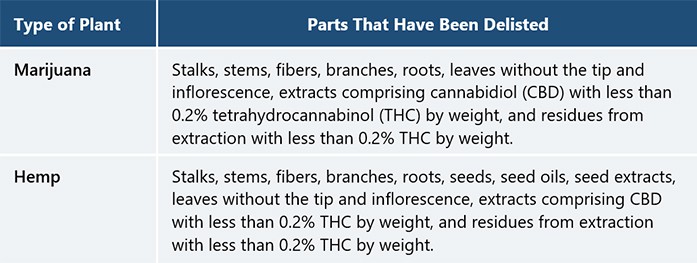
Anyone who wishes to participate in this emerging cannabis industry must be cautious and carefully review the Narcotics Act and its relevant notifications. Although many parts of the cannabis plant were delisted, there some parts remain on the narcotics list (e.g., marijuana seeds, buds, and leaves with cannabis inflorescence or complete cannabis flower head), and the limits on CBD and THC content must be strictly observed.

Importantly, this notification covers only cannabis cultivated in Thailand. Foreign participants are precluded from any participation in an approved cannabis business until a five-year ban on foreign participation—counting from the initial delisting in February 2019—has passed. This means that only the Thai government and its authorized partners have standing to apply for a commercial license until February 20, 2024, which is when foreign parties will be allowed to obtain a commercial cannabis license (subject to any extension or further imposition of restrictions). However, non-commercial licenses (e.g., for research and development) may be issued to Thai applicants.

Despite these limitations, the MOPH notification is another progressive step for driving cannabis research, development, and industry in Thailand. In addition, it delisted other plants that had been classified as category 5 narcotics, including kratom plants (a common plant in Southeast Asia with mild stimulant properties) such as Mitragyna speciosa (Korth.) Havil; opium plants such as Papaver somniferum L. and Papaver bracteatum Lindl.; and fungi of the species Psilocybe cubensis, which contain psilocybin or psilocin. Further notifications on these substances are expected to be issued soon.

The government quickly followed up on the December 14, 2020, notification by publishing another notification on December 30, establishing the criteria for filing applications for licenses to produce, import, export, distribute, and possess hemp (Cannabis sativa) in Thailand. Processing of these applications by the FDA opened on January 29, 2021, for interested Thai citizens and entities under Thai law. Industry operators are now waiting for the Thai FDA’s final promulgation of its own regulations for cannabis licensing to support this development.

Parties interested in entering into this emerging industry should closely monitor the ongoing development of the regulatory regime for cannabis plants in Thailand, as this regime is solidifying rapidly. Those who stay apprised of the situation and remain ready to act when opportunities arise will be able to take full advantage of the new regulatory changes, and in the process will help strengthen a nascent industry in Thailand.

RELATED INSIGHTS​ 

July 11, 2023
Enacted in 2009, Indonesia’s current Law on Health (Law No. 36/2009) is due for a refresh. The government realized that the law has not maintained its relevance when it comes to health trends such as digital health, which refers to the provision of health services online (also commonly known as telemedicine). While regulations and policy blueprints, such as Ministry of Health (MOH) Regulation No. 46/2017 concerning National E-Health Strategies, have addressed these shifting trends, Indonesia’s main health legislation has proved inadequate in this regard. For this reason, the government began making plans for an update to the law, and the first draft Omnibus Health Law was published in March 2023. The law addresses digital health and other important issues in today’s health landscape, and it seeks to promote the use of locally made health supplies. The draft Omnibus Health Law represents a notable step forward, but in its attempt to govern and regulate all aspects of health, there are also some issues in the draft that may overlap with some existing government regulations, such as provisions on Halal certification, compulsory licensing of patents, and addictive substances. This article outlines some of the draft law’s key aspects as well as some potential issues. Digital Health In addressing the growing health trend of telemedicine, the draft law confirms, reinforces, and fills gaps left by Indonesia’s three main regulations concerning telemedicine. namely, MOHR No. 20/2019 concerning Telemedicine, MOHR No. 24/2022 concerning Medical Records, and Medical Council Regulation No. 74/2020 concerning Telemedicine (MCR No. 74/2020). One of these regulations, MOH Regulation No. 20/2019, allows health service facilities to provide telemedicine services to other health service facilities. This covers telemedicine services related to radiology, electrocardiography, ultrasonography, and telemedicine consultancy services—including those that reflect developments in science and technology. This is the only regulation concerning
July 10, 2023
One of the more positive outcomes of the COVID-19 pandemic is that telemedicine has become remarkably important as an interactive system between patients and healthcare professionals. Thailand, which ranks near the top as a world medical hub, is a highly favored destination in Asia for expat workers. Currently, the Thai market has both Thai-based and foreign-based platforms with information about healthcare providers and telemedicine readily available. “Doctor Locator,” “Weed Map,” and “Find a Teeth Aligner Dentist” are examples of online platforms connecting patients with medical and telemedicine services. These digital platforms provide information about the location of specialized clinics, cannabis dispensaries, pharmacy stores, and orthodontic practitioners in Thailand. These platforms act as intermediaries between medical care businesses and consumers. As actual medical services are not offered or provided, these digital platforms do not have to be regulated under the Medical Facility Act of Thailand. However, healthcare digital platform services that act as an intermediary or conduit managing information used to connect medical clinics or cannabis dispensaries with patients or customers via a computer network are now regulated under the soon-to-be-implemented Royal Decree on Digital Platforms, regardless of whether payment is actually made via the platform. The regulatory authority for this is the Electronic Transactions Development Agency (ETDA). Under this royal decree, digital platform providers that intend to operate a digital platform service must notify the ETDA prior to initiating operations. The extent of the details to be included in the notification to the ETDA will be more comprehensive if the digital platform: has annual revenue (before expenses) for digital platform services within Thailand exceeding THB 1.8 million (approx. USD 51,200) for an individual operator or THB 50 million (approx. USD 1.42 million) for a corporate or entity operator; or has more than 5,000 users (on average) per month. Apart
July 10, 2023
On June 30, 2023, the Ministry of Health of Vietnam issued Circular No. 14/2023/TT-BYT stipulating the process and procedure for building bidding package prices for procurement of goods and services in the field of medical devices at public health facilities (“Circular 14”). Circular 14 took effect on July 1, 2023, and will be valid through the end of 2023. Circular 14 applies to the procurement of medical devices/equipment and their accessories, spare parts, and supplies, as well as related services of repair, maintenance, inspection, and calibration. Under Circular 14, there are three methods of determining the price of bidding packages: Collecting quotations provided by suppliers of goods and services in the field of medical devices. Surveying the winning bid prices of similar goods and services on the national bidding network system (https://muasamcong.gov.vn). Using the results of price appraisal of a competent state agency that conducts price appraisal, or a specialized price appraisal enterprise. Method (i) must be used first; the two remaining methods can be applied only after method (i) has been unsuccessful. If the investor/procuring entity uses two or more methods to determine the price of bidding packages, it can select the highest price that is suitable to its financial capacity and professional requirements. Circular 14 further sets out the specific step-by-step process to build prices for procuring products and services in the field of medical devices/equipment. Transitional Provision For bidding packages that have already approved a contractor selection plan before July 1, 2023, the approved contractor selection plan will be followed. For bidding packages for which a contractor selection plan has been submitted by the investor/procuring entity but the plan has not yet been approved, the competent person can decide on the approval of the submitted plan or can request the investor/procuring entity to rebuild the bidding
July 4, 2023
Practitioners from Tilleke & Gibbins’ Vietnam offices contributed content for the latest edition of the Practical Law Life Sciences Global Guide. The guide provides a comparative overview, in Q&A format, of laws and regulations on pharmaceuticals, medical devices, and other life sciences products in dozens of jurisdictions around the world. The Life Sciences Global Guide is divided into two sections: Regulation (see more details here) and Commercialization, which covers the following topics: Overview of the life sciences sector Pricing, government funding, and reimbursement: National health care system, price regulation and reimbursement Distribution and sale Cross-border trade and parallel imports Advertising to the public and engagement with patient organizations Advertising to healthcare professionals and organizations: Gifts and incentives and transparency and disclosure Patents: Conditions for patentability, registration, length of protection, infringement, international treaties Trademarks: Requirements, registration Competition law issues: Authorities and legislation, commercial contracts and competition law, licensing approvals and formalities Product liability: Regulators, medicinal product liability law, liable partners, defenses, product liability claims, remedies Practical Law, produced by Thomson Reuters, is the world’s leading legal know-how resource for business lawyers, publishing a huge range of guides covering hundreds of jurisdictions and practice areas. The full “Life Sciences Commercialization in Vietnam” section can be found on the Practical Law website.