
You are using an outdated browser and your browsing experience will not be optimal. Please update to the latest version of Microsoft Edge, Google Chrome or Mozilla Firefox. Install Microsoft Edge

March 2, 2021

Thailand’s Decriminalization of Cannabis Plants

Informed Counsel

The cannabis plant has fascinated many civilizations, societies, and individuals through the centuries with its unique properties, and many have learned how to benefit from these, finding a variety of therapeutic and industrial uses of the plant that, in turn, enhanced domestic economies worldwide. In Thailand, cannabis plants and their derivatives have been used since ancient times as treatment for many diseases, and the plant forms a key ingredient in many Thai traditional medicinal remedies. However, over the past few decades, cannabis usage was seen to change in a way that became incrementally more abusive, resulting in outright prohibition in almost all countries. Thailand was no exception, and in 1979 the Thai government officially enacted the Narcotics Act forbidding the use of cannabis and listing cannabis plants and their derivatives—most notably marijuana (cannabis with psychoactive properties) and hemp (cannabis with limited or no psychoactive properties)—as category 5 narcotics (i.e., prohibited substances).

Despite these restrictions, many Thais continued to use cannabis illegally, and some urged the government to legalize personal and commercial use of cannabis plants and their derivatives. Eventually, some in the Thai government agreed that it was time to consider steps toward legalization, As a result, the government has been taking action to delist cannabis plants from the list of prohibited narcotics since 2018, when a regulation allowed the cultivation of hemp for industrial and non-commercial purposes, such as household cooking and research and development.

The next significant step came in February 2019, when the Narcotics Act (No. 7) was amended, legalizing medical marijuana within certain limitations. In national elections the following month, the Bhumjaithai political party, whose election campaign included a pledge to decriminalize and legalize cannabis plants, won substantial support in parts of the country and chose to join the coalition government, with the Bhumjaithai party leader assuming control of the Ministry of Public Health (MOPH). Since then, the government, with cooperation from the MOPH and the Food and Drug Administration (FDA), has been working to reclassify cannabis products and to issue new regulatory pathways to accommodate these new “cash crops” to boost the domestic economy. Subsequently, a notification was issued in August 2019 that reclassified certain modern drugs, cosmeceuticals, nutraceuticals, cosmetics, and food containing hemp out of the scope of the Narcotics Act. At the same time, cannabis and hemp legalization were also taking a higher profile in the public sphere. For instance, the issue of cannabis legalization was raised and promoted in the election campaigns of early 2019 by one of the large political parties.

After a long interlude (caused primarily by government focus turning to the COVID-19 pandemic and other emergent priorities), a new MOPH notification was published in the Government Gazette on December 14, 2020, expanding the delisting of cannabis from the Narcotics Act to include nearly all parts of cannabis and hemp plants, as detailed in the table below.
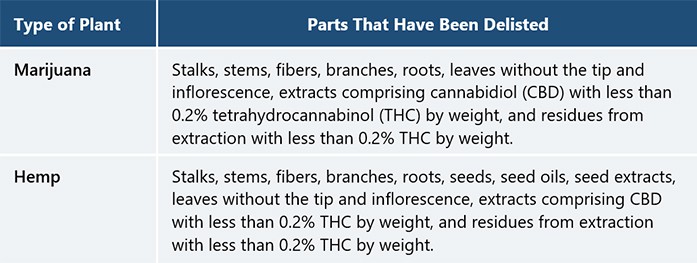
Anyone who wishes to participate in this emerging cannabis industry must be cautious and carefully review the Narcotics Act and its relevant notifications. Although many parts of the cannabis plant were delisted, there some parts remain on the narcotics list (e.g., marijuana seeds, buds, and leaves with cannabis inflorescence or complete cannabis flower head), and the limits on CBD and THC content must be strictly observed.

Importantly, this notification covers only cannabis cultivated in Thailand. Foreign participants are precluded from any participation in an approved cannabis business until a five-year ban on foreign participation—counting from the initial delisting in February 2019—has passed. This means that only the Thai government and its authorized partners have standing to apply for a commercial license until February 20, 2024, which is when foreign parties will be allowed to obtain a commercial cannabis license (subject to any extension or further imposition of restrictions). However, non-commercial licenses (e.g., for research and development) may be issued to Thai applicants.

Despite these limitations, the MOPH notification is another progressive step for driving cannabis research, development, and industry in Thailand. In addition, it delisted other plants that had been classified as category 5 narcotics, including kratom plants (a common plant in Southeast Asia with mild stimulant properties) such as Mitragyna speciosa (Korth.) Havil; opium plants such as Papaver somniferum L. and Papaver bracteatum Lindl.; and fungi of the species Psilocybe cubensis, which contain psilocybin or psilocin. Further notifications on these substances are expected to be issued soon.

The government quickly followed up on the December 14, 2020, notification by publishing another notification on December 30, establishing the criteria for filing applications for licenses to produce, import, export, distribute, and possess hemp (Cannabis sativa) in Thailand. Processing of these applications by the FDA opened on January 29, 2021, for interested Thai citizens and entities under Thai law. Industry operators are now waiting for the Thai FDA’s final promulgation of its own regulations for cannabis licensing to support this development.

Parties interested in entering into this emerging industry should closely monitor the ongoing development of the regulatory regime for cannabis plants in Thailand, as this regime is solidifying rapidly. Those who stay apprised of the situation and remain ready to act when opportunities arise will be able to take full advantage of the new regulatory changes, and in the process will help strengthen a nascent industry in Thailand.

RELATED INSIGHTS​ 

September 7, 2023
Thailand is a member state of the ASEAN Economic Community, and next year, it is expected that the ASEAN Harmonization of Traditional Medicines and Health Supplements will be signed by the economic minister of each ASEAN country. Following ratification, the ASEAN Guidelines on Claims and Claims Substantiation for Traditional Medicines and Health Supplements will become the standard guidelines in the region, and various implementation efforts and instruments will follow. These guidelines cover a wide range of medicines and supplements; however, it is not possible to cover all herbal products. There are three types of health supplement claims: nutritional claims, functional claims, and disease risk reduction claims. Examples of the three types of claims include the following: Nutritional claims: supplements nutrition, nourishes the body, supports healthy growth and development, etc. Functional claims: maintains healthy joints, supports immunity, maintains liver function, etc. Disease risk reduction claims: helps to reduce risk of dyslipidemia, helps to reduce risk of osteoporosis, etc. The degree of evidence required for substantiating disease risk reduction claims is higher than for functional claims and nutritional claims. Functional claims and disease risk reduction claims must be substantiated by efficacy studies and the relevant toxicity data. It is the responsibility of the health supplement company to provide the required evidence in order to comply with the criteria for making such claims. Tips on Health Claims for Health Supplements 1. Nutritional Claims For essential nutrients such as vitamins and minerals, as listed by the Thai Food and Drug Administration (FDA), the amount included in a supplement must be between 15% and 100% of the Thai Recommended Daily Intake (RDI) values. Rules for specific kinds of nutritional claims are provided in the Notification of the Thai FDA RE: Nutrient Function Claims. For example, the nutrients that can be claimed as boosting the
August 29, 2023
Laos’ Ministry of Health (MOH) has promulgated a regulation detailing registration and notification protocols for medical devices. Decision on the Registration and Notification of Medical Devices No. 1470/MOH will come into force 60 days after both the signing of the regulation (which already occurred in July) and publication in the Official Gazette, which has not yet been specified by the government. Registration of medical devices in Laos is mentioned in the country’s Law on Drugs and Medical Products No. 07/NA, dated December 21, 2011, but a registration procedure has not been put in place. There was only a separate requirement to furnish certain required documents when importing medical devices. Now, the decision outlines the registration and notification process for medical devices through the Ministry of Health’s Food and Drug Department (FDD), in line with the regulatory principles in the ASEAN Medical Device Directive of 2015, which Laos has ratified. Medical Devices in Laos The decision defines medical devices as any instrument, apparatus, implement, machine, appliance, implant, in vitro reagent or calibrator, software, material, or other similar or related article intended for any of the following uses in humans: Diagnosis, prevention, monitoring, recovery from, or alleviation or treatment of a disease; Diagnosis, monitoring, recovery from, or alleviation of or compensation for an injury; Replacement, modification, or support of anatomy or a physiological process; Supporting and sustaining life; Controlling or assisting in conception; or Disinfection and sterilization of tools and medical devices. Medical devices in Laos are given one of four classifications based on their level of risk: Class A – Low risk (e.g., rubber belts, cotton for medical purposes, nonwoven swabs, adhesive bandages) Class B – Low-moderate risk (e.g., neonatal suction equipment, surgical gloves, gastro-catheters) Class C – Moderate-high risk (e.g., endoscopic surgical equipment, anesthesia equipment, peritoneal dialysis equipment) Class
August 29, 2023
Since the June 9, 2022, delisting of all parts of the cannabis plant according to the Narcotics Code, there has been an explosion of cannabis dispensaries operating in Thailand. The Department of Thai Traditional and Alternative Medicine (DTTAM) has issued more than 12,000 cannabis dispensary licenses to businesses in Thailand. A license allows a dispensary to sell cannabis flowers legally. In addition, the DTTAM requests the cooperation of dispensaries in submitting monthly reports about the sourcing, selling, and inventory of cannabis flowers. The DTTAM may suspend the selling license of dispensaries that fail to submit these reports. Apart from the enforcement duties and administrative acts of the DTTAM, the enactment of the laws and regulations pertaining to cannabis seemed to be drastically winding down. One of the reasons was that Thailand had delays in the process of forming a new government following the general election of May 14, 2023. These delays dampened Thailand’s thriving cannabis industry. In particular, the industry has concerns about the uncertainty of the nascent cannabis law. On August 11, 2023, the Narcotics Control Division of the Thai Food and Drug Administration (FDA) posted the Draft Regulation Re: Application for Approval and Approval for Manufacture, Importation, Exportation, Distribution or Possession of Narcotics under Category 5 (Extracts from Cannabis or Hemp Plants Only). This may be the first regulation that the newly formed government implements with regard to cannabis extracts. Unlike the DTTAM’s enforcement activities, the Thai FDA requests that a domestic manufacturer, importer, exporter, or seller of cannabis extracts apply for a license. The Thai FDA, as the authority, will consider granting a license only in the following cases: For medical benefits; For commercial or industrial benefits; For the benefit of medical or scientific analysis or research; and For use by the government for preventing and
July 11, 2023
Enacted in 2009, Indonesia’s current Law on Health (Law No. 36/2009) is due for a refresh. The government realized that the law has not maintained its relevance when it comes to health trends such as digital health, which refers to the provision of health services online (also commonly known as telemedicine). While regulations and policy blueprints, such as Ministry of Health (MOH) Regulation No. 46/2017 concerning National E-Health Strategies, have addressed these shifting trends, Indonesia’s main health legislation has proved inadequate in this regard. For this reason, the government began making plans for an update to the law, and the first draft Omnibus Health Law was published in March 2023. The law addresses digital health and other important issues in today’s health landscape, and it seeks to promote the use of locally made health supplies. The draft Omnibus Health Law represents a notable step forward, but in its attempt to govern and regulate all aspects of health, there are also some issues in the draft that may overlap with some existing government regulations, such as provisions on Halal certification, compulsory licensing of patents, and addictive substances. This article outlines some of the draft law’s key aspects as well as some potential issues. Digital Health In addressing the growing health trend of telemedicine, the draft law confirms, reinforces, and fills gaps left by Indonesia’s three main regulations concerning telemedicine. namely, MOHR No. 20/2019 concerning Telemedicine, MOHR No. 24/2022 concerning Medical Records, and Medical Council Regulation No. 74/2020 concerning Telemedicine (MCR No. 74/2020). One of these regulations, MOH Regulation No. 20/2019, allows health service facilities to provide telemedicine services to other health service facilities. This covers telemedicine services related to radiology, electrocardiography, ultrasonography, and telemedicine consultancy services—including those that reflect developments in science and technology. This is the only regulation concerning