You are using an outdated browser and your browsing experience will not be optimal. Please update to the latest version of Microsoft Edge, Google Chrome or Mozilla Firefox. Install Microsoft Edge

January 4, 2024

Thailand Unveils Regulations for Cross-Border Personal Data Transfer

On December 25, 2023, Thailand’s Personal Data Protection Committee (PDPC) issued two notifications under sections 28 and 29 of the Personal Data Protection Act 2019 (PDPA) that address essential aspects and criteria for the cross-border transfer of personal data. These notifications are scheduled to come into effect on March 24, 2024.

Key points in the notifications are outlined below.

Adequate Data Protection Standards (Section 28)

Unless otherwise provided by the PDPA, the destination country or international organization that receives the transferred personal data must have “adequate data protection standards,” as determined by the following factors:

  • Legal measures and mechanisms. The destination country or international organization must have legal measures or mechanisms aligned with the personal data protection laws in Thailand. Specifically, the obligations of data controllers need to include providing appropriate security measures, implementing personal data protection measures that are suitable and that enable the exercise of data subjects’ rights, and establishing effective legal remedial measures.
  • Regulatory authority. The presence of an agency or organization entrusted with the duties and authority to enforce laws and regulations related to personal data protection is also a critical factor.

In addition, this notification empowers the Office of the PDPC to refer cases, either independently identified or proposed by a data controller, to the PDPC for adjudication. The PDPC retains the discretion to make decisions on a case-by-case basis or to establish a list of destination countries or international organizations that it considers to have adequate data protection standards.

Binding Corporate Rules and Appropriate Safeguards (Section 29):

In the realm of global data exchange, two prominent mechanisms have emerged as key enablers of secure and compliant transfer of personal data:

  • Binding corporate rules (BCRs). Implementation of BCRs involves enforcing an approved policy for safeguarding personal data transferred among affiliated businesses or within the same group of undertakings in order to jointly operate the business.
  • Appropriate safeguards. Appropriate safeguards not only protect personal data but can also enforce the rights of data subjects and include effective legal remedial measures. These safeguards can take various forms, such as standard contractual clauses.

To be deemed effective mechanisms for cross-border data transfer, both BCRs and appropriate safeguards must do the following:

  • Maintain legal effectiveness and enforceability across all parties involved, including juristic and natural persons, data processors, senders/transferors, and recipients of personal data while complying with personal data protection laws and being binding upon the personnel, employees, staff, any other persons related to the senders/transferors, and recipients of the personal data;
  • Recognize personal data protection, the rights of the data subject, and lodging of complaints in relation to the personal data that has been sent or transferred to a foreign country; and
  • Provide personal data protection measures and security measures that comply with personal data protection laws and with the minimum standards prescribed by law, such as those described in the initial set of subordinate regulations enacted under the PDPA.

In the absence of a decision on adequate data protection standards or where there are no BCRs in place, cross-border transfer of personal data is permissible if appropriate safeguards are implemented. This implementation can take the form of any of the following:

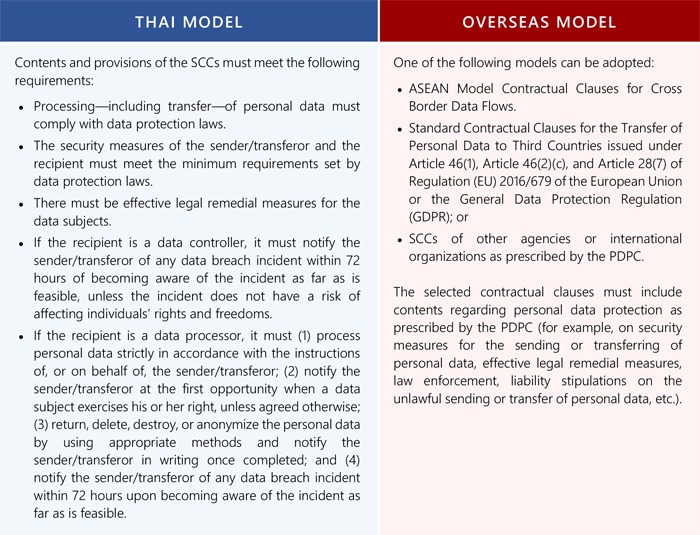
  • Standard contractual clauses (SCCs) that serve as foundational frameworks for establishing legal agreements, especially in the context of cross-border data transfers. In this regard, Thailand currently accepts two distinct SCC models, the Thai Model and the Overseas Model. The specific provisions and applications of each model—either of which can be adopted, as appropriate—are summarized in the table below.
  • Certification of the implementation of the appropriate safeguards in accordance with recognized standards to be determined by the PDPC. These must include the personal data protection contents as prescribed in the notification.
  • Statutes or agreements that are legally binding and enforceable between state agencies in Thailand and foreign state agencies that transfer personal data between each other.

For more details on Thailand’s requirements for the cross-border transfer of personal data, or on any aspect of compliance with the PDPA, please contact Athistha (Nop) Chitranukroh at [email protected], Nopparat Lalitkomon at [email protected], Gvavalin Mahakunkitchareon at [email protected], Thammapas Chanpanich at [email protected], or Punyavee Koaysomboon at [email protected].

RELATED INSIGHTS​ 

August 4, 2026
Thailand’s Personal Data Protection Act B.E. 2562 (2019) (PDPA) could soon see some important changes, as a draft bill to amend the PDPA has been introduced in the House of Representatives. The draft amendment is currently in the public consultation phase, with comments accepted from July 16 to August 15, 2026. If enacted in its current form, the amendment would make three key changes: expanding the government exemption to cover anticorruption operations, introducing a statutory definition of “government agency,” and restructuring the lawful bases for personal data processing to align with international standards. Background The PDPA has encountered several enforcement challenges since its implementation, including three core problems identified by the bill’s sponsors: (1) the current exemptions for government agencies do not cover anticorruption and misconduct-prevention operations; (2) the PDPA lacks a clear statutory definition of “government agency,” causing legal uncertainty as to which entities are covered; and (3) the existing framework for lawful bases of data processing does not align with international standards—particularly the multiple-lawful-bases system in the EU’s General Data Protection Regulation (GDPR)—making compliance inflexible for both government and private sector entities. Expanded Government Exemption The current PDPA exempts government agencies performing duties related to national security (including fiscal security), public safety, anti-money laundering, forensic science, and cybersecurity. The proposed amendment adds “prevention and suppression of corruption and misconduct” to this list of exempted functions. This would allow anticorruption bodies—most notably the National Anti-Corruption Commission (NACC), which is identified as a directly affected party—to collect, use, and disclose personal data without being subject to PDPA requirements when carrying out their duties. New Statutory Definition of “Government Agency” Notably, while the current PDPA use the term “government agency” in several provisions, the term is not comprehensively defined, creating potential uncertainty as to its scope. The draft bill therefore
August 3, 2026
On July 23, 2026, the Bank of Thailand (BOT) released for public comment its draft Notification on Digital Channel Security, which would significantly expand the scope and stringency of Thailand’s existing mobile banking security framework. If finalized in its current form, the draft notification would extend mandatory security requirements to credit card providers and credit providers, cover internet banking in addition to mobile applications, phase out SMS one-time passwords (OTPs) for transaction authentication, and introduce biometric verification requirements for high-value transactions. The public comment period is open through August 24, 2026. Background The BOT’s existing Mobile Banking Security Notification, issued in 2024, sets minimum security standards for financial institutions, specialized financial institutions (SFIs), and e-money providers, significantly reducing “money-draining app” fraud. However, fraudsters have since shifted to nonbank providers and internet banking channels, prompting the BOT to propose broader security requirements. Expanded Scope of Regulated Entities and Channels The existing Mobile Banking Security Notification covers only financial institutions, SFIs, and e-money providers offering mobile banking services. The draft expands coverage in two key areas: entities and channels. On the entity side, it adds credit card providers and credit providers that offer fund transfers to third parties at other financial service providers or that provide cash withdrawal services to individual retail customers. On the channel side, it broadens coverage to include internet banking in addition to mobile banking. Strengthened Customer Authentication The draft introduces enhanced authentication requirements in three areas: Service enrollment and device changes. Providers must implement rigorous identity verification, notify customers of enrollment results through out-of-band communication channels, and adopt risk-mitigation measures such as cooling-off periods and temporary transaction limits. Transaction-level authentication. Providers must use two-factor authentication for fund transfers, cardless ATM withdrawals, and transaction limit increases. Secure authentication factors. Key requirements include the following: “What-you-know” factors must
July 28, 2026
Data protection officers (DPOs) have become a fixture of Thailand’s privacy compliance landscape since the Personal Data Protection Act B.E. 2562 (2019) (PDPA) took full effect and the Office of the Personal Data Protection Committee (PDPC) began requiring certain organizations to appoint them. On July 7, 2026, the Office of the PDPC presented draft guidance on DPOs as part of a public consultation on a series of draft personal data protection manuals and recommendations. The draft offers the clearest indication yet of how the regulator expects the DPO role to work in practice, addressing recurring implementation issues under the PDPA—including when an organization must appoint a DPO, how the DPO should operate independently, how to manage conflicts of interest, and how data subjects and regulators should be able to contact the DPO. Because it remains in draft, organizations have an opportunity to weigh the practical implications now before the guidance is finalized. When a DPO Must Be Appointed The draft guidance clarifies the triggers for mandatory DPO appointment, including: Regular and systematic monitoring of personal data or systems on a large scale, such as tracking, analyzing, or predicting behavior, attitudes, or individual characteristics. Core activities involving large-scale processing of sensitive personal data, such as health data, biometric data, or criminal records. Certain foreign-organization representative arrangements. Public-sector coverage under relevant notifications identifying government entities that must appoint a DPO. Processing involving 100,000 or more data subjects may be considered large-scale. The guidance also contemplates voluntary DPO appointment for organizations that wish to raise their privacy governance standards, and such organizations should still comply with the standards applicable to DPOs under the law. Independence and Reporting Lines The draft guidance identifies lack of DPO independence as a core risk because an ineffective or constrained DPO may be unable to raise deficiencies
July 27, 2026
Vietnam’s new E-Commerce Law, which took effect on 1 July 2026 along with its implementing Decree No. 248/2026/ND-CP (Decree 248), marks a significant development in the country’s approach to online intellectual property (IP) enforcement, reflecting a clear shift from a reactive model of intermediary liability to one that expects platforms to play a more active role in preventing infringement. From notice-and-takedown to platform responsibility The most significant change introduced by the E-Commerce Law is the transformation of the legal role of e-commerce platforms. The existing safe harbor provisions under the IP Law and the copyright notice-and-takedown regime established by Decree 17/2023/ND-CP (Decree 17) largely required intermediaries to act only after receiving notice of infringement. Once infringing content had been removed, the platform’s legal obligation was generally considered fulfilled. The new legislation adopts a fundamentally different approach. Article 17 of the E-Commerce Law requires intermediary platforms to screen information relating to goods and services before publication in order to prevent listings involving counterfeit or IP-infringing goods, and goods of unknown origin. Rather than relying exclusively on complaints from rights holders, platforms are now expected to implement preventive measures before infringing listings become publicly available. Decree 248 further requires platforms to update keyword filters based on recommendations issued by competent authorities. These filtering mechanisms are intended to prevent prohibited listings from appearing on the platform and represent a further move away from a purely complaint-driven enforcement model. The legislation also introduces Vietnam’s first statutory stay-down obligation. Under the E-Commerce Law and Decree 248, major digital platforms must maintain automated systems capable of reviewing, warning against, and removing unlawful listings while also implementing measures to prevent repeat violations, defined under Decree 248 as conduct that has previously been identified and handled by the platform, but continues to recur. This obligation addresses one