You are using an outdated browser and your browsing experience will not be optimal. Please update to the latest version of Microsoft Edge, Google Chrome or Mozilla Firefox. Install Microsoft Edge

December 29, 2022

Thailand Unveils New Land and Building Tax Rate Reductions and Deadline Extensions

On December 20, 2022, Thailand’s cabinet approved draft legislation providing further Land and Building Tax reductions of 15% in 2023, on top of current reductions in tax rates, on some types of taxable property. When enacted, the legislation will provide further tax reductions only for the property types in the table below.
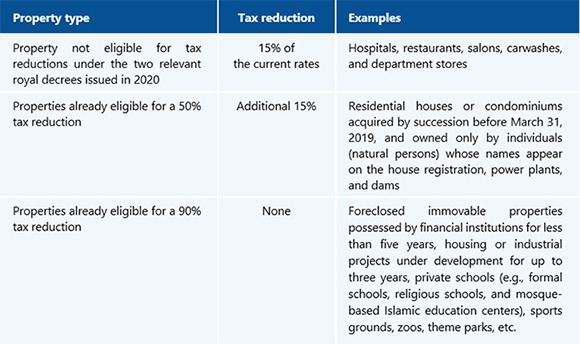
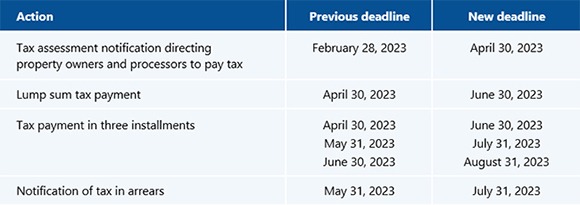
Moreover, in early December, Thailand’s Ministry of Interior promulgated an announcement extending the deadline for tax assessment notification and tax payment (including by scheduled installments) by another two months from the previous statutory deadline of December 20, 2022. The key deadline extensions are shown in the table below.
The Land and Building Tax is a property tax collected annually, with rates varying based on the purpose of use—agricultural, commercial, industrial, or residential. Owners or possessors of land or buildings are liable for Land and Building Tax, which is computed based on the officially appraised value of the property.

For more information on Thailand’s Land and Building Tax, please contact Auaychai Sukawong at [email protected] or Chaiwat Keratisuthisathorn at [email protected].

RELATED INSIGHTS​ 

February 23, 2021
As many are already aware, following the change of government in Myanmar on February 1, 2021, a draft Cyber Security Law was proposed which attracted widespread criticism. However, less attention has been paid to significant amendments to two existing laws, some of which have a similar effect to parts of the draft Cyber Security Law. In other words, while the draft Cyber Security Law has not progressed further and is under public scrutiny, significant elements of it have found their way into law in Myanmar by other routes. Because these amendments are already law, it is very important that individuals and businesses in Myanmar understand their implications. Amendments to the Law Protecting the Privacy and Security of Citizens The Law Protecting the Privacy and Security of Citizens (2017), or the “Privacy Law,” was amended on February 13, 2021, less than two weeks after the military government came into power. These amendments chiefly address the power of the government to conduct searches, seizures, and arrests; to extend detention without judicial oversight; and to carry out broad surveillance and investigation activities that could intrude on individual privacy. The amendments accomplish this by suspending various sections of the Privacy Law for as long as the State Administration Council (the military body now governing Myanmar) is in power. The suspended sections include the following: Section 5: Search, seizure, and arrest without civilian observation The relevant part of Section 5 of the Privacy Law states, “The responsible authorities shall … when acting in accordance with existing law, not enter into a person’s residence or a room used as a residence, or a building, compound or building in a compound, for the purpose of search, seizure, or arrest, unless accompanied by minimum of two witnesses who should comprise Ward or Village Tract Administrators…”. The suspension
February 22, 2021
Following the recent imposition of sanctions on Myanmar individuals and companies by the US, the UK and Canada have now imposed new sanctions. As with the US sanctions, these new measures impact UK and Canadian citizens and companies, and non-UK and non-Canadian companies and citizens with interests in those jurisdictions. The EU has indicated that it is planning to issue similar sanctions in the near future. New UK Sanctions In addition to the 16 individuals already sanctioned by the UK government, on February 18, 2021, the UK government announced that three individuals have been sanctioned for serious human rights violations and are now subject to asset freezes and travel bans. The full list of Myanmar individuals and companies sanctioned by the UK is available on the website of the Office of Financial Sanctions Implementation. Breaches of UK financial sanctions are criminal offences punishable in the UK by up to 7 years imprisonment and heavy fines. New Canadian Sanctions Also on February 18, timed to coincide with the UK sanctions, new Canadian sanctions were imposed on nine individuals. As with the UK, Canada already had a number of individuals in the Myanmar military on its sanctions list, and the new additions bring the total number of individuals sanctioned by Canada to 54. All assets of these individuals in Canada are now frozen, and they are banned from travelling to Canada. Canadian businesses or entities may not do business with any of the 54 individuals. Full details of the impact of the sanctions are available on the Government of Canada’s website, as is a database of the Myanmar individuals and companies subject to them. Breach of Canadian sanctions carries with it up to 5 years’ imprisonment in Canada and/or a large fine. Other Countries The EU is reportedly drawing up sanctions
February 12, 2021
On January 29, 2021, Thailand’s Revenue Department published the Notification of the Director-General of the Revenue Department Re: Income Tax (No. 400), which prescribes the criteria, methods, and conditions for Revenue Department officials on how to assess income and adjust expenses for transactions between related parties (as defined in Section 71 bis of the Revenue Code) that engage in intercompany transactions where conditions between the two parties in their commercial or financial relations differ from those that would be made between independent parties (i.e., where the transaction is not an “arms length” transaction). Those who are familiar with international transfer pricing standard practices will note that the measures under the notification generally follow the concept of chapters II, III, VI and VII of the OECD Transfer Pricing Guidelines for Multinational Enterprises and Tax Administrations. The key elements of the notification are summarized below. Accepted Transfer Pricing Methods The notification recognizes the following as accepted transfer pricing methods: Comparable Uncontrolled Price Method Resale Price Method Cost Plus Method Transactional Net Margin Method Transactional Profit Split Method The notification also requires that the arm’s length result of an intercompany transaction (i.e. the controlled transaction) must be determined using the most appropriate transfer pricing method. If none of the above transfer pricing methods is appropriate for the tested controlled transaction, the company may apply an alternate pricing method to the transaction by notifying the Director General of Revenue in writing, within the relevant accounting period, and describing the reason for doing so. Selection of the Most Appropriate Transfer Pricing Method  There is no formal order of preference for the use of the five accepted pricing methods. However, the notification requires the selection process to take account of the following factors: The respective strengths and weakness of the recognized methods; The appropriateness of