You are using an outdated browser and your browsing experience will not be optimal. Please update to the latest version of Microsoft Edge, Google Chrome or Mozilla Firefox. Install Microsoft Edge

December 29, 2022

Thailand Unveils New Land and Building Tax Rate Reductions and Deadline Extensions

On December 20, 2022, Thailand’s cabinet approved draft legislation providing further Land and Building Tax reductions of 15% in 2023, on top of current reductions in tax rates, on some types of taxable property. When enacted, the legislation will provide further tax reductions only for the property types in the table below.
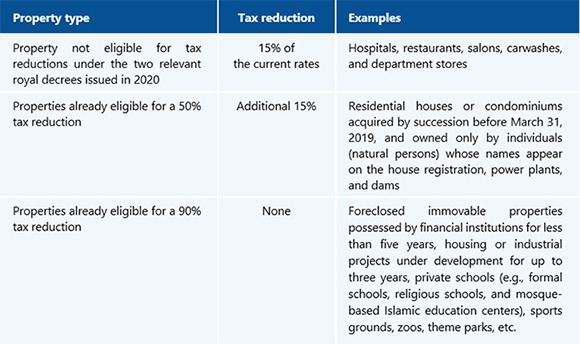
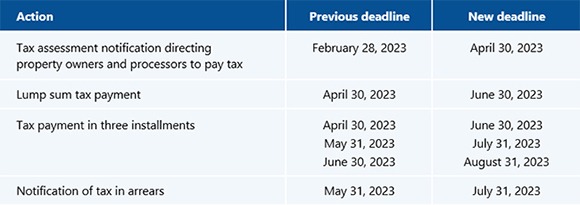
Moreover, in early December, Thailand’s Ministry of Interior promulgated an announcement extending the deadline for tax assessment notification and tax payment (including by scheduled installments) by another two months from the previous statutory deadline of December 20, 2022. The key deadline extensions are shown in the table below.
The Land and Building Tax is a property tax collected annually, with rates varying based on the purpose of use—agricultural, commercial, industrial, or residential. Owners or possessors of land or buildings are liable for Land and Building Tax, which is computed based on the officially appraised value of the property.

For more information on Thailand’s Land and Building Tax, please contact Auaychai Sukawong at [email protected] or Chaiwat Keratisuthisathorn at [email protected].

RELATED INSIGHTS​ 

December 8, 2022
Experts on Vietnamese real estate law from Tilleke & Gibbins provided the chapter on Vietnam for Practical Law’s Commercial Real Estate Global Guide 2022, a high-level comparative overview of commercial real estate laws and regulations in 31 jurisdictions worldwide. The main topics include the following, among others: Real estate investment structures, including REITs Sale of real estate Liability Due diligence Warranties Real estate tax, including VAT and stamp duty/transfer tax; Climate change targets Restrictions on foreign ownership Real estate finance Commercial leases Planning law The chapter also highlights recent trends in the condominium, office, and retail sectors of the Vietnam real estate market. To read the Vietnam chapter, please visit the Practical Law website or click on the link below.
December 2, 2022
On November 11, 2022, Myanmar’s Ministry of Commerce (MOC) announced a pilot period for importing electric vehicles into Myanmar, which came into force with MOC Order No. 62/2022, issued under the Import and Export Law. A separate order (No. 61/2022) issued on the same day specifies rules for importation of motorcycles by companies that do not have a certificate to open a showroom, as well as rules for opening motorcycle showrooms. Electric Vehicle Importation According to the order, which takes effect January 1, 2023, “electric vehicles” includes only battery electric vehicles (BEVs) for both personal use and passenger use. In order to import electric vehicles into Myanmar without having a certificate to open a showroom, companies must: Be registered as a company, either wholly owned by nationals or a joint venture, at the Directorate of Investment and Company Administration (DICA); Be able to present the purchase and sales agreement for each brand of imported electric vehicles; Receive approval from the National Steering Committee for Development of Electric Vehicles and Associated Businesses, and import according to the quality and quantity of electric vehicles permitted by the committee; Arrange the necessary warranty, spare parts availability, and after-sales service for the imported electric vehicles; Deposit a bank guarantee of MMK 50 million at a bank recognized by the Central Bank of Myanmar; and Apply for a purchase permit at the MOC, for the purpose of registering the imported vehicles with the Road Transport Administration Department. BEV Tax Exemption Following MOC Order No. 62/2022, BEVs and their batteries are now exempted from commercial tax and special goods tax, which came into force with the Law Amending the Union Tax Law 2022 (State Administrative Council Law No. 48/2022) dated November 17, 2022. These tax exemptions will be effective from October 1, 2022, to March
October 28, 2022
The draft regulations referred to below were withdrawn from the legislative process on November 8, 2022.   On October 25, 2022, the Thai cabinet approved in principle a draft version of new ministerial regulations that permit certain types of foreign nationals to acquire land for residential use. These draft ministerial regulations represent an additional scheme that complements the existing ministerial regulations from 2002 prescribing rules, methods, and conditions for foreign nationals’ acquisition of land for residential purposes. These draft ministerial regulations aim to attract to Thailand foreign nationals who invest at least THB 40 million. The targeted foreign nationals consist of four groups: Wealthy individuals; Retirees; Foreign nationals who wish to work from Thailand; and Highly skilled expatriates. These four groups are eligible to acquire up to 1 rai (1,600 square meters) of land for use as their own residence in Bangkok, Pattaya City, a municipal area (khet thetsaban), or a designated residential area under the law governing city planning. The area must be situated outside any designated military safety zone. The THB 40 million minimum investment mentioned above may be any type of investment permitted under the ministerial regulations. Some examples include Thai government bonds, real estate or infrastructure mutual funds, real estate investment trusts (REITs), and share capital of Board of Investment (BOI) promoted entities (or a business eligible for BOI promotion). The investment must have been made before submission of the application for land ownership, and it must be maintained for at least three years. If the qualifications are met, the application for land ownership and the related supporting documents (including a certificate of investment issued by the relevant authorities) must be submitted to the director general of the Land Department for consideration and further submission to the Minister of Interior for approval. If approved, the applicant
August 26, 2022
Thailand’s Board of Investment (BOI) has extended its previously announced period for reduction of import duty on imported raw and essential materials for battery manufacturing for electric vehicles and other applications. The BOI’s announcement No. 5/2565 dated August 8, 2022, extended the reduction period to a maximum of five years. The BOI’s promoted activities list includes two battery-manufacturing business activities: Activity 4.8.3.1 – Battery manufacturing Activity 5.2.6.1 – High energy density battery manufacturing Qualifying battery manufacturers who have cell or module manufacturing processes are eligible for 90% import duty reductions on raw and essential materials that cannot be produced in Thailand. These reductions will be available on an annual basis, and are renewable for five years in total—up from the original two years. Existing projects (i.e., those which have the original two-year duration in their BOI certificate) can also benefit from the extension by preparing a project amendment form, along with a clarification letter and supporting documents, for submission to the BOI office. For more details on these customs duty reductions, or on any aspect of investment promotion in Thailand, please contact Charuwan Charoonchitsathian at [email protected] or +66 2056 5657, or Napassorn Lertussavavivat at [email protected] or +66 2056 5662.