You are using an outdated browser and your browsing experience will not be optimal. Please update to the latest version of Microsoft Edge, Google Chrome or Mozilla Firefox. Install Microsoft Edge

December 29, 2022

Thailand Unveils New Land and Building Tax Rate Reductions and Deadline Extensions

On December 20, 2022, Thailand’s cabinet approved draft legislation providing further Land and Building Tax reductions of 15% in 2023, on top of current reductions in tax rates, on some types of taxable property. When enacted, the legislation will provide further tax reductions only for the property types in the table below.
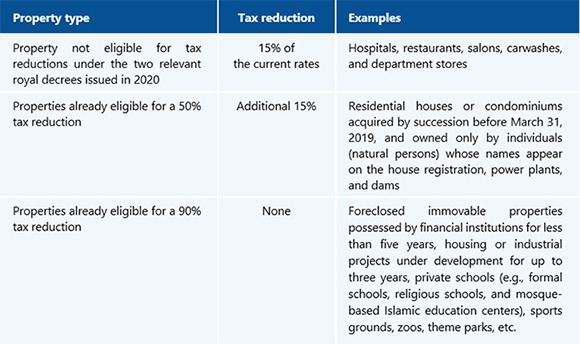
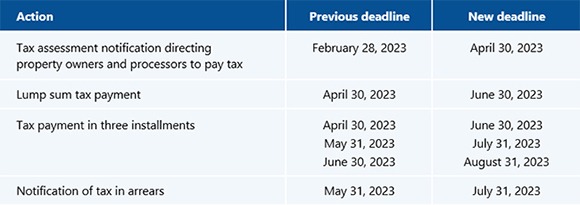
Moreover, in early December, Thailand’s Ministry of Interior promulgated an announcement extending the deadline for tax assessment notification and tax payment (including by scheduled installments) by another two months from the previous statutory deadline of December 20, 2022. The key deadline extensions are shown in the table below.
The Land and Building Tax is a property tax collected annually, with rates varying based on the purpose of use—agricultural, commercial, industrial, or residential. Owners or possessors of land or buildings are liable for Land and Building Tax, which is computed based on the officially appraised value of the property.

For more information on Thailand’s Land and Building Tax, please contact Auaychai Sukawong at [email protected] or Chaiwat Keratisuthisathorn at [email protected].

RELATED INSIGHTS​ 

May 17, 2023
In Myanmar, a Union Tax Law is enacted each year to announce the rates of tax set out in the Income Tax Law 1974, the Commercial Tax Law 1990, and the Special Goods Tax Law 2016. The Union Tax Law 2023 (UTL 2023) came into force on April 1, 2023. It sets the rates of special goods tax (SGT), income tax (IT), and commercial tax (CT) for the period of April 1, 2023, to March 31, 2024, and exempts certain goods and services from these taxes. The key changes implemented by the UTL 2023 are summarized below. Special Goods Tax The UTL 2023 exempts battery electric vehicles (BEVs) from SGT. At the same time, it increases the rate of SGT on imported liquor. Previously, the rate of SGT ranged from 190 MMK per liter to 60 percent of the per-liter price of imported liquor in the previous fiscal year. The UTL 2023 raises the minimum rate to 209 MMK per liter while leaving the upper rate unchanged. Commercial Tax and Customs Tariffs BEVs imported into Myanmar were made exempt from CT under the Law Amending the Union Tax Law 2022. The UTL 2023 extends the exemption until the end of the 2023–24 fiscal year, along with two- and three-wheeler BEVs, BEV batteries, and related parts for specific use in BEVs. The CT exemption for battery charging services for BEVs, also introduced in 2022, has similarly been extended. Following enactment of the UTL 2023, the Ministry of Planning and Finance (MOPF) issued Notification No. 31/2023, reducing to zero the customs tariffs on imported BEVs, including those imported completely built up (CBU), completely knocked down (CKD), or semi-knocked down (SKD). The tariffs on spare parts and materials for BEVs have also been reduced to zero. In addition to exempting BEVs from
April 11, 2023
On April 3, 2023, the government of Vietnam issued Decree No. 10/2023/ND-CP (“Decree 10”) to resolve a number of existing land-related problems pending the expected promulgation of a new Land Law later this year. The changes under Decree 10, which will take effect on May 20, 2023, include the following: New Regulations on Land Use Right Bidding Decree 10 outlines the conditions for organizations and individuals to participate in the bidding process for land use rights, as well as the conditions that must be met for the land site to be eligible for bidding. Specifically, in addition to the conditions already stated in Article 58.3 of the Land Law 2013 and Articles 14.2 and 14.3 of Decree No. 43/2014/ND-CP, organizations seeking to participate in the land use rights bidding process must ensure that no more than one company with cross-ownership participates in the bidding. Furthermore, they must also submit a 20% deposit of the total value of the land site, which is the starting price for the bidding. After the announcement of the auction results, the down-payment and any interest earned will be converted into a security deposit to ensure the bidder’s financial obligations are met. If the winning bidder fails to pay the full amount for the land use rights, the security deposit will be forfeited. In addition, a land site put up for bidding must satisfy certain conditions, such as having a starting price of bidding determined by the state authority and having an approved 1/500 detailed plan for the land used for investment and construction of residential buildings. The auction must be conducted on a plot-by-plot basis. Certifying Ownership of Real Estate for Tourism Accommodation Ownership of buildings on commercial and service land that are used for tourism accommodation purposes (such as condotels or other types
March 21, 2023
Thailand has issued a royal decree officially reducing the land and building tax due in 2023. The Royal Decree on Land and Building Tax Reduction (No. 3) B.E. 2566 (2023), which was announced and published in Thailand’s Government Gazette on March 19, 2023, and came into effect the following day, will effectively reduce land and building tax payments by 15% in 2023 for the following types of land and buildings: Land or buildings used for agricultural purposes; Land or buildings used for residential purposes; Land or buildings used for other purposes; and Vacant or unused land or buildings. Owners of these types of land or buildings are therefore only required to pay 85% of the land and building tax normally owed for 2023. Furthermore, owners of certain types of land or buildings that were eligible for tax reduction of 50% or 90% under the Royal Decree on Land and Building Tax Reduction B.E. 2563 (2020) will enjoy an additional 15% reduction of the tax amount that was reduced by 50% or a continuation of the 90% tax reduction, depending on the circumstances. For more details on these measures, or on any aspect relating to Thailand’s land and building tax, please contact Chaiwat Keratisuthisathorn at [email protected] or +66 2056 5507.
February 22, 2023
The Contract Committee of Thailand’s Consumer Protection Board has issued a new notification relating to home renovation business operations. The Notification of the Contract Committee Re: Services for Providing Renovations of Buildings for Residential Purpose as a Controlled Business in Relation to Details Regarding Payment Receipts B.E. 2566 (2023) (the “Notification”) was published in the Government Gazette on February 13, 2023, and will come into effect after 90 days (i.e., on May 14, 2023). Once the new Notification is effective, a contractor who provides residential building renovation services will be required to provide a receipt for the payment received from the customer which contains specific details, terms, and conditions as required under the Notification. Key Definitions Under the Notification, a “service for providing renovations of buildings for residential purposes” is defined as a business in which a business operator is engaged by a customer to make additions, modifications, alterations, repairs, or improvements to a building (including any house or any structure) which can be used for residential purposes, either in whole or in part. “Residential purposes” means for residing in the building (in whole, or in any part), whereby the building will not be sold, leased out, hire-purchased, or subject to other arrangements relating to the building with compensation or other benefits involved. Key Required Content The Notification requires that the payment receipt be provided by the business operator to the customer immediately upon receiving payment in whole or in part. The receipt must be clearly legible in Thai language, with a minimum font size, and include the following material terms and conditions: Details about the business operator, customer, and service, including contact information, milestones and payments, the daily penalty rate, and other related information. If the business operator is unable to complete the work within the agreed period,