You are using an outdated browser and your browsing experience will not be optimal. Please update to the latest version of Microsoft Edge, Google Chrome or Mozilla Firefox. Install Microsoft Edge

December 29, 2022

Thailand Unveils New Land and Building Tax Rate Reductions and Deadline Extensions

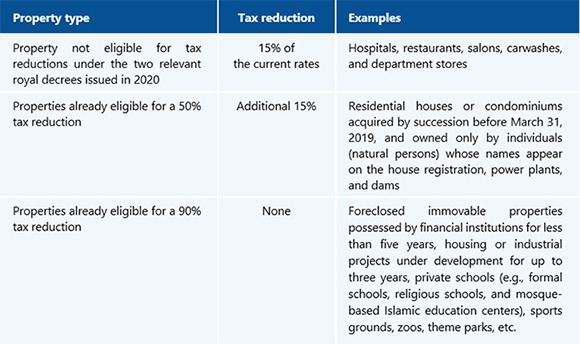
On December 20, 2022, Thailand’s cabinet approved draft legislation providing further Land and Building Tax reductions of 15% in 2023, on top of current reductions in tax rates, on some types of taxable property. When enacted, the legislation will provide further tax reductions only for the property types in the table below.
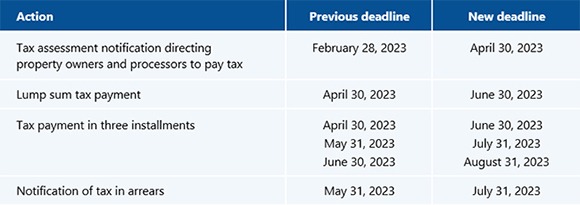
Moreover, in early December, Thailand’s Ministry of Interior promulgated an announcement extending the deadline for tax assessment notification and tax payment (including by scheduled installments) by another two months from the previous statutory deadline of December 20, 2022. The key deadline extensions are shown in the table below.
The Land and Building Tax is a property tax collected annually, with rates varying based on the purpose of use—agricultural, commercial, industrial, or residential. Owners or possessors of land or buildings are liable for Land and Building Tax, which is computed based on the officially appraised value of the property.

For more information on Thailand’s Land and Building Tax, please contact Auaychai Sukawong at [email protected] or Chaiwat Keratisuthisathorn at [email protected].

RELATED INSIGHTS​ 

October 16, 2023
Myanmar has issued amendments levying a new tax on nonresident Myanmar citizens’ salary income. The State Administration Council (SAC) instituted the tax by amending the Union Tax Law 2023 with Law No. 55/2023 on September 12, 2023, effective from October 1, 2023, to March 31, 2024. As defined by Myanmar’s Income Tax Law, nonresident citizens are those who reside and earn income outside Myanmar at any time during the applicable financial year. The recent amendment to the Union Tax Law levies a tax on nonresident citizens’ salary income earned abroad, as detailed below, in addition to the 10% tax on other types of income obtained abroad without deducting the tax reliefs under sections 6 and 6-A of the Income Tax Law. The tax is payable in the same currency as the income obtained. This tax on nonresidents’ salary income earned abroad can be calculated according to whichever of the two methods below yields the lowest amount of tax due: The applicable salary income tax (0% to 25%) under the Union Tax Law after deduction of allowances for the respective financial year; or A 2% tax on salary income without deducting the amount of the exemption provided by sections 6 and 6-A of the Income Tax Law. Taxpayers may also subtract the amount of foreign taxes paid from the total tax calculated under this law. Employees of an overseas company who work remotely from Myanmar and receive payment from overseas are unaffected by this amendment as they are only involved as resident citizens. Payment Process Nonresident citizens must remit taxes to the Myanmar embassy in their country either monthly, quarterly, annually, or at the time of passport renewal. Evidence of tax payment must also be presented when renewing an overseas worker identification card at the Ministry of Labour, according to
October 12, 2023
Thailand has announced tax exemptions for issuers and holders of depositary receipts (DRs) of listed foreign securities to encourage DR transactions, create more investment products in the Thai capital markets, and promote and offer opportunities for retail investors to invest in foreign securities. The exemptions are laid out in the Royal Decree under the Revenue Code B.E. 2481 (No. 775) B.E. 2566 (Royal Decree No. 775), which came into force on August 16, 2023. DRs are certificates representing underlying foreign securities listed on a foreign exchange, but DRs are listed and traded on the Stock Exchange of Thailand (SET). Holders of a DR can receive the same benefits payable from the underlying listed foreign securities as direct holders of the listed foreign securities. According to the relevant notifications from Thailand’s Securities and Exchange Commission (SEC), DRs include the following: Certificates that confer the right to receive financial benefits equivalent or in reference to the received financial benefit from certain underlying listed foreign securities held by the certificate’s issuer; Unitized instruments having the same terms and conditions for each unit and issued by a custodian for the purpose of representing the holder’s right to claim for the deposited underlying listed foreign securities subject to the deposit agreement, or other rights as described by the custodian in the instrument. Issuance of a DR is subject to similar approval and disclosure requirements as those the SEC sets for general securities issued in Thailand. The recently announced tax exemptions for DR issuers and holders—which also apply to fractional DRs (also called DRx)—are detailed below. Corporate Income Tax Exemption Under Royal Decree No. 775, companies or registered partnerships that issue a DR in accordance with the Securities and Exchange Act B.E. 2535 (1992) (SEA) are exempt from paying corporate income tax (CIT) for income
October 10, 2023
The Royal Decree issued under the Revenue Code B.E. 2481 (1938) on the Exemption from Taxes (No. 779) B.E. 2566 (Royal Decree No. 779), which came into force on August 16, 2023, provides exemptions from corporate income tax (CIT) and value-added tax (VAT) for qualifying transfers of digital tokens for investment. Transfers of these digital investment tokens—as opposed to securities transfers—have been subject to taxes. By establishing CIT and VAT exemptions, Royal Decree No. 779 introduces incentives in order to promote digital investment tokens as a new alternative tool for fundraising. The authorities hope that this will stimulate investment in the country’s economic system and elevate the standards for digital assets in Thailand. The key points of Royal Decree No. 779 are summarized below. Digital Investment Token Definition Royal Decree No. 779 and relevant digital asset regulations define “digital investment tokens” as a type of digital tokens that grant the holder the right to invest in a project or business, with the holders of the digital investment tokens receiving a share of revenue or profits as a return on their investment. In this way, digital investment tokens resemble securities. Tax Exemptions Primary Market Royal Decree No. 779 exempts companies and registered partnerships that legally issue and offer digital investment tokens for sale to the public (i.e., the primary market) from CIT and VAT on income or the value of the tax base earned from the sale. These exemptions apply to all primary market issuance from May 14, 2023, onward. However, the relevant notifications of Thailand’s Securities and Exchange Commission only allow limited companies (private and public) incorporated under Thai law to offer digital tokens for sale. Therefore, registered partnerships will not yet be able to benefit from the tax exemptions in Royal Decree No. 779. If a digital token
October 6, 2023
On August 25, 2023, Thailand’s Ministry of Interior issued the Ministerial Regulation Prescribing the Types of Hotels and the Criteria for Hotel Business Operation No. 2 B.E. 2566 (2023), which amends the threshold for hotel license exemption and hotel business operation requirements specified in the similarly named ministerial regulation from 2008. The ministerial regulation, issued by virtue of the Hotel Act B.E. 2547 (2004), adjusts the hotel type classifications and introduces new compliance requirements for other types of structures that can be used as hotels (e.g., rafts, tents, or containers). The 2023 ministerial regulation was announced and published in the Government Gazette on August 30, 2023, and will come into effect after 60 days (i.e., on October 29, 2023), amending certain provisions in the original 2008 ministerial regulation. Key changes and new requirements under the 2023 ministerial regulation are detailed below. Hotel License Exemption Threshold The 2023 ministerial regulation raises the threshold for exemption from the requirement to obtain a hotel license. Under the new rules, accommodations with up to 8 rooms accommodating no more than 30 guests (previously no more than 4 rooms and 20 guests) are not regarded as hotels under the Hotel Act, and thus, a hotel license is not required. Hotel Types The 2023 ministerial regulation also changes the definition of the types of hotel accommodations that require a hotel license under the Hotel Act. The new classifications are: Type 1: Hotels with up to 50 guest rooms only. Type 2: Hotels with more than 50 guest rooms only, or hotels with (1) guest rooms and (2) a dining room, restaurant, or kitchen. Type 3: Hotels with (1) guest rooms, (2) a dining room, restaurant, or kitchen, and (3) an entertainment venue under the law governing entertainment venues, or a conference room. Type 4: Hotels