
You are using an outdated browser and your browsing experience will not be optimal. Please update to the latest version of Microsoft Edge, Google Chrome or Mozilla Firefox. Install Microsoft Edge

November 4, 2021

Thailand Streamlines Renewal of Licenses for Hazardous Substances and Cosmetics

A new royal decree in Thailand (Royal Decree Re: Licensee to Pay the License Renewal Fee in Lieu of a Grace Period When Submitting a License Renewal Application B.E. 2564) does away with the current red tape associated with renewing certain marketing authorization and business licenses. Under the new royal decree, there is no longer any need to submit renewal applications for eligible licenses or to wait for approval from the relevant authority. Instead, the licenses will be automatically renewed upon payment of renewal fees. There are 31 eligible licenses listed in the royal decree, with a focus on licenses for hazardous substances and cosmetics.

The royal decree on license renewal was published in the Government Gazette in May 2021 and will come into force on November 22, 2021. Although the new royal decree has not yet come into force, Thailand’s Food and Drug Administration (FDA) has already begun renewing licenses for hazardous substance licenses and cosmetics notification receipts via the new procedure. These licenses and notification receipts are detailed below:
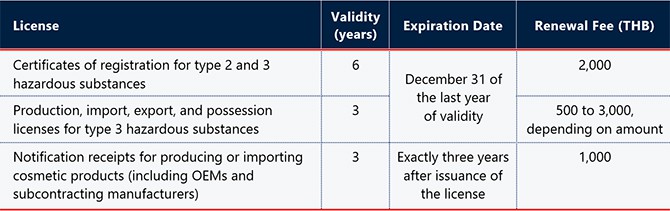
(Note: Hazardous substances for household use and public health are classified into four types according to their risk. Products containing type 2 and 3 substances are a higher risk than type 1 and must be registered with the FDA. Type 4 substances are prohibited.)

Procedural Guidance

The licenses for hazardous substances in the table above should be renewed in the two months preceding their expiry date, while the notification receipts for cosmetics should be renewed in the six months before their expiry date. Renewed licenses are valid for another six or three years (i.e., matching the original validity period).

Under the new royal decree on license renewal, eligible licenses for hazardous substances and cosmetics can be renewed by notifying the FDA via its e-submission system. The license holder will then receive a payment order for the renewal fees, which can be paid through various channels (e.g., payment service points, banks, offices of the relevant authorities, and electronic banking). Upon payment, the license will be renewed automatically and the license holder can download a new license for the cosmetic product or a license attachment for the hazardous substance. It can be used instead of or attached to the old license, and there is no need to change the FDA number.

Other Considerations

The new renewal procedure under this royal decree will greatly reduce the time and effort businesses spend seeking license renewal. Nonetheless, this simpler renewal procedure could also be cause for concern due to the lack of verification or approval in the process. The relevant authority may find it difficult to verify and ensure that businesses are operating properly under relevant laws, which could lead to safety issues for consumers and the general public.

For instance, this streamlining of the license renewal process bears some similarity to circumstances surrounding the recent hazardous substance factory explosion in Samut Prakan Province. In the days after the explosion, the latest amendment of the Factory Act B.E. 2562 (2019) was criticized by the public because it removed license renewal requirements, instead stipulating that factory operation permits no longer had an expiry date—a change from the previous requirement to renew the permit every five years. This change meant that factories no longer had to be verified every five years when it was time to renew the permit. Without verification and monitoring from the relevant authority, it is difficult to confirm factory safety and compliance with the relevant laws and regulations.

Similarly, this latest royal decree on license renewal outlines an easy renewal procedure (automatic approval) without verification or approval from the relevant authority. This lack of regulatory verification and approval could lead to heightened safety concerns for employees, consumers, and the general public. It seems that it is now up to businesses themselves to verify their own regulatory compliance and to be aware of any changes that require a license amendment before renewal. It is the responsibility of the business to ensure that its products are safe and in full compliance with laws and regulations. Therefore, this license renewal procedure under the new royal decree eases bureaucratic burdens on businesses but also serves as a reminder of their essential role in protecting consumers and the public interest.


RELATED INSIGHTS​ 

July 24, 2026
For businesses in Thailand’s regulated industries, the problem of “too many licenses” is one of the most familiar hurdles to getting a product to market. Take a simple example: importing the materials necessary to sell teriyaki chicken skewers. To legally do this, a business may need approvals from several different agencies—separate permits for the chicken (Department of Livestock Development), the dipping sauce (Thai FDA), the wooden skewers (Department of Forestry), and other ingredients, each under a different authority. This kind of overlap is often cited to argue for a “regulatory guillotine”—a systematic review to cut outdated or duplicative rules that slow investment and business activity. The Facilitation of Licensing and Public Service Consideration Act B.E. 2569 (2026) (Licensing Facilitation Act 2026) is Thailand’s most significant response yet to that concern. This article looks at the Facilitation Act 2026 through a life sciences and regulatory affairs lens—what it may mean for the manufacturers, importers, and distributors of food, drugs, medical devices, cosmetics, and similar products who routinely deal with several regulators to bring a single product to market. The Super License: One Approval Standing in for Many The reform with the clearest potential for regulated-product businesses is the law’s “super license” mechanism, referred to as a “main license” in the statute. Once a business obtains the main license for a regulated activity, it is automatically deemed to hold all related sublicenses issued by other agencies for that same activity, provided the activity has been designated as eligible in the Government Gazette. The Licensing Facilitation Act 2026 also creates a central application center, allowing applicants to submit a single application and pay all relevant fees at one point of contact, with the center routing the application to each agency through a shared information system. The potential benefits of this for businesses
July 13, 2026
Indonesia’s Halal Product Assurance Agency (BPJPH) has issued new regulations establishing clearer procedures for imposing administrative sanctions on businesses that violate halal product assurance requirements. BPJPH Regulation No. 2 of 2026 on the Imposition of Administrative Sanctions for Violations of Halal Product Assurance Implementation, issued on June 5, 2026, strengthens Indonesia’s halal compliance framework, as mandated under Law No. 33 of 2014 on Halal Product Assurance and Government Regulation No. 42 of 2024 on the Implementation of Halal Product Assurance. BPJPH Regulation No. 2/2026 also supports the upcoming mandatory halal compliance deadline of October 17, 2026, which will apply to a broad range of products and services, including imported food and beverages, slaughtering products and services, natural and quasi-drugs, health supplements, cosmetics, chemical and genetically engineered products, clothing and accessories, household goods, prayer equipment, stationery, and class A medical devices. Scope BPJPH is authorized to impose administrative sanctions for violations of halal product assurance requirements committed by businesses, halal inspection agencies (LPH), halal auditors, halal product process companion institutions (lembaga pendamping PPH), and halal product process companions (pendamping PPH). The head of BPJPH has authority to determine, cancel, or amend the imposition of administrative sanctions, including upon receipt of objections. This authority covers revocation of Halal Certificates (including foreign halal certificate registration numbers), withdrawal of goods from circulation, freezing of LPH operations, freezing of halal product process companion institutions, revocation of PPH companion institution registration numbers, revocation of halal auditor registration numbers, and revocation of LPH accreditation status. Administrative Sanctions Businesses may be subject to any of the following administrative sanctions: Written warning; Administrative fine; Revocation of the halal certificate, including revocation of foreign halal certificate registration numbers; and Withdrawal of goods from circulation. The regulation sets out the types of violations that may trigger these sanctions, with each
July 1, 2026
Obtaining marketing authorization is a fundamental requirement for bringing pharmaceutical products to the Thai market. Companies must navigate the Thai Food and Drug Administration’s registration procedures while also complying with post-approval pharmacovigilance obligations, licensing requirements for manufacturing and importation, data protection rules, and other regulatory requirements. This guide provides an overview of Thailand’s regulatory framework for pharmaceutical marketing authorization, including available registration pathways, review timelines, application fees, postmarketing surveillance obligations, licensing requirements, exemptions, data exclusivity, freedom of information, and parallel import considerations. It is intended as a practical reference for pharmaceutical companies, regulatory affairs professionals, and others involved in bringing medicinal products to the Thai market. Download the guide below for a concise overview of the current requirements and procedures governing pharmaceutical marketing authorization in Thailand.
June 24, 2026
Patent enablement requirements are provided under Article 102 of Vietnam’s Law on Intellectual Property (IP Law). In particular, a patent specification must “fully and clearly disclose the nature of the invention to such an extent that, based on the specification, a person having ordinary skill in the relevant art can implement the invention.” In pharmaceutical and biotechnology patents, this requirement is more complicated and subject to more rigorous assessment. The Patent Examination Guidelines (Guidelines) of the Intellectual Property Office of Vietnam (IP Office) were amended in March 2026 to introduce Annexes III and IV for the pharmaceutical and biotechnology sectors, in which Annex III provides detailed guidelines on the assessment of specification requirements. These amendments were made under a project for strengthening capacity in industrial property examination between the Japan International Cooperation Agency (JICA) and the IP Office. Annex III provides detailed instructions on how examiners assess enablement in a pharmaceutical or biotechnology application, and offers examples of acceptable and unacceptable descriptions with regard to the enablement aspect. Enablement Requirements in Pharma and Biotech Patents Article 12.7 of Circular 10/2026/TT-BKHCN (Circular 10) adds to the requirements of Article 102 of the IP Law that the description must demonstrate the novelty, inventive step, and industrial applicability of the technical solution. For pharmaceutical composition subject matters, Article 12.9 of Circular 10 sets out that the description must present the results of clinical trials and/or the pharmacological effects of the claimed pharmaceutical composition, and must include at least the following information: Substance/mixture used. Testing method (system) employed. Information on the test results. Correlation between the pharmacological effects obtained from the tests and the application of the pharmaceutical product in the prevention, diagnosis, and treatment of diseases. The Guidelines note that pharmacological study results should be presented in a quantified manner, and pharmacological