
You are using an outdated browser and your browsing experience will not be optimal. Please update to the latest version of Microsoft Edge, Google Chrome or Mozilla Firefox. Install Microsoft Edge

June 5, 2020

Thailand Sets New Security Standards for Electronic Meetings

On May 26, 2020, Thailand’s Ministry of Digital Economy and Society issued a new Notification Re: Security Standards of Meetings via Electronic Means, which came into effect the following day. The notification details the mandatory security standards and procedures that meeting organizers must comply with when convening electronic meetings under the recent Royal Decree on Teleconferences through Electronic Means B.E. 2563 (2020) (which has been in effect since April 19, 2020). The key elements of the notification are explained in further detail below.

General Security Standard for Electronic Meetings

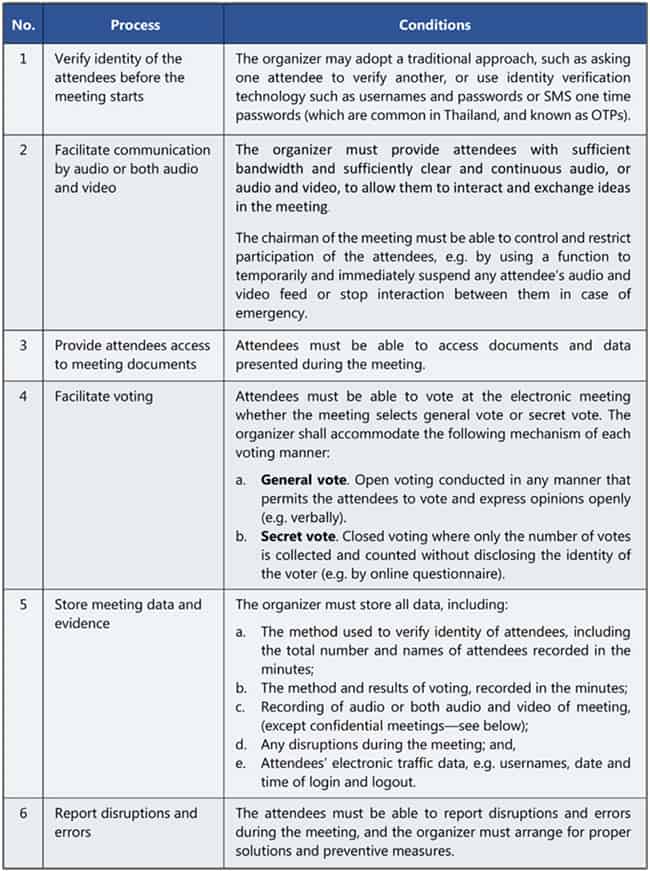
The meeting organizer must inform all attendees that the meeting is an electronic meeting held under the royal decree. They must be able to carry out the following processes:
Special Security Standards for Confidential Electronic Meetings

If an electronic meeting is held for confidential matters, the following additional requirements apply:

  • The meeting organizer must set up security measures to prevent unauthorized access to the meeting, data, and documents;
  • Each individual attendee must affirm to the meeting that no unauthorized person has access to meeting and the attendee is attending the meeting from an access-controlled place; and,
  • Recording audio or video during the confidential electronic meeting is prohibited.

IT Security Standards

The notification sets five principles of IT security standards for electronic meetings:

  1. Confidentiality—IT mechanisms to prevent unauthorized access.
  2. Integrity—IT mechanisms to prevent modifications, loss, and damage.
  3. Availability—IT mechanisms to ensure functionality and access.
  4. Privacy and protection of personal data.
  5. Other IT measures, such as authenticity, accountability, non-repudiation, and reliability.

The Electronic Transactions Development Agency (ETDA) is empowered to set forth additional IT security standards for meeting control systems. In addition, the ETDA, or another agency designated by the ETDA, may provide services for verification and certification of qualifying meeting control systems, which should be announced soon.

Any electronic meetings which were already arranged prior to the notification coming into effect (on May 27, 2020), but which have not yet been held, can be held in accordance with the previous security standards for electronic meetings issued in 2014, provided they are held within 60 days of May 27.


RELATED INSIGHTS​ 

June 15, 2026
The surge in AI development has led to a desperate demand for large, high-quality training data. However, real-world data can be expensive to collect, difficult to access, and often subject to strict privacy and regulatory constraints. Synthetic data, which consists of artificially generated records that replicate the statistical properties of real-world data without reproducing specific individuals’ information, provides an appealing solution by generating artificial datasets at scale without relying on identifiable personal information. It combines speed, cost efficiency, and regulatory compliance, making it a sensible alternative for organizations seeking to reduce risks while maintaining data utility. When properly anonymized, synthetic datasets may fall outside the scope of laws such as the EU’s General Data Protection Regulation (GDPR) or Thailand’s Personal Data Protection Act (PDPA), reducing compliance burdens while still supporting high-quality model training. However, relying on synthetic data without rigorous legal due diligence could be a strategic mistake. It replaces one set of known risks (scraping, direct privacy liability) with a new set of complex liabilities. The narrative that synthetic data is a “silver bullet” for privacy and IP compliance is dangerous and could be misleading. While synthetic data addresses data scarcity, it also introduces new legal uncertainties. Legal counsel should anticipate downstream risks arising from compromised data sources. Models trained on unlawfully obtained data may need to be decommissioned, even if their outputs appear lawful. What is synthetic data? Synthetic data refers to artificially generated information created using AI techniques such as deep learning and generative models. Instead of copying real records, it reproduces the statistical patterns and relationships found in the original dataset. Synthetic data generally falls into three categories: Fully synthetic data – Entirely new data points generated from learned patterns. The model studies the structure of the original data and produces records that resemble real-world
June 11, 2026
Thailand’s Electronic Transactions Development Agency (ETDA) has released a revised draft Electronic Transactions Act (ETA) for public hearing from May 12, 2026, to June 15, 2026. This is not merely an amendment to certain provisions of the current ETA, but a comprehensive redrafting of the entire act. The revised draft ETA introduces several significant changes from the current framework, with practical implications for businesses operating in Thailand. Unified Coverage of Public and Private Sectors The current law segregates government transactions into a separate chapter with distinct rules. The draft ETA eliminates this division, defining “transaction” to encompass civil and commercial juristic acts as well as administrative procedures, administrative contracts, and other acts of government agencies. Enhanced E-Signature Definition The definition of “electronic signature” is broadened to expressly include biometric data and refocused on identifying the signatory and demonstrating intent regarding the content of the electronic data. Shift in Burden of Proof When a party challenges the reliability of electronic data created using a “trusted electronic method” or a method prescribed by the ETDA, the burden of proof and the cost of proving unreliability shifts to the challenger. Introduction of New Digital Method Concepts The draft ETA introduces several new digital method concepts that are not currently recognized under the existing ETA framework. These include: Electronic timestamping (e-timestamp) Electronic registered delivery Electronic company seals Electronic stamp duty compliance Electronic identity authentication and verification Electronic transferable records (electronic bills of lading, promissory notes, and similar negotiable instruments) Recognition of Automated Systems and Electronic Contracting The draft ETA expressly recognizes the legal validity and enforceability of contracts formed through automated systems, including contracts concluded entirely between automated systems or between an automated system and a person. A party may not deny the binding effect of such contracts solely because no human review
June 5, 2026
Vietnam’s AI regulatory framework has reached an important milestone. While the Law on Artificial Intelligence No. 134/2025/QH15 (AI Law) established the foundation for AI governance, many practical compliance requirements were left to implementing regulations. On April 30, 2026, the government issued Decree No. 142/2026/ND-CP (Decree 142), which took effect on May 1, 2026, and provides the first detailed guidance on the implementation of the AI Law. Although an official list of high-risk AI systems is still pending from the prime minister, Decree 142 provides valuable insight into how Vietnam’s risk-based AI regulatory framework will operate in practice. Risk Classification Framework The AI Law adopts a risk-based approach under which AI systems are classified as high-risk, medium-risk, or low-risk. Decree 142 builds on this framework by providing detailed guidance on how these classifications are determined. High-risk AI systems are determined based on factors such as (i) their potential impact on life, health, property, human rights, public interests, or national security; (ii) the sector in which they are deployed; and (iii) the scale of affected users or integration with critical infrastructure. The latest draft list of high-risk AI systems appears to follow these same principles. Medium-risk AI systems generally include systems that may mislead, influence, or manipulate users, particularly where users may not realize they are interacting with AI or AI-generated content. The focus is therefore on transparency and authenticity risks rather than broader societal or safety concerns. Low-risk AI systems are those that do not meet the criteria for either high-risk or medium-risk classification. Importantly, Decree 142 seeks to avoid over-classification. Certain systems may fall outside the high-risk or medium-risk regimes, including internal-use systems, office-support tools, technical editing applications, certain back-end processing systems, and AI systems used in artistic, gaming, cinematic, or other creative contexts. Providers must also review and
June 5, 2026
On May 11, 2026, Thailand’s Ministry of Social Development and Human Security released a draft Child Protection Act (“CPA”) for public review. The draft CPA would completely repeal and replace the current Child Protection Act B.E. 2546 (2003). This represents the most comprehensive overhaul of Thailand’s child protection framework in over two decades, reflecting the government’s stated objective of modernizing the law to address evolving social challenges—including those arising from digital technology—and to promote greater coordination among government agencies, local authorities, and civil society. The public review period closes on June 9, 2026. Key changes introduced by the draft CPA that could have significant implications for businesses, particularly online platform providers, media companies, and entities operating child-related services in Thailand, are set out below. Expanded Definition of “Child” Under the current CPA, a “child” is defined as a person under the age of 18, excluding those who have attained legal majority through marriage. The draft CPA removes the marriage exception entirely, broadening the scope of the law’s protections to include all individuals under 18 without exception. Replacement of “Abuse” with Broader Concept of “Violence” The current CPA uses the term “abuse/cruelty,” which covers acts causing harm to a child’s liberty, body, or mind; sexual offenses against children; and using children in harmful or immoral activities. The draft CPA replaces this with the broader concept of “violence,” which encompasses any act or omission causing harm to a child’s body, mind, or development; abandonment or neglect; improper exploitation; and sexual abuse. Notably, the new definition adds developmental harm as a recognized category of injury and captures all forms of misconduct regardless of the child’s consent. New Standalone Definition of Sexual Abuse, Including Online Conduct One of the most significant additions in the draft CPA is the introduction of a standalone definition