You are using an outdated browser and your browsing experience will not be optimal. Please update to the latest version of Microsoft Edge, Google Chrome or Mozilla Firefox. Install Microsoft Edge

February 27, 2024

Thailand Lays Out New Cybersecurity Standards

Thailand’s National Cyber Security Committee (NCSC) released three notifications under the Cybersecurity Act on January 18, 2024, setting cybersecurity-related requirements for key organizations and assets. While one of these notifications already took effect, the two most notable will take effect on January 18, 2025 (i.e., one year from their publication in the Government Gazette).

These two are the NCSC Notification Re: Standards for Defining the Security Category for Data or Information Systems B.E. 2566 (2023) (“Notification on Security Category”) and the NCSC Notification Re: Minimum Standards for Data and Information Systems B.E. 2566 (2023) (“Notification on Minimum Standards”).

These notifications apply to:

  • State agencies;
  • Supervising or regulating organizations (i.e., state organizations, private organizations, or persons designated by law to regulate or supervise the affairs of state organizations or critical information infrastructure organizations); and
  • Critical information infrastructure organizations (i.e., organizations related to or providing national security, significant public services, banking and finance, information technologies and telecommunications, transportation and logistics, energy and public utilities, and public health).

Collectively these are defined as “Organizations” under the notifications.

Notification on Security Category

The Notification on Security Category sets forth risk-based security classifications—or “security categories”—for Organizations’ data or information systems.

For security category assessment purposes, Organizations are required to perform a self-assessment of their data or information systems based on three key security objectives: confidentiality, integrity, and availability. Each of these objectives is further categorized into three risk levels (low, medium, and high), taking into account the assessment of potential impact in the following areas:

  • Organizations’ financial value or reputation;
  • Organizations’ number of service users;
  • Organizations’ ability to perform their duties;
  • State stability or public order.

The risk levels for the three objectives are determined by considering whether there are “minimal,” “severe,” or “serious severe” effects, as described below:

  • Confidentiality (not including data classified as “secret,” which follows different criteria): The effects of unauthorized disclosure of data on Organizations’ reputation and financial value;
  • Integrity: The effects of unauthorized alteration or destruction of data on Organizations’ performance; and
  • Availability: The effects of inability to access or use the data or information system on Organizations’ performance.

If their systems handle different types of data, Organizations must assess each type and set the security category based on the highest risk level identified.

The security category should be reviewed at least once every three years, with the results properly recorded.

Notification on Minimum Standards

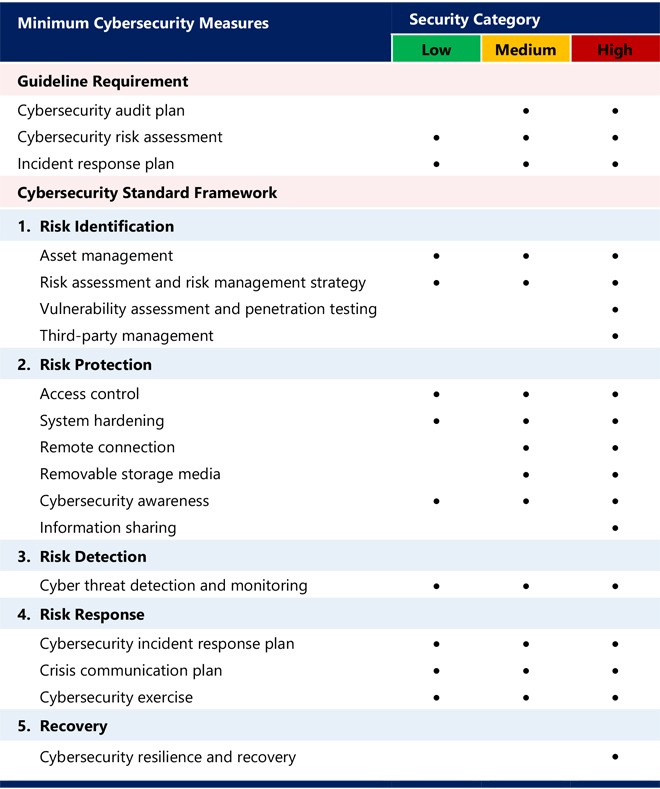
Once the security category is determined, Organizations are responsible for applying the minimum cybersecurity measures stipulated in the Notification on Minimum Standards. These measures are outlined in the table below, which indicates the items that are required for minimum cybersecurity measures under each security category.
For more information on compliance with these notifications under the Cybersecurity Act, or on any aspect of cybersecurity in Thailand, please contact Athistha (Nop) Chitranukroh at [email protected], Nopparat Lalitkomon at [email protected], Napassorn Lertussavavivat at [email protected], or Rada Lamsam at [email protected].

RELATED INSIGHTS​ 

June 11, 2026
Thailand’s Electronic Transactions Development Agency (ETDA) has released a revised draft Electronic Transactions Act (ETA) for public hearing from May 12, 2026, to June 15, 2026. This is not merely an amendment to certain provisions of the current ETA, but a comprehensive redrafting of the entire act. The revised draft ETA introduces several significant changes from the current framework, with practical implications for businesses operating in Thailand. Unified Coverage of Public and Private Sectors The current law segregates government transactions into a separate chapter with distinct rules. The draft ETA eliminates this division, defining “transaction” to encompass civil and commercial juristic acts as well as administrative procedures, administrative contracts, and other acts of government agencies. Enhanced E-Signature Definition The definition of “electronic signature” is broadened to expressly include biometric data and refocused on identifying the signatory and demonstrating intent regarding the content of the electronic data. Shift in Burden of Proof When a party challenges the reliability of electronic data created using a “trusted electronic method” or a method prescribed by the ETDA, the burden of proof and the cost of proving unreliability shifts to the challenger. Introduction of New Digital Method Concepts The draft ETA introduces several new digital method concepts that are not currently recognized under the existing ETA framework. These include: Electronic timestamping (e-timestamp) Electronic registered delivery Electronic company seals Electronic stamp duty compliance Electronic identity authentication and verification Electronic transferable records (electronic bills of lading, promissory notes, and similar negotiable instruments) Recognition of Automated Systems and Electronic Contracting The draft ETA expressly recognizes the legal validity and enforceability of contracts formed through automated systems, including contracts concluded entirely between automated systems or between an automated system and a person. A party may not deny the binding effect of such contracts solely because no human review
June 5, 2026
Vietnam’s AI regulatory framework has reached an important milestone. While the Law on Artificial Intelligence No. 134/2025/QH15 (AI Law) established the foundation for AI governance, many practical compliance requirements were left to implementing regulations. On April 30, 2026, the government issued Decree No. 142/2026/ND-CP (Decree 142), which took effect on May 1, 2026, and provides the first detailed guidance on the implementation of the AI Law. Although an official list of high-risk AI systems is still pending from the prime minister, Decree 142 provides valuable insight into how Vietnam’s risk-based AI regulatory framework will operate in practice. Risk Classification Framework The AI Law adopts a risk-based approach under which AI systems are classified as high-risk, medium-risk, or low-risk. Decree 142 builds on this framework by providing detailed guidance on how these classifications are determined. High-risk AI systems are determined based on factors such as (i) their potential impact on life, health, property, human rights, public interests, or national security; (ii) the sector in which they are deployed; and (iii) the scale of affected users or integration with critical infrastructure. The latest draft list of high-risk AI systems appears to follow these same principles. Medium-risk AI systems generally include systems that may mislead, influence, or manipulate users, particularly where users may not realize they are interacting with AI or AI-generated content. The focus is therefore on transparency and authenticity risks rather than broader societal or safety concerns. Low-risk AI systems are those that do not meet the criteria for either high-risk or medium-risk classification. Importantly, Decree 142 seeks to avoid over-classification. Certain systems may fall outside the high-risk or medium-risk regimes, including internal-use systems, office-support tools, technical editing applications, certain back-end processing systems, and AI systems used in artistic, gaming, cinematic, or other creative contexts. Providers must also review and
June 5, 2026
On May 11, 2026, Thailand’s Ministry of Social Development and Human Security released a draft Child Protection Act (“CPA”) for public review. The draft CPA would completely repeal and replace the current Child Protection Act B.E. 2546 (2003). This represents the most comprehensive overhaul of Thailand’s child protection framework in over two decades, reflecting the government’s stated objective of modernizing the law to address evolving social challenges—including those arising from digital technology—and to promote greater coordination among government agencies, local authorities, and civil society. The public review period closes on June 9, 2026. Key changes introduced by the draft CPA that could have significant implications for businesses, particularly online platform providers, media companies, and entities operating child-related services in Thailand, are set out below. Expanded Definition of “Child” Under the current CPA, a “child” is defined as a person under the age of 18, excluding those who have attained legal majority through marriage. The draft CPA removes the marriage exception entirely, broadening the scope of the law’s protections to include all individuals under 18 without exception. Replacement of “Abuse” with Broader Concept of “Violence” The current CPA uses the term “abuse/cruelty,” which covers acts causing harm to a child’s liberty, body, or mind; sexual offenses against children; and using children in harmful or immoral activities. The draft CPA replaces this with the broader concept of “violence,” which encompasses any act or omission causing harm to a child’s body, mind, or development; abandonment or neglect; improper exploitation; and sexual abuse. Notably, the new definition adds developmental harm as a recognized category of injury and captures all forms of misconduct regardless of the child’s consent. New Standalone Definition of Sexual Abuse, Including Online Conduct One of the most significant additions in the draft CPA is the introduction of a standalone definition
May 25, 2026
After several years of policy discussion and continued efforts led by the Ministry of Commerce (MOC) to relax the list of reserved businesses under the Foreign Business Act B.E. 2542 (1999) (FBA), the reform process has now reached a significant milestone. On May 12, 2026, the Thai cabinet approved in principle two draft subordinate legislative instruments aimed at delisting certain reserved business activities under the FBA and reducing licensing requirements for foreign business operators. These developments signal a renewed and concrete effort by the government to modernize Thailand’s business regulatory framework in order to attract foreign investment and boost Thailand’s competitiveness in the global market. Nine Businesses Set for FBA Delisting Below is a list of the nine businesses that are being targeted for delisting from the FBA’s restrictions. A draft ministerial regulation would delist the first eight reserved businesses, while a royal decree has been drafted to delist the ninth business: Telecommunications services (Type 1 license only, covering operators without their own telecommunications infrastructure), under the supervision of the Office of the National Broadcasting and Telecommunications Commission. Treasury center services subject to the Foreign Exchange Control Act B.E. 2485 and under the supervision of the Bank of Thailand. Securities-collateralized lending, pursuant to the laws governing securities and exchange and derivatives regulated by the Securities and Exchange Commission. Agency, dealer, advisory, or fund management services relating to derivatives where the underlying assets fall outside the scope of the Derivatives Act B.E. 2546 (2003) Intra-group shared services, including administrative, human resources, and IT functions Intra-group domestic debt guarantee services Leasing of partial space for installation of financial service machines and automatic vending machines for employee use Petroleum drilling services Trading of agricultural product derivatives through a futures exchange, with physical delivery or receipt of agricultural products at a futures exchange–designated