
You are using an outdated browser and your browsing experience will not be optimal. Please update to the latest version of Microsoft Edge, Google Chrome or Mozilla Firefox. Install Microsoft Edge

May 15, 2024

Thailand Issues Draft Cybersecurity Standards for Cloud Services

On May 1, 2024, Thailand’s National Cyber Security Committee (NCSC) published the draft NCSC Notification Re: Cloud Cybersecurity Standards for a public hearing period, which was open until May 14, 2024. These standards have been drafted to drive the country’s cloud-first policy with the aim of minimizing risks from cyber threats to cloud services utilized by government agencies, supervising or regulating organizations, and critical information infrastructure (CII) organizations.

The key points of the draft Cloud Cybersecurity Standards are below.

Scope

  • The standards apply to government agencies, supervising or regulating organizations, and CII organizations under the Cybersecurity Act B.E. 2562 (2019), as well as cloud service providers (defined below).
  • The standards prescribe cloud system cybersecurity measures for cloud service customers (defined below) and providers only to the extent that the service is provided to the in-scope organizations outlined above.

Definitions

  • Cloud service customers (CSCs): In-scope organizations that have a formal contractual agreement to use cloud services provided by a cloud service provider.
  • Cloud service providers (CSPs): Persons who enable cloud services to be used by a cloud service customer, responsible for maintaining infrastructure, platforms, and software that enable provision of the cloud services and for managing these resources to ensure their accessibility, security, and scalability for their cloud service customers.

Application

  • In-scope organizations that will use or have been using cloud services must comply with the Cloud Cybersecurity Standards by taking into account their data or technology information systems’ level of impact, as specified in the previously issued Notification of the NCSC Re: Standards for Defining the Security Category for Data and Information Systems B.E. 2566 (2023).
  • The impact level related to personal data is to be rated as being at least at the medium level, and the minimum standards for that level specified in the draft Cloud Cybersecurity Standards must be adopted.
  • In-scope organizations must report their implementation of the Cloud Cybersecurity Standards to the National Cyber Security Agency (NCSA) within 30 days of completing the implementation.
  • The draft Cloud Cybersecurity Standards will come into force one year from their publication in the Government Gazette.

Structure

The requirements in the Cloud Cybersecurity Standards are divided into two areas, (1) cloud security governance and (2) cloud infrastructure and operations:

Requirement Area 1: Cloud Security Governance

  • Information security policies
  • Organization of information security
  • External supplier relationships
  • Compliance

Requirement Area 2: Cloud Infrastructure Security and Operations  

  • Human resource security
  • Asset management
  • Access control
  • Cryptography
  • Physical and environmental security
  • Operational security
  • Communication security
  • System acquisition, development, and maintenance
  • External supplier relationships
  • Information security incident management

Impact Levels and Requirements

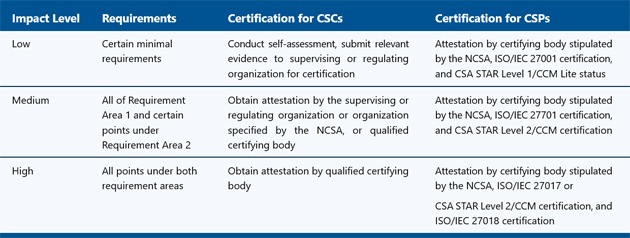
The stipulations of the Cloud Cybersecurity Standards vary depending on the data or information systems’ level of impact. The requirements for each level are summarized in the table below.
For more information on the draft Cloud Cybersecurity Standards, or on any aspect of cybersecurity and cloud-related laws in Thailand, please contact Athistha (Nop) Chitranukroh at [email protected] and Thammapas Chanpanich at [email protected].

RELATED INSIGHTS​ 

August 15, 2024
On August 9, 2024, Thailand’s Electronic Transactions Development Agency (ETDA) opened a period for public feedback regarding the 2022 Royal Decree on Digital Platforms and its subregulations. To collect this feedback, the ETDA has prepared a 44-question survey on specific attributes of the royal decree and its requirements, covering issues such as the definition of digital platform services (DPSs), types of services that are subject to notification requirements, information that must be submitted annually, and the royal decree’s extraterritorial scope. Business operators that fall within the scope of the royal decree and wish to provide feedback on its effectiveness should prepare and submit the survey online to the ETDA by the end of August 2024. Royal Decree on Digital Platforms Thailand’s Royal Decree on Digital Platforms was published in the Government Gazette on December 22, 2022. It defines a DPS as any service that facilitates or mediates transactions between users through a digital platform, such as e-commerce, food delivery, ride-hailing, online travel agency, online payment provider, or social media platform. The decree requires DPS operators to notify the ETDA before commencing operations, with some limited exemptions. The decree also empowers the ETDA to issue notifications (i.e., subregulations) and guidelines for implementing the decree and to monitor and enforce compliance by DPS operators. The ETDA may impose administrative sanctions, such as warnings, fines, service suspension, or revocation of notification, for any violation of the royal decree or the ETDA’s subregulations. In-scope DPS operators should take this opportunity to provide comments to the ETDA in order to voice their opinions on the practicality of the requirements and support the regulator in shaping the requirements of the royal decree and its subregulations. For more information on this initiative from the ETDA, or on any aspect related to the Royal Decree on Digital
August 5, 2024
On June 28, 2024, Thailand’s Board of Investment (BOI) updated its list of promoted activities to include data hosting, which is listed as “Activity 8.2.4 Data Hosting Services.” Qualifying data hosting services are eligible for a corporate income tax exemption (capped) for eight years, along with other tax and nontax incentives, such as import duty exemption on imported machinery to be used in the project, the right for foreigners to own land, and work permit and visa facilitation for expats, among others. To be eligible for these BOI incentives, projects must: Provide services for leasing host servers for data storage (data hosting); Have at least two data centers located in Thailand that meet or exceed the ISO/IEC 27001 data center standards; and Have an investment amount (excluding cost of land and working capital) of at least THB 5 billion. Apart from the above specific criteria, projects also need to comply with the general BOI criteria, such as a debt-to-equity ratio no higher than 3:1, submission of a feasibility study report, and use of new machinery, among others. For more details on BOI incentives for software and data center activities, or on any aspect of investment promotion in Thailand, please contact Athistha (Nop) Chitranukroh at [email protected], Nopparat Lalitkomon at [email protected], or Napassorn Lertussavavivat at [email protected].
July 19, 2024
Tilleke & Gibbins has contributed the Cambodia, Myanmar, Thailand, and Vietnam chapters to How the Use of Artificial Intelligence Is Regulated in Southeast Asia, a comparative resource published by Drew Network Asia (DNA). The guide provides an accessible introduction to artificial intelligence (AI) and examines how ASEAN member states are approaching governance, regulation, and responsible deployment of AI technologies. The publication begins by outlining core AI concepts and summarizing the ASEAN Guide on AI Governance and Ethics, which reflects the region’s collective approach to promoting innovation while addressing risks. It then presents a comparative overview of nine ASEAN jurisdictions, highlighting emerging national strategies, regulatory developments, and institutional frameworks. Each country chapter responds to a consistent set of ten practical questions. These cover whether a national AI strategy has been issued; the extent to which dedicated AI laws or sectoral regulations apply; the existence of relevant judicial decisions; available guidelines and government support schemes; regulators responsible for AI oversight; approaches to liability, copyright, and data protection; and key considerations for organizations deploying AI technologies. By consolidating developments across the region, the guide serves as a useful reference for businesses exploring AI-related opportunities or compliance obligations in Southeast Asia. As regulatory approaches continue to evolve, readers seeking jurisdiction-specific advice are encouraged to contact the practitioners listed in each chapter. The full guide is available for download using the button below or directly from the DNA website.
July 10, 2024
The need for privacy and security has grown in tandem with the rapid proliferation of internet-enabled technologies. This is a major concern for consumers and individuals, and governments are increasingly mindful of online threats to their national security and their citizens. All of this represents an imposing challenge for companies—especially now that technology has enabled them to operate with relative ease across jurisdictions throughout the world.
