
You are using an outdated browser and your browsing experience will not be optimal. Please update to the latest version of Microsoft Edge, Google Chrome or Mozilla Firefox. Install Microsoft Edge

May 15, 2024

Thailand Issues Draft Cybersecurity Standards for Cloud Services

On May 1, 2024, Thailand’s National Cyber Security Committee (NCSC) published the draft NCSC Notification Re: Cloud Cybersecurity Standards for a public hearing period, which was open until May 14, 2024. These standards have been drafted to drive the country’s cloud-first policy with the aim of minimizing risks from cyber threats to cloud services utilized by government agencies, supervising or regulating organizations, and critical information infrastructure (CII) organizations.

The key points of the draft Cloud Cybersecurity Standards are below.

Scope

  • The standards apply to government agencies, supervising or regulating organizations, and CII organizations under the Cybersecurity Act B.E. 2562 (2019), as well as cloud service providers (defined below).
  • The standards prescribe cloud system cybersecurity measures for cloud service customers (defined below) and providers only to the extent that the service is provided to the in-scope organizations outlined above.

Definitions

  • Cloud service customers (CSCs): In-scope organizations that have a formal contractual agreement to use cloud services provided by a cloud service provider.
  • Cloud service providers (CSPs): Persons who enable cloud services to be used by a cloud service customer, responsible for maintaining infrastructure, platforms, and software that enable provision of the cloud services and for managing these resources to ensure their accessibility, security, and scalability for their cloud service customers.

Application

  • In-scope organizations that will use or have been using cloud services must comply with the Cloud Cybersecurity Standards by taking into account their data or technology information systems’ level of impact, as specified in the previously issued Notification of the NCSC Re: Standards for Defining the Security Category for Data and Information Systems B.E. 2566 (2023).
  • The impact level related to personal data is to be rated as being at least at the medium level, and the minimum standards for that level specified in the draft Cloud Cybersecurity Standards must be adopted.
  • In-scope organizations must report their implementation of the Cloud Cybersecurity Standards to the National Cyber Security Agency (NCSA) within 30 days of completing the implementation.
  • The draft Cloud Cybersecurity Standards will come into force one year from their publication in the Government Gazette.

Structure

The requirements in the Cloud Cybersecurity Standards are divided into two areas, (1) cloud security governance and (2) cloud infrastructure and operations:

Requirement Area 1: Cloud Security Governance

  • Information security policies
  • Organization of information security
  • External supplier relationships
  • Compliance

Requirement Area 2: Cloud Infrastructure Security and Operations  

  • Human resource security
  • Asset management
  • Access control
  • Cryptography
  • Physical and environmental security
  • Operational security
  • Communication security
  • System acquisition, development, and maintenance
  • External supplier relationships
  • Information security incident management

Impact Levels and Requirements

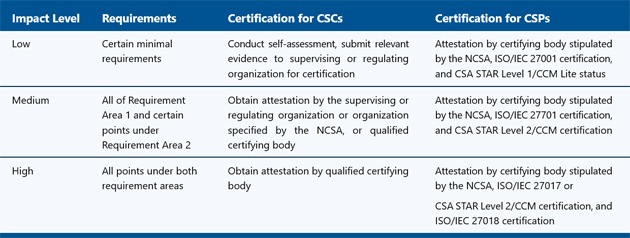
The stipulations of the Cloud Cybersecurity Standards vary depending on the data or information systems’ level of impact. The requirements for each level are summarized in the table below.
For more information on the draft Cloud Cybersecurity Standards, or on any aspect of cybersecurity and cloud-related laws in Thailand, please contact Athistha (Nop) Chitranukroh at [email protected] and Thammapas Chanpanich at [email protected].

RELATED INSIGHTS​ 

September 4, 2025
With advancements in health technology, telemedicine has taken on a wider online presence in Thailand. Under the Medical Facility Act, licensed clinics and hospitals may now diagnose, prescribe, and issue electronic prescriptions during a video call, provided they maintain patient confidentiality and proper recordkeeping. As a complementary concept, a telepharmacy allows a pharmacist to verify prescriptions, counsel patients, and dispense medication from a remote site. Hospitals, clinic chains, and some retail pharmacy groups have adopted “drive-thru” or “locker” pick-up points where drugs are bagged only after a real-time video consultation with a registered pharmacist. The clear benefits of telehealth include shorter waiting times and broader access to specialists, which is in the public interest. Drug Distribution and Advertising in Thailand The online pharmacy ecosystem creates a legal bridge in that once a teleconsulting doctor issues an e-prescription, a licensed pharmacy can lawfully dispense and deliver the medicine prescribed to the patient’s door. Nonetheless, the critical compliance component remains the advertising of medicinal drugs. It is still not allowed to advertise prescription/pharmacy-dispensed drugs to the public in Thailand. Although Thailand’s Drug Act of 1967 was written more than half a century ago, it still governs the trading of every medicinal drug that makes its way to consumers in Thailand—whether bought at a pharmacy or delivered with a few taps on a smartphone. First and foremost, the pharmacy must hold a license to sell medicinal drugs as a retailer. It is also mandatory that arrangements be made for a pharmacist to be on duty during opening hours. Drugs are classified into three main categories: prescription drugs, pharmacy-dispensed drugs, and over-the-counter (OTC) drugs. The listing of OTC drugs with their prices via an online platform is allowed, as only OTC drugs may be advertised directly to the public. However, naming or showing
September 2, 2025
Thailand’s National Space Policy Committee (NSPC) has proposed new regulations that would permit foreign satellite operators to provide services within the country. The draft announcement responds to rapid advancements in digital and space technologies that have led to new global satellite operators expanding their services worldwide, including into Thailand. These include low-Earth-orbit (LEO) satellite constellations offering high-speed internet, nonterrestrial network (NTN) technologies that integrate terrestrial and satellite communications, and direct-to-device (D2D) technologies that transmit signals directly from satellites to mobile devices without relying on terrestrial networks. The draft aims to replace the existing announcement, which was issued in 2021, to better align with current national policies on foreign satellite usage. The draft announcement was published for public consultation on August 20, 2025, with the comment period concluding on September 3, 2025. Applying for Authorization Two types of operators may apply for authorization: Thai operators who intend to use foreign satellites owned by World Trade Organization (WTO) member countries to provide satellite communication services to third parties; and Foreign operators of satellites owned by WTO member countries who intend to operate a business providing satellite communication services within Thailand. Applications for approval must be submitted to the National Broadcasting and Telecommunications Commission (NBTC) according to the NBTC’s established procedures. In considering whether to permit foreign satellites to provide services within Thailand, the relevant authority will take into account technical justifications, economic benefits, social benefits, and national security considerations. Determining Satellite Ownership The determination of which country qualifies as the owner of a satellite is based primarily on the country that holds the satellite network filing rights registered with the International Telecommunication Union (ITU). The satellite network filing includes details regarding frequency usage, orbital positions, and technical specifications of the satellite operations. It serves as a regulatory tool used by the
August 25, 2025
Artificial intelligence (AI), semiconductors, and digital assets are considered critical drivers of Vietnam’s future economic growth and are fundamental to the nation’s digital transformation targets. These sectors form the core of Vietnam’s strategy to build a robust, globally competitive digital economy. This strategic direction gained substantial momentum with the issuance of the Law on Digital Technology Industry (DTI Law) on June 14, 2025. The DTI Law was designed to attract investment, stimulate innovation, cultivate high-quality human resources, and ensure the responsible, secure, and sustainable growth of digital technologies like AI and digital assets, harmonizing Vietnam’s digital industry with international standards while safeguarding public interests and national security. Several key provisions of the DTI Law took effect on July 1, 2025, and the law will become fully effective on January 1, 2026. The government is delegated to provide further necessary guidelines and details for implementation of the law. Artificial Intelligence (AI): Principle-Driven and Risk-Based Regulations Under the DTI Law, there are seven core principles guiding the development, provision, and use of AI which are applicable to AI developers, providers and deployers. These principles favor values-based governance over purely technical prescriptions, and include the following: Taking a human-centered approach that upholds ethical values, inclusivity, flexibility, equality, and non-discrimination. Ensuring transparency, accountability, and explainability, with AI systems remaining under human control. Maintaining cybersecurity and system safety. Adherence to data protection and privacy regulations. Having the ability to control AI algorithms and models. Effective risk management throughout the entire lifecycle of AI systems. Compliance with consumer protection laws and other relevant legal frameworks. AI system management follows a risk-based approach, with the law categorizing systems into high-risk, high-impact, and other groups. High-risk AI systems are those that, in certain applications, may pose significant threats or harm to individuals or the public interest while
