
You are using an outdated browser and your browsing experience will not be optimal. Please update to the latest version of Microsoft Edge, Google Chrome or Mozilla Firefox. Install Microsoft Edge

May 15, 2024

Thailand Issues Draft Cybersecurity Standards for Cloud Services

On May 1, 2024, Thailand’s National Cyber Security Committee (NCSC) published the draft NCSC Notification Re: Cloud Cybersecurity Standards for a public hearing period, which was open until May 14, 2024. These standards have been drafted to drive the country’s cloud-first policy with the aim of minimizing risks from cyber threats to cloud services utilized by government agencies, supervising or regulating organizations, and critical information infrastructure (CII) organizations.

The key points of the draft Cloud Cybersecurity Standards are below.

Scope

  • The standards apply to government agencies, supervising or regulating organizations, and CII organizations under the Cybersecurity Act B.E. 2562 (2019), as well as cloud service providers (defined below).
  • The standards prescribe cloud system cybersecurity measures for cloud service customers (defined below) and providers only to the extent that the service is provided to the in-scope organizations outlined above.

Definitions

  • Cloud service customers (CSCs): In-scope organizations that have a formal contractual agreement to use cloud services provided by a cloud service provider.
  • Cloud service providers (CSPs): Persons who enable cloud services to be used by a cloud service customer, responsible for maintaining infrastructure, platforms, and software that enable provision of the cloud services and for managing these resources to ensure their accessibility, security, and scalability for their cloud service customers.

Application

  • In-scope organizations that will use or have been using cloud services must comply with the Cloud Cybersecurity Standards by taking into account their data or technology information systems’ level of impact, as specified in the previously issued Notification of the NCSC Re: Standards for Defining the Security Category for Data and Information Systems B.E. 2566 (2023).
  • The impact level related to personal data is to be rated as being at least at the medium level, and the minimum standards for that level specified in the draft Cloud Cybersecurity Standards must be adopted.
  • In-scope organizations must report their implementation of the Cloud Cybersecurity Standards to the National Cyber Security Agency (NCSA) within 30 days of completing the implementation.
  • The draft Cloud Cybersecurity Standards will come into force one year from their publication in the Government Gazette.

Structure

The requirements in the Cloud Cybersecurity Standards are divided into two areas, (1) cloud security governance and (2) cloud infrastructure and operations:

Requirement Area 1: Cloud Security Governance

  • Information security policies
  • Organization of information security
  • External supplier relationships
  • Compliance

Requirement Area 2: Cloud Infrastructure Security and Operations  

  • Human resource security
  • Asset management
  • Access control
  • Cryptography
  • Physical and environmental security
  • Operational security
  • Communication security
  • System acquisition, development, and maintenance
  • External supplier relationships
  • Information security incident management

Impact Levels and Requirements

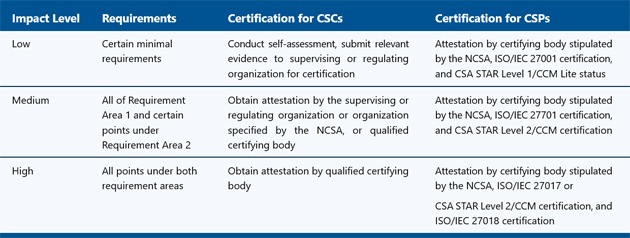
The stipulations of the Cloud Cybersecurity Standards vary depending on the data or information systems’ level of impact. The requirements for each level are summarized in the table below.
For more information on the draft Cloud Cybersecurity Standards, or on any aspect of cybersecurity and cloud-related laws in Thailand, please contact Athistha (Nop) Chitranukroh at [email protected] and Thammapas Chanpanich at [email protected].

RELATED INSIGHTS​ 

October 31, 2025
On September 29, 2025, Thailand’s Office of the Personal Data Protection Committee (PDPC Office) published its Regulations on the Review and Certification of Binding Corporate Rules B.E. 2568 (2025) (the Regulations). The Regulations provide clarity on the PDPC Office’s approach to reviewing and certifying binding corporate rules (BCRs) under Section 29 of the Personal Data Protection Act B.E. 2562 (2019) (PDPA), and aim to facilitate international data transfers within a group of undertakings or enterprises (a “corporate group”). In conjunction with this development, the PDPC Office also approved BCRs for two companies operating in Thailand on September 30, 2025. This milestone represents the first concrete progress since the PDPC’s Notification on Criteria for the Protection of Personal Data Sent or Transferred to a Foreign Country pursuant to Section 29 of the PDPA B.E. 2566 (2023) came into effect in March 2024. Some key features of the Regulations are set out below. Categorization of BCRs BCRs are classified into two types: (1) BCRs for Controllers (BCR-C) and (2) BCRs for Processors (BCR-P). The category must be clearly specified when submitting the BCRs to the PDPC Office. Documentation Requirement The applicant must prepare and submit the application (a standard template may be provided by the PDPC Office in the future) along with supporting documents for review and certification in the Thai language. If the supporting documents are in a foreign language, a certified Thai translation should be provided. The translation must be notarized by a notary public or qualified person. Supporting documents may include, among others, a binding instrument such as an intra-group agreement, or a list of entities subject to the BCRs. Expedited Process Requirement Organizations with existing BCR approvals under the EU or UK GDPR, or from countries announced by the PDPC under Section 28, may apply through an
October 26, 2025
AI-generated songs are now making waves in Vietnam on platforms like TikTok, with tracks such as “Say mot doi vi em” quickly gaining popularity and sparking widespread attention. This phenomenon raises a host of legal and ethical questions: Who is the author of these songs? Can they be protected by copyright? Who is responsible if there is an infringement? These questions are becoming increasingly urgent as AI music becomes more mainstream in Vietnam. Copyright Protection for AI-Generated Music in Vietnam Under current Vietnamese law, copyright protection is reserved for works that bear the mark of human creativity. The 2022 amendments to Vietnam’s Intellectual Property Law reaffirm that only works created by humans are eligible for copyright. In practice, if a human meaningfully contributes to the creative process—by providing prompts, making selections, editing, or arranging—their contribution may be protected. However, if a song is generated entirely by AI without significant human input, it is unlikely to qualify for copyright protection. When an AI-generated song does not qualify for copyright protection, the question arises as to whether the person who writes the prompts, edits, or compiles the work can still be considered the owner of an asset under the Vietnamese Civil Code. According to Article 105 of the Civil Code 2015, assets include objects, money, valuable papers, and property rights. While AI-generated music that is not protected by copyright is not considered money or valuable papers, it may be regarded as an object (in the form of a digital file or recording) or as a property right if it can be possessed, used, transferred, or exploited for value. Use of AI-Generated Works Without Copyright Protection If a song is not protected by copyright, does that mean anyone can use it freely? Not necessarily. The absence of copyright does not mean the
October 3, 2025
On September 26, 2025, the Contract Committee under Thailand’s Consumer Protection Board issued a regulation that aims to standardize contracts and enhance consumer protection within the beauty and wellness industry. The Notification on Prescribing the Beauty Service Business as a Contract-Controlled Business B.E. 2568 (2025), which takes effect on January 24, 2026, requires business operators to use a prescribed standard contract in Thai and adhere to strict mandatory provisions and prohibitions. These regulations apply to operators across all in-person and online service channels, including via digital platforms. “Beauty services business” is defined as the provision of services under an agreement allowing consumers to receive a series of treatments, either over a set number of sessions or within a set period. This includes massage, spa, other methods for cleanliness, beauty, or care of facial or body skin, and weight control and body shaping—including services offered electronically. The law excludes surgery, liposuction, and medical treatments performed by licensed practitioners. The notification establishes the following key requirements: Mandatory contract and formatting. All contracts with consumers must use the standard contract form, in Thai, with clear, readable text (minimum font size of 2 millimeters, no more than 11 characters per inch), and include all essential terms from the annexed form. Contract execution. Contracts must be made in duplicate, with one copy given to the consumer at signing. For agreements concluded through electronic channels, the process must comply with the Electronic Transactions Act and use the same required terms. Digital platforms. Business operators who provide services facilitated through a digital platform as an intermediary are ultimately responsible for ensuring the consumer receives a compliant contract. Prohibited clauses. The law prohibits clauses that limit or exclude liability for damages to life, body, health, mind, or property resulting from breach of contract or a wrongful act;
September 26, 2025
As Vietnam accelerates its digital transformation, data centers have emerged as critical infrastructure supporting the shift toward a digital government, digital economy, and digital society. For businesses targeting Vietnam’s rapidly growing data center market, a clear understanding of the evolving regulatory landscape, compliance obligations, and government incentives is key to successful market entry and operation. This article provides a strategic overview of investment opportunities and key compliance requirements in Vietnam’s dynamic data center sector. Investment Incentives to Boost Data Center Growth Since July 1, 2024, organizations and individuals across all economic sectors have been encouraged to invest in and contribute to the development of data centers. By law, there are no restrictions on shareholding ratios, capital contributions, or foreign investor participation in data center and cloud computing services under business cooperation contracts. Currently, investment in AI data centers is classified as a specially incentivized industry, qualifying for preferential treatments and incentives in terms of investment, taxation, land use, and other related areas. Large-scale data centers, together with AI and cloud computing, are currently considered as strategic technologies and products for which Vietnam offers significant fiscal, tax, and land incentives to promote investment. Additionally, these large-scale projects may receive direct financial support from local development budgets for facility construction, technical infrastructure, and equipment procurement, subject to state budget provisions and applicable laws. AI data center construction projects also enjoy preferential treatment under customs regulations. Regulatory Approvals for Providing Data Center Services The 2023 Telecom Law and its guiding documents marked a significant milestone by classifying data center services as value-added telecom services. Under the law, a data center service is defined as a telecom service that enables users to process, store, and retrieve information via a telecom network through the leasing of part or all of a data center. A
