
You are using an outdated browser and your browsing experience will not be optimal. Please update to the latest version of Microsoft Edge, Google Chrome or Mozilla Firefox. Install Microsoft Edge

May 15, 2024

Thailand Issues Draft Cybersecurity Standards for Cloud Services

On May 1, 2024, Thailand’s National Cyber Security Committee (NCSC) published the draft NCSC Notification Re: Cloud Cybersecurity Standards for a public hearing period, which was open until May 14, 2024. These standards have been drafted to drive the country’s cloud-first policy with the aim of minimizing risks from cyber threats to cloud services utilized by government agencies, supervising or regulating organizations, and critical information infrastructure (CII) organizations.

The key points of the draft Cloud Cybersecurity Standards are below.

Scope

  • The standards apply to government agencies, supervising or regulating organizations, and CII organizations under the Cybersecurity Act B.E. 2562 (2019), as well as cloud service providers (defined below).
  • The standards prescribe cloud system cybersecurity measures for cloud service customers (defined below) and providers only to the extent that the service is provided to the in-scope organizations outlined above.

Definitions

  • Cloud service customers (CSCs): In-scope organizations that have a formal contractual agreement to use cloud services provided by a cloud service provider.
  • Cloud service providers (CSPs): Persons who enable cloud services to be used by a cloud service customer, responsible for maintaining infrastructure, platforms, and software that enable provision of the cloud services and for managing these resources to ensure their accessibility, security, and scalability for their cloud service customers.

Application

  • In-scope organizations that will use or have been using cloud services must comply with the Cloud Cybersecurity Standards by taking into account their data or technology information systems’ level of impact, as specified in the previously issued Notification of the NCSC Re: Standards for Defining the Security Category for Data and Information Systems B.E. 2566 (2023).
  • The impact level related to personal data is to be rated as being at least at the medium level, and the minimum standards for that level specified in the draft Cloud Cybersecurity Standards must be adopted.
  • In-scope organizations must report their implementation of the Cloud Cybersecurity Standards to the National Cyber Security Agency (NCSA) within 30 days of completing the implementation.
  • The draft Cloud Cybersecurity Standards will come into force one year from their publication in the Government Gazette.

Structure

The requirements in the Cloud Cybersecurity Standards are divided into two areas, (1) cloud security governance and (2) cloud infrastructure and operations:

Requirement Area 1: Cloud Security Governance

  • Information security policies
  • Organization of information security
  • External supplier relationships
  • Compliance

Requirement Area 2: Cloud Infrastructure Security and Operations  

  • Human resource security
  • Asset management
  • Access control
  • Cryptography
  • Physical and environmental security
  • Operational security
  • Communication security
  • System acquisition, development, and maintenance
  • External supplier relationships
  • Information security incident management

Impact Levels and Requirements

The stipulations of the Cloud Cybersecurity Standards vary depending on the data or information systems’ level of impact. The requirements for each level are summarized in the table below.
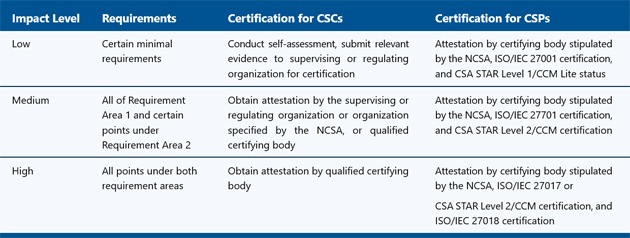
For more information on the draft Cloud Cybersecurity Standards, or on any aspect of cybersecurity and cloud-related laws in Thailand, please contact Athistha (Nop) Chitranukroh at [email protected] and Thammapas Chanpanich at [email protected].

RELATED INSIGHTS​ 

January 8, 2026
Thailand’s Digital Government Development Agency (DGA) has proposed new standards that would require government agencies to select cloud services exclusively from a preapproved shortlist of providers. The draft Digital Government Standards re: Cloud Service Provider Standards aims to strengthen procurement confidence and reduce risks associated with selecting cloud service providers that do not meet the required standards. A public hearing period on these standards concluded on December 27, 2025. The DGA will now review submitted comments and consider revising the standards accordingly. Shortlisted Cloud Service Provider Tiers The draft standards establish three tiers of cloud service providers based on their assessed service capability levels, core qualifications, and certifications. The DGA sets qualification requirements for each tier, and it is at the discretion of each agency to select the tier of cloud service provider that best suits its operational needs, as follows: Tier 1 cloud service providers are suitable for providing services involving disclosable official data. Tier 2 cloud service providers are suitable for handling official data and protected data, such as personal data, which requires a high-security public cloud (e.g., virtual private cloud). Tier 3 cloud service providers are suitable for providing services to agencies with specific regulatory and security requirements that handle highly protected data, such as the national security system. These providers must offer sovereign or hybrid cloud as stipulated by the Ministry of Digital Economy and Society. All tiers of cloud service providers must be legal entities incorporated under Thai law and can be authorized distributors of offshore cloud service providers. However, each tier will be subject to different requirements, including infrastructure obligations. Government agencies are encouraged to select a cloud service provider appropriate for their intended use. For example, if a government agency intends to procure cloud services for operating applications that process personal data,
January 8, 2026
Thailand has enacted comprehensive sexual harassment legislation that significantly expands criminal penalties and creates new compliance obligations for online platform operators. The Act Amending the Penal Code (No. 30) B.E. 2568 (2025), enacted on December 29, 2025, and taking effect the following day, introduces a comprehensive definition of sexual harassment, establishes new criminal offenses with graduated penalties, and imposes content removal obligations on social media platforms and computer system service providers. The amendment, which establishes a comprehensive framework for addressing sexual harassment in both physical and digital environments, significantly expands legal exposure for online service operators. It also grants courts authority to order takedowns of violating data accessible to the public. Definition of Sexual Harassment The law introduces “sexual harassment” as a distinct statutory concept covering physical conduct, verbal conduct, sounds, gestures, expressions, postures, communications, surveillance, stalking, and acts committed through computer systems or electronic devices. Conduct qualifies as sexual harassment when it is sexual in nature and likely to cause the victim distress, annoyance, embarrassment, humiliation, fear, or a sense of sexual insecurity. Criminal Offenses and Penalties The amended Penal Code establishes graduated penalties based on the severity and context of the harassment—including enhanced penalties for public or online conduct. For instance: Basic sexual harassment is punishable by imprisonment for up to one year, a fine of up to THB 20,000, or both. Continuous or repeated harassment that prevents normal life escalates penalties to imprisonment for up to two years, a fine of up to THB 40,000, or both. Critically for online operators, harassment committed in public places, in the presence of the public, or through computer systems accessible to the general public triggers imprisonment for up to three years, a fine of up to THB 60,000, or both. Acts of harassment committed by supervisors, employers, or others
January 6, 2026
On December 30, 2025, Thailand’s Electronic Transactions Development Agency (ETDA) notified digital marketplace operators of a consolidated list of “high‑risk products” that are subject to strict monitoring on digital platforms. The list was jointly prepared by the Thai Industrial Standards Institute (TISI) and the Food and Drug Administration (FDA) to guide platform compliance in the initial phase of implementation of the Electronic Transaction Committee’s Notification on Other Measures for Marketplace for Goods with Specific Characteristics under Section 18(2) of the 2022 Royal Decree on Digital Platform Businesses Requiring Notification B.E.2568 (2025). The notice is addressed to operators of digital platform services that function as product marketplaces with specific characteristics laid out in the notification. The ETDA states that the TISI and the FDA are closely monitoring the high‑risk product categories on digital platforms, and the published list serves as the baseline reference for platform screening during the initial phase of the notification’s implementation. High‑Risk Product List The list aggregates categories of products that are illegal to sell online or are otherwise tightly regulated under Thai law, with an emphasis on health-related products, controlled substances, medical devices, and a wide range of industrial products that require certification or compliance with specified Thai Industrial Standards, as detailed below. Prohibited and tightly controlled health products. This includes all categories of modern medicines subject to control other than general household remedies; all categories of controlled herbal products except for over-the-counter herbal products; narcotics; psychotropic substances; and medical devices requiring use in medical facilities or a physician’s prescription. Selected industrial products requiring heightened controls. The list highlights dozens of TISI-regulated items commonly sold online. Examples include pacifiers, rice cookers, electrical wire, food wrap film, crayons, washing machines and dryers, air conditioners, electric cookers and air fryers, water heaters, microwave ovens, LED luminaires, hair dryers
January 5, 2026
On December 31, 2025, the government of Vietnam promulgated Decree No. 356/2025/ND-CP detailing and guiding the implementation of the new Personal Data Protection Law (PDPL) that was issued in June 2025. The new decree, like the PDPL, entered into force on January 1, 2026, with the previous Decree No. 13/2023/ND-CP on personal data protection ceasing effect on the same day. Some key points of the new decree include the following: Comprehensive lists of basic and sensitive personal data are provided, which will require companies to review again their existing documents and data type classification to ensure compliance. New timelines are established for responding to specific data subject requests. These timelines are more reasonable and longer than the previous 72-hour requirements. Additional consent guidelines are provided, prohibiting default consent or ambiguous instructions that confuse data subjects about giving or withholding consent. Mandatory content for data transfer agreements/clauses in particular cases is provided. This covers, among other things, (i) the legal basis for the transfer of personal data; (ii) responsibilities for personal data protection during the transfer and processing of personal data; (iii) responsibilities for ensuring the exercise of the rights of personal data subjects; and (iv) responsibilities for coordination and compliance of the parties in cases where violations of personal data protection regulations are detected. The qualifications and responsibilities of data protection officers (DPOs) and data protection departments include, among others, having been trained and fostered in legal knowledge and professional skills regarding personal data protection. There are no specific provisions governing the qualifications or requirements for organizations that provide data protection training or education. New mandatory templates and requirements are provided in relation to data processing impact assessment and data transfer impact assessment, and for cases in which companies need to re-submit assessments to the regulator. Stricter requirements are
