
You are using an outdated browser and your browsing experience will not be optimal. Please update to the latest version of Microsoft Edge, Google Chrome or Mozilla Firefox. Install Microsoft Edge

May 15, 2024

Thailand Issues Draft Cybersecurity Standards for Cloud Services

On May 1, 2024, Thailand’s National Cyber Security Committee (NCSC) published the draft NCSC Notification Re: Cloud Cybersecurity Standards for a public hearing period, which was open until May 14, 2024. These standards have been drafted to drive the country’s cloud-first policy with the aim of minimizing risks from cyber threats to cloud services utilized by government agencies, supervising or regulating organizations, and critical information infrastructure (CII) organizations.

The key points of the draft Cloud Cybersecurity Standards are below.

Scope

  • The standards apply to government agencies, supervising or regulating organizations, and CII organizations under the Cybersecurity Act B.E. 2562 (2019), as well as cloud service providers (defined below).
  • The standards prescribe cloud system cybersecurity measures for cloud service customers (defined below) and providers only to the extent that the service is provided to the in-scope organizations outlined above.

Definitions

  • Cloud service customers (CSCs): In-scope organizations that have a formal contractual agreement to use cloud services provided by a cloud service provider.
  • Cloud service providers (CSPs): Persons who enable cloud services to be used by a cloud service customer, responsible for maintaining infrastructure, platforms, and software that enable provision of the cloud services and for managing these resources to ensure their accessibility, security, and scalability for their cloud service customers.

Application

  • In-scope organizations that will use or have been using cloud services must comply with the Cloud Cybersecurity Standards by taking into account their data or technology information systems’ level of impact, as specified in the previously issued Notification of the NCSC Re: Standards for Defining the Security Category for Data and Information Systems B.E. 2566 (2023).
  • The impact level related to personal data is to be rated as being at least at the medium level, and the minimum standards for that level specified in the draft Cloud Cybersecurity Standards must be adopted.
  • In-scope organizations must report their implementation of the Cloud Cybersecurity Standards to the National Cyber Security Agency (NCSA) within 30 days of completing the implementation.
  • The draft Cloud Cybersecurity Standards will come into force one year from their publication in the Government Gazette.

Structure

The requirements in the Cloud Cybersecurity Standards are divided into two areas, (1) cloud security governance and (2) cloud infrastructure and operations:

Requirement Area 1: Cloud Security Governance

  • Information security policies
  • Organization of information security
  • External supplier relationships
  • Compliance

Requirement Area 2: Cloud Infrastructure Security and Operations  

  • Human resource security
  • Asset management
  • Access control
  • Cryptography
  • Physical and environmental security
  • Operational security
  • Communication security
  • System acquisition, development, and maintenance
  • External supplier relationships
  • Information security incident management

Impact Levels and Requirements

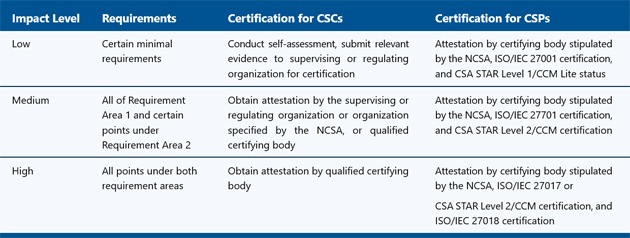
The stipulations of the Cloud Cybersecurity Standards vary depending on the data or information systems’ level of impact. The requirements for each level are summarized in the table below.
For more information on the draft Cloud Cybersecurity Standards, or on any aspect of cybersecurity and cloud-related laws in Thailand, please contact Athistha (Nop) Chitranukroh at [email protected] and Thammapas Chanpanich at [email protected].

RELATED INSIGHTS​ 

December 8, 2023
In a significant development on December 5, 2023, the Central Bank of Myanmar (CBM) issued Letter No. FE-1/2937 granting authorized dealer licensed banks (ADLBs) the authority to freely transact in foreign currency trades, buying and selling at the market exchange rate for Myanmar kyat (MMK) as proposed by buyers and sellers through online trading platforms. Offshore remittances, however, must comply with the remittance criteria set by the Foreign Exchange Supervisory Committee. The online trading platform Refinitiv, initiated in June 2022 under the CBM’s guidance, facilitates the buying and selling of foreign currency between ADLBs and between banks and customers. The initiative was implemented in accordance with CBM Letter No. FE-1/789, dated June 21, 2023. The platform’s inception saw the exchange rate set at over MMK 2,900 per USD 1. Then, in August 2023, the CBM ordered banks and traders to limit foreign exchange transactions to an approved online trading platform, again with the exchange rate fixed at MMK 2,900 per USD 1. Transactions outside of online trading platforms continue to be governed by the exchange rate set by the CBM of 2,100 MMK per USD 1. Conversion Rules for Exporters On December 6, 2023, the CBM issued Notification No. 26/2023 lowering the percentage of Myanmar companies’ export earnings in foreign currency subject to mandatory conversion into MMK from 50% to 35% at the current official exchange rate set by the CBM at USD 1 to MMK 2,100. This mandatory conversion must follow the requirements for mandatory conversion of foreign currency, which remain in effect. For more details on foreign exchange developments, or on any aspect of financial regulations in Myanmar, please contact Tilleke & Gibbins at [email protected].
November 27, 2023
The emergence of generative artificial intelligence (AI) has transformed the landscape for innovators and creators. As many legal practitioners have pointed out, it’s imperative for both developers of AI and artists using generative AI to understand the intricacies of intellectual property (IP) strategies so they can navigate this evolving terrain successfully. This article lays out some essential considerations relating to the major types of IP for both developers and creators in the realm of generative AI. IP Strategies for Developers of Generative AI Developers of generative AI technologies play a pivotal role in the innovation landscape. There are three overarching IP-related issues to consider: protecting their own intellectual property, mitigating the risk of violating other people’s IP rights, and IP commercialization. Key aspects of these concerns, along with suggested approaches for developers, are outlined below. Protecting IP Copyrights. One of the primary considerations for AI developers is the protection of AI-generated works, such as art and source code. The good news is that in most countries, these creations enjoy copyright protection without the need for registration. As a result, the works are automatically protected from the moment of creation. However, it’s crucial to maintain comprehensive records of your work to establish your ownership. Trademarks. Trademarks are vital for AI developers looking to establish and protect their brand. Pay close attention to Nice classifications, particularly class 9 (for software), class 35 (for business management and online marketing), and class 42 (for software design and development). Registering trademarks in these classes can provide robust protection for your brand and products. Patents. For truly innovative AI algorithms, techniques, or processes, consider the option of patenting. Patents offer strong protection, but they require a thorough application process and the documentation of your innovation, including evidence that the invention is novel, non-obvious, and practically
November 27, 2023
Thailand’s Electronic Transaction Development Agency (ETDA) has released two new subordinate regulations under the Royal Decree on Digital Platform Services: one detailing the assessment of digital platform services (DPSs) that will be deemed “high-risk” and subject to additional obligations, and another setting guidelines on user verification and authentication for all DPSs. The two subordinate regulations are summarized below. Impact Assessment of DPS Operations Under the Royal Decree on Digital Platform Services, DPS operations that have the risk of seriously impacting financial and commercial security, reliability and credibility of data message systems, or the general public are subject to additional obligations. The first subordinate regulation mentioned above (officially titled Notification of the Electronic Transactions Commission Re: Criteria for Impact Assessment on Operation of Digital Platform Services) outlines the criteria for the ETDA to determine which DPSs are “high-risk.” DPSs falling under this designation include: DPSs whose total value of transactions conducted through the platform in Thailand exceeds THB 100 million (approx. USD 2.8 million) per year; DPSs whose operators have not registered their entities with the Department of Business Development (DBD)—notably overseas operators—and that have 100 or more merchants or business users in Thailand or total users in Thailand between 5 and 10 percent of the country’s population (i.e., approx. 3.3–6.1 million users, calculated using official 2022 figures); DPSs that allow their users to freely post certain messages, or do certain acts, that may affect the public in certain cases, such as: (1) unlawful messages or acts; (2) messages or acts that may affect a child’s rights or people’s fundamental rights; and (3) messages or acts that may negatively affect political opinions of Thai citizens (whether before or after an election) or statements or actions likely to negatively affect other individuals due to gender differences or sexual violence. After considering
November 23, 2023
On November 14, 2023, Thailand’s Personal Data Protection Committee (PDPC) published a draft notification on collection of personal data regarding criminal records. The draft notification aims to provide clarifications and prescribe further criteria for processing criminal record data under the Personal Data Protection Act (PDPA), which generally requires the processing of criminal records to be carried out under the control of the relevant official authority under the law or under a data protection measure implemented according to rules prescribed by the PDPC. After its eventual passage, the draft notification will have important implications for businesses’ recruitment and human resources activities in relation to individuals with criminal records. Key aspects of the draft notification include the following: “Personal data regarding a criminal record” and “criminal record data” denote personal data related to the investigations of criminal offenses, criminal prosecution, or criminal punishment that is official information or certified by the relevant supervisory authority, regardless of whether that action is connected to a final judgment. Under the draft notification, data controllers may process criminal record data for the purpose of a recruitment process, checking the qualifications of personnel, and considering the suitability of a person for a position if the processing activities are required by law or when a data controller obtains explicit consent from the data subject. Furthermore, the necessity of processing the criminal record data must be announced at the beginning of the recruitment process. Data controllers’ requests for explicit consent to collect a data subject’s criminal record data must also notify the data subject of the consequences of not providing consent or withdrawing consent. The draft notification sets the allowable retention period for criminal record data at a maximum of six months from the end of the processing activities specified above. After the retention period ends, the criminal
