
You are using an outdated browser and your browsing experience will not be optimal. Please update to the latest version of Microsoft Edge, Google Chrome or Mozilla Firefox. Install Microsoft Edge

May 15, 2024

Thailand Issues Draft Cybersecurity Standards for Cloud Services

On May 1, 2024, Thailand’s National Cyber Security Committee (NCSC) published the draft NCSC Notification Re: Cloud Cybersecurity Standards for a public hearing period, which was open until May 14, 2024. These standards have been drafted to drive the country’s cloud-first policy with the aim of minimizing risks from cyber threats to cloud services utilized by government agencies, supervising or regulating organizations, and critical information infrastructure (CII) organizations.

The key points of the draft Cloud Cybersecurity Standards are below.

Scope

  • The standards apply to government agencies, supervising or regulating organizations, and CII organizations under the Cybersecurity Act B.E. 2562 (2019), as well as cloud service providers (defined below).
  • The standards prescribe cloud system cybersecurity measures for cloud service customers (defined below) and providers only to the extent that the service is provided to the in-scope organizations outlined above.

Definitions

  • Cloud service customers (CSCs): In-scope organizations that have a formal contractual agreement to use cloud services provided by a cloud service provider.
  • Cloud service providers (CSPs): Persons who enable cloud services to be used by a cloud service customer, responsible for maintaining infrastructure, platforms, and software that enable provision of the cloud services and for managing these resources to ensure their accessibility, security, and scalability for their cloud service customers.

Application

  • In-scope organizations that will use or have been using cloud services must comply with the Cloud Cybersecurity Standards by taking into account their data or technology information systems’ level of impact, as specified in the previously issued Notification of the NCSC Re: Standards for Defining the Security Category for Data and Information Systems B.E. 2566 (2023).
  • The impact level related to personal data is to be rated as being at least at the medium level, and the minimum standards for that level specified in the draft Cloud Cybersecurity Standards must be adopted.
  • In-scope organizations must report their implementation of the Cloud Cybersecurity Standards to the National Cyber Security Agency (NCSA) within 30 days of completing the implementation.
  • The draft Cloud Cybersecurity Standards will come into force one year from their publication in the Government Gazette.

Structure

The requirements in the Cloud Cybersecurity Standards are divided into two areas, (1) cloud security governance and (2) cloud infrastructure and operations:

Requirement Area 1: Cloud Security Governance

  • Information security policies
  • Organization of information security
  • External supplier relationships
  • Compliance

Requirement Area 2: Cloud Infrastructure Security and Operations  

  • Human resource security
  • Asset management
  • Access control
  • Cryptography
  • Physical and environmental security
  • Operational security
  • Communication security
  • System acquisition, development, and maintenance
  • External supplier relationships
  • Information security incident management

Impact Levels and Requirements

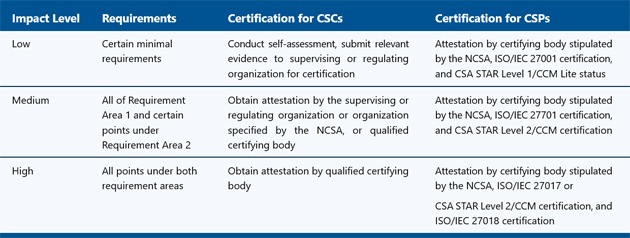
The stipulations of the Cloud Cybersecurity Standards vary depending on the data or information systems’ level of impact. The requirements for each level are summarized in the table below.
For more information on the draft Cloud Cybersecurity Standards, or on any aspect of cybersecurity and cloud-related laws in Thailand, please contact Athistha (Nop) Chitranukroh at [email protected] and Thammapas Chanpanich at [email protected].

RELATED INSIGHTS​ 

April 30, 2024
On March 25, 2024, Thailand’s Securities and Exchange Commission (SEC) published an amendment to its Notification re: Public Digital Token Offering to strengthen governance for initial coin offerings (ICOs). The amendments took effect on April 16, 2024, and reflect the SEC’s commitment to creating a safer and more transparent ICO environment, enhancing investor protection, and building confidence in ICOs as a fundraising tool. The key changes are outlined below: New Checks and Balances Requirements The new regulations require digital token issuers to implement checks and balances to protect investor rights—including an annual audit requirement and measures to prevent and manage conflicts of interest. These measures must be clearly disclosed in the ICO filing documents. In addition, certain project-related decisions must be approved by the issuer’s board of directors, which is also responsible for the accountability of such decisions. Improved Rules Concerning Voting Rights The SEC has introduced rules concerning voting rights and procedures for digital token holders, particularly for token types that previously lacked regulatory clarity. These rules specify the procedures for soliciting votes, the rationale behind vote requests, and the criteria for determining voting outcomes. The new rules, however, do not apply to real estate-backed tokens or infrastructure-backed tokens. Enhanced Advertising Regulations The SEC has revised advertising guidelines to ensure that investors receive essential information. The updated rules now require all ICO advertising to be fair and informative and to avoid misleading content. Advertisements must include appropriate risk warnings and a credible source for any claims made. The notification also stresses that it is the responsibility of digital token issuers to strictly supervise and ensure that those who create advertisements with or for an issuer comply with all relevant advertising regulations, including the following: Warning of investment risk: Advertisements must include warnings about investment risks and contact information
April 5, 2024
On March 15, 2024, Thailand’s Board of Investment (BOI) updated its investment incentives for software development and data centers by issuing a regulation replacing the previous categories of software or platforms for digital services or content (category 8.1) and data centers (category 8.2.1). The new and updated categories are detailed below. Software and Platform Development Under the new promotion policy, the BOI has made separate subcategories for “development” and “improvement” of software or platforms, each with its own set of incentives. The BOI is expected to clarify the characteristics of these two activities in a forthcoming announcement. Qualifying development activities are eligible for a corporate income tax (CIT) exemption for eight years (capped), while improvement activities are not eligible for any CIT exemption. A number of adjustments have been made to the eligibility criteria for development of software and platforms for digital services or content. These include the following: Salary expenditures for Thai information technology (IT) personnel hired temporarily after applying for investment promotion can now be included in the calculation of total salary expenditures for Thai IT personnel hired subsequent to applying for investment promotion. Previously, only salary expenditures for permanently employed personnel could be included in this figure. The minimum salary expenditures for each project remain unchanged at THB 1.5 million per year. Similarly, salary expenditures for temporary hiring of Thai IT personnel can be included in calculating the actual expenditures in the year that the project would like to benefit from the CIT exemption. Projects must commence operations within 12 months of the promotion certificate being issued. No extensions are allowed. Projects are no longer allowed to extend the machinery importation period. The other eligibility criteria for development of software and platforms for digital services or content remain unchanged. Projects in the new BOI subcategory for
April 4, 2024
On March 18, 2024, the president of the Supreme Court of Thailand announced the establishment of a specialized Technology Crime Division within the Criminal Court of Thailand. This represents a significant commitment to cybercrime within the Thai judiciary and a step forward in Thailand’s ability to investigate cybercrime. The rise in cybercrime investigations in recent years has made it increasingly difficult for Thailand’s traditional criminal courts to consider and issue enforcement orders in support of ongoing investigations in a timely manner. The new Technology Crime Division addresses this challenge. This new division has jurisdiction over cybercrime and technology-related crime, fraud or extortion using computers, and criminal offenses relating to personal data protection laws. In addition, this new division has jurisdiction over all requests from competent law enforcement officers seeking court orders under the Computer Crimes Act B.E. 2550, the Personal Data Protection Act B.E. 2562, and the Cybersecurity Act B.E. 2562. The Technology Crime Division will have trainees and judges with expertise in technology and cybercrime—not only to facilitate expert prosecution of cybercrime but also to offer critical and time-sensitive support to law enforcement investigations of alleged cybercrime. The Technology Crime Division is not yet operational. The president of the Supreme Court is expected to announce the division’s opening date in the coming months. For more details on Thailand’s measures for dealing with cybercrime, please contact Michael Ramirez at [email protected] or Piyawat Vitooraporn at [email protected].
March 29, 2024
Thailand’s Cybersecurity Regulating Committee (CRC) released a notification under the Cybersecurity Act on February 22, 2024, setting key operational obligations for critical information infrastructure (CII) organizations. The notification takes effect on June 20, 2024. CII organizations are state or private entities that carry out services related to national security, public services, banking and finance, information technology and telecommunications, transportation and logistics, energy and public utilities, or public health. CII organizations will be identified by the National Cyber Security Committee (NCSC) and notified of their status. The key obligations of CII organizations are laid out below. Reporting to the National Cyber Security Agency (NCSA) CII organizations must provide the following to the NCSA: A list of executive and operational staff, along with emergency contacts who can be reached within 60 minutes in the event of a cyber threat. The NCSA must be notified of any updates to this list within 15 days following any changes. A list of internal departments or individuals who are the responsible persons, owners, and holders of the computer systems, along with emergency contacts who can be reached within 60 minutes in the event of a cyber threat. The NCSA must be notified of any updates to this list at least 7 days prior to any changes (or within 15 days after the change if there is a necessary reason). Policies, Guidelines, and Procedures As specified in the National Cyber Security Committee (NCSC) guidelines, CII organizations must prepare the following internal documents by June 20, 2025: Cybersecurity practice guidelines, consisting of an inspection plan, risk assessment, and incident response plan. Cybersecurity standards framework, consisting of measures for risk identification, risk prevention, threat detection and monitoring, incident responses, and resilience and recovery. CII organizations must also prepare the following: Mechanisms, procedures, and steps for monitoring and detecting
