
You are using an outdated browser and your browsing experience will not be optimal. Please update to the latest version of Microsoft Edge, Google Chrome or Mozilla Firefox. Install Microsoft Edge

May 15, 2024

Thailand Issues Draft Cybersecurity Standards for Cloud Services

On May 1, 2024, Thailand’s National Cyber Security Committee (NCSC) published the draft NCSC Notification Re: Cloud Cybersecurity Standards for a public hearing period, which was open until May 14, 2024. These standards have been drafted to drive the country’s cloud-first policy with the aim of minimizing risks from cyber threats to cloud services utilized by government agencies, supervising or regulating organizations, and critical information infrastructure (CII) organizations.

The key points of the draft Cloud Cybersecurity Standards are below.

Scope

  • The standards apply to government agencies, supervising or regulating organizations, and CII organizations under the Cybersecurity Act B.E. 2562 (2019), as well as cloud service providers (defined below).
  • The standards prescribe cloud system cybersecurity measures for cloud service customers (defined below) and providers only to the extent that the service is provided to the in-scope organizations outlined above.

Definitions

  • Cloud service customers (CSCs): In-scope organizations that have a formal contractual agreement to use cloud services provided by a cloud service provider.
  • Cloud service providers (CSPs): Persons who enable cloud services to be used by a cloud service customer, responsible for maintaining infrastructure, platforms, and software that enable provision of the cloud services and for managing these resources to ensure their accessibility, security, and scalability for their cloud service customers.

Application

  • In-scope organizations that will use or have been using cloud services must comply with the Cloud Cybersecurity Standards by taking into account their data or technology information systems’ level of impact, as specified in the previously issued Notification of the NCSC Re: Standards for Defining the Security Category for Data and Information Systems B.E. 2566 (2023).
  • The impact level related to personal data is to be rated as being at least at the medium level, and the minimum standards for that level specified in the draft Cloud Cybersecurity Standards must be adopted.
  • In-scope organizations must report their implementation of the Cloud Cybersecurity Standards to the National Cyber Security Agency (NCSA) within 30 days of completing the implementation.
  • The draft Cloud Cybersecurity Standards will come into force one year from their publication in the Government Gazette.

Structure

The requirements in the Cloud Cybersecurity Standards are divided into two areas, (1) cloud security governance and (2) cloud infrastructure and operations:

Requirement Area 1: Cloud Security Governance

  • Information security policies
  • Organization of information security
  • External supplier relationships
  • Compliance

Requirement Area 2: Cloud Infrastructure Security and Operations  

  • Human resource security
  • Asset management
  • Access control
  • Cryptography
  • Physical and environmental security
  • Operational security
  • Communication security
  • System acquisition, development, and maintenance
  • External supplier relationships
  • Information security incident management

Impact Levels and Requirements

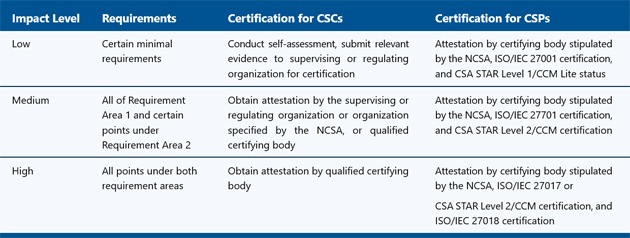
The stipulations of the Cloud Cybersecurity Standards vary depending on the data or information systems’ level of impact. The requirements for each level are summarized in the table below.
For more information on the draft Cloud Cybersecurity Standards, or on any aspect of cybersecurity and cloud-related laws in Thailand, please contact Athistha (Nop) Chitranukroh at [email protected] and Thammapas Chanpanich at [email protected].

RELATED INSIGHTS​ 

November 11, 2024
The Vietnamese government has demonstrated a strong commitment to building a digital government, digital economy, and digital society through its recently issued national strategy on digital infrastructure. Under Decision No. 1132/QD-TTg dated October 19, 2024, on “Digital Infrastructure Strategy to 2025 with Orientation to 2030,” the government will create supportive conditions for both domestic and international businesses to invest in digital infrastructure with cybersecurity as a priority. Recognized as vital to the economy, this digital infrastructure will consist of four main components: (i) telecommunications and internet infrastructure, (ii) data infrastructure, (iii) physical-digital infrastructure, and (iv) digital utility infrastructure, including digital technology as a service. Key goals for 2025 include universal fiber optic access for households, 100% 5G coverage across all provinces and cities, deployment of at least two new international undersea fiber optic cables, establishment of AI data centers, development of green-standard data centers, and platforms for IoT, AI, big data, blockchain, and cybersecurity. By 2030, goals include fiber access with speeds of at least 1 Gbps, 5G coverage for 99% of the population, readiness for 6G trials, six additional international undersea fiber optic cables, development of a hyperscale data center, and positioning Vietnam as a digital hub. To achieve these goals, the government has outlined some core tasks, creating significant opportunities for both foreign and domestic investors: Developing telecommunications and internet infrastructure for widespread fiber optic and 5G access, while preparing for emerging technologies like 6G, Open RAN, satellite, and IpV6. Telecommunication enterprises will jointly invest in and share the use of international fiber optic cable routes to ensure efficient capacity utilization and optimize investment capital. Attracting foreign and domestic investment to establish hyperscale data centers and cloud computing services that meet global standards. Creating physical-digital infrastructure by integrating technology across key sectors such as transportation, energy, healthcare,
November 8, 2024
On October 31, 2024, Thailand’s Office of the Personal Data Protection Committee (PDPC) opened a public consultation period on its draft notifications—one directed at data controllers and another at data processors—regarding exemptions from the requirement to create and maintain records of processing activities (ROPAs) under the Personal Data Protection Act B.E. 2562 (2019) (PDPA). The draft notification for data controllers aims to amend and revoke certain aspects of the first ROPA exemption notification issued in June 2022 and outlines the criteria for data controllers to be exempted from the obligation to prepare and maintain such records. Although it is officially titled “Notification of the Personal Data Protection Committee on Exemption from Record-Keeping Requirements for Small Business Data Controllers,” this draft notification applies to all types of exempted data controllers (see list below), and not only small businesses. The draft notification for data processors is new and does not replace any prior notification. The criteria under both draft notifications exempt certain data controllers and data processors from the obligation to maintain ROPAs, but exempted data controllers are not free from the obligation to retain information on the rejection of data subjects’ requests to exercise certain rights under the PDPA. While these criteria remain consistent with the June 2022 ROPA exemption notification, there are a few key takeaways from the notifications, as detailed below. Types of Exempted Parties The draft notification on data controllers adds condominium and housing estate juristic persons, as well as individuals, to the list of parties eligible for an exemption, while removing internet cafes from the list. The new draft notification for data processors mirrors the corresponding list in the draft notification for data controllers. The complete list of parties eligible for ROPA exemptions under the draft notifications is as follows: SMEs according to the law on
October 8, 2024
On October 1, 2024, the Thai cabinet acknowledged the recommendations proposed by the National Anti-Corruption Commission (NACC) to prevent corruption related to online gambling. The Ministry of Digital Economy and Society (MDES) has been assigned as the lead agency to collaborate with various relevant agencies to reach a consensus on the necessary amendments and updates to laws related to online gambling. In assigning the MDES this role, the cabinet emphasized the importance of the following key items: Establishment of a national committee. The national committee will be chaired by a minister and will comprise relevant agencies, including policymaking bodies, technology agencies, frequency management agencies, law enforcement agencies, and other experts. The committee’s primary responsibility will be to consider amending and updating laws related to online gambling. Urgent action on online gambling. As online gambling has been deemed a serious issue requiring urgent action, joint policies will be developed among relevant agencies such as the Royal Thai Police, the Bank of Thailand, and the Anti-Money Laundering Office to elevate the importance of online gambling issues. Public awareness and law enforcement. Public awareness campaigns are to be conducted to educate the public about the risks and legal consequences of online gambling, and laws against online gambling and related financial crimes are to be strictly enforced. Compliance with the Cybersecurity Act. It is necessary to ensure strict compliance with the Cybersecurity Act B.E. 2562 (2019). At the same time, government data systems are to be moved to cloud computing for enhanced data security. Next Steps The MDES is tasked with summarizing the results of the related discussions, actions taken, and overall opinions and submitting the summary to the cabinet secretariat for further presentation to the cabinet. These measures aim to address and mitigate the risks associated with online gambling and related corruption.
October 8, 2024
Thailand’s Electronic Transactions Development Agency (ETDA) issued guidelines for managing advertisements on digital platform services (DPSs) earlier this year. These guidelines aim to prevent fraud, illegal product or service offerings, and inducements to commit illegal acts, and are likely to provide a basis for greater regulation of this issue in the future. Key obligations for DPS business operators under the guidelines are detailed below. Advertiser Screening and Data Collection Verification and collection: Business operators must establish processes for verifying and collecting advertiser data. This includes steps, methods, and required information for advertiser registration. Identity verification: Business operators should follow identity verification requirements for advertiser registration. This may include using identity verification results from other identity providers or conducting their own identity verification processes with a minimum identity assurance level (IAL) of IAL2. Data storage: Advertiser data must be stored in a machine-readable format. Business operators must maintain records for watchlists, blacklists, and whitelists. Prepublication Advertisement Review Review process: Business operators should review advertisements before publication. This review should consider factors such as prohibited or restricted advertisements, required permissions, and avoiding sensitive user data. Postpublication Monitoring Advertisement monitoring: Business operators must monitor published advertisements using automated systems, staff, or contracted personnel. Criteria for prioritizing reviews should be established. Reporting channels: Business operators must provide channels for users to report illegal or inappropriate advertisements. Reports must be promptly addressed, prioritizing cases involving intellectual property owners or multiple credible reports. Advertiser account monitoring: Business operators must monitor advertiser accounts. This includes considering factors such as the number of reports/flags received and compliance with service agreements and community standards. For more information on this initiative from the ETDA, or on any aspect related to Thailand’s regulations for DPSs, please contact Athistha (Nop) Chitranukroh at [email protected], Thammapas Chanpanich at [email protected], Pornpan Wichawut at [email protected],
