
You are using an outdated browser and your browsing experience will not be optimal. Please update to the latest version of Microsoft Edge, Google Chrome or Mozilla Firefox. Install Microsoft Edge

May 15, 2024

Thailand Issues Draft Cybersecurity Standards for Cloud Services

On May 1, 2024, Thailand’s National Cyber Security Committee (NCSC) published the draft NCSC Notification Re: Cloud Cybersecurity Standards for a public hearing period, which was open until May 14, 2024. These standards have been drafted to drive the country’s cloud-first policy with the aim of minimizing risks from cyber threats to cloud services utilized by government agencies, supervising or regulating organizations, and critical information infrastructure (CII) organizations.

The key points of the draft Cloud Cybersecurity Standards are below.

Scope

  • The standards apply to government agencies, supervising or regulating organizations, and CII organizations under the Cybersecurity Act B.E. 2562 (2019), as well as cloud service providers (defined below).
  • The standards prescribe cloud system cybersecurity measures for cloud service customers (defined below) and providers only to the extent that the service is provided to the in-scope organizations outlined above.

Definitions

  • Cloud service customers (CSCs): In-scope organizations that have a formal contractual agreement to use cloud services provided by a cloud service provider.
  • Cloud service providers (CSPs): Persons who enable cloud services to be used by a cloud service customer, responsible for maintaining infrastructure, platforms, and software that enable provision of the cloud services and for managing these resources to ensure their accessibility, security, and scalability for their cloud service customers.

Application

  • In-scope organizations that will use or have been using cloud services must comply with the Cloud Cybersecurity Standards by taking into account their data or technology information systems’ level of impact, as specified in the previously issued Notification of the NCSC Re: Standards for Defining the Security Category for Data and Information Systems B.E. 2566 (2023).
  • The impact level related to personal data is to be rated as being at least at the medium level, and the minimum standards for that level specified in the draft Cloud Cybersecurity Standards must be adopted.
  • In-scope organizations must report their implementation of the Cloud Cybersecurity Standards to the National Cyber Security Agency (NCSA) within 30 days of completing the implementation.
  • The draft Cloud Cybersecurity Standards will come into force one year from their publication in the Government Gazette.

Structure

The requirements in the Cloud Cybersecurity Standards are divided into two areas, (1) cloud security governance and (2) cloud infrastructure and operations:

Requirement Area 1: Cloud Security Governance

  • Information security policies
  • Organization of information security
  • External supplier relationships
  • Compliance

Requirement Area 2: Cloud Infrastructure Security and Operations  

  • Human resource security
  • Asset management
  • Access control
  • Cryptography
  • Physical and environmental security
  • Operational security
  • Communication security
  • System acquisition, development, and maintenance
  • External supplier relationships
  • Information security incident management

Impact Levels and Requirements

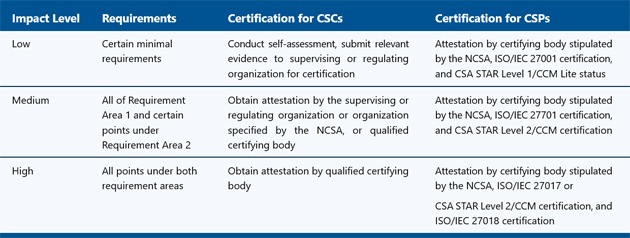
The stipulations of the Cloud Cybersecurity Standards vary depending on the data or information systems’ level of impact. The requirements for each level are summarized in the table below.
For more information on the draft Cloud Cybersecurity Standards, or on any aspect of cybersecurity and cloud-related laws in Thailand, please contact Athistha (Nop) Chitranukroh at [email protected] and Thammapas Chanpanich at [email protected].

RELATED INSIGHTS​ 

February 7, 2025
Vietnam’s political system is currently undergoing a significant reorganization to streamline government operations and improve efficiency. In this regard, Plan 141/KH-BCDTKNQ18, issued on December 6, 2024, provided guidelines on the restructuring of existing ministries, ministerial-level agencies, and government-affiliated agencies. Accordingly, the number of ministries is being reduced from 18 to 14 through mergers and consolidations and the establishment of a new Ministry of Ethnic and Religious Affairs. The number of ministerial-level agencies is being reduced to three, and government-affiliated agencies to five. Similar streamlining is happening at provincial levels. The newly consolidated state agencies will assume all functions, rights, and responsibilities of the merged entities, and will continue handling all ongoing matters previously handled by the former agencies. Some examples of these changes include the following: The Ministry of Science and Technology (MOST) will oversee telecommunications, IT applications, cybersecurity, e-transactions, and national digital transformation, which had previously been managed by the Ministry of Information and Communications (MIC). MOST will also be responsible for issuing licenses related to these areas, such as licenses for G1 online game services and telecommunication services. The Ministry of Culture, Sports, and Tourism will assume the responsibility of press management, previously under the MIC. The Ministry of Finance will assume state management functions related to investment, previously handled by the Ministry of Planning and Investment. Provincial Departments of Finance will issue Investment Registration Certificates and Enterprise Registration Certificates, a responsibility previously held by the Departments of Planning and Investment. The Ministry of Home Affairs will oversee labor and employment matters. Provincial Departments of Home Affairs will be authorized to issue work permits and will be the designated authorities for companies to register their internal labor regulations. Advantages for Businesses The restructuring aims to simplify regulations and expedite licensing processes. By reducing the number of agencies
February 6, 2025
The Thai government has proposed amendments to the Gambling Act B.E. 2478 (1935), aiming to address the growing influence of online gambling activities and strengthen regulatory oversight. These amendments, if enacted, would introduce significant changes, particularly concerning online gambling operators, participants, and related advertising activities. The draft amendment is currently in the public hearing process, which is scheduled to conclude on February 14, 2025. Key highlights of the proposed amendments are discussed below. Online Gambling In the proposed amendment, “online gambling” refers to gambling via a computer system or electronic system either through the internet or through remote communication. Organizing, participating in, or engaging in any type of online gambling is prohibited unless authorized by the competent authority. This opens the door for the authorization of casino-style online gambling in Thailand. However, the proposed amendment also imposes strict penalties on both operators and gamblers engaging in unauthorized online gambling: Anyone who organizes unauthorized online gambling is subject to imprisonment for 7–12 years. This penalty also applies to those responsible for managing electronic systems or tools used to facilitate gambling, as well as anyone involved in advertising, promoting, or deceiving others, either directly or indirectly, to engage in online gambling without proper authorization. Any person who engages in unauthorized online gambling is subject to imprisonment for 1–3 years. Dealers, supervisors of gambling or gambling activities, runners conveying wagers or other betting information, and owners of premises who knowingly permit such unauthorized activities are subject to imprisonment for 5–7 years. Penalties for Unauthorized Offline Gambling Operators The proposed amendment revokes the previous penalties under the Gambling Act and proposes stronger penalties. Both the original penalties and the proposed replacements depend on the type of gambling activity under the law, which classifies gambling activities into two types—list A and list B. List
February 3, 2025
On January 28, 2025, the Office of the Personal Data Protection Committee (PDPC) hosted Data Privacy Day 2025, bringing together over 1,000 participants from both the public and private sectors. The event underscored the importance of personal data protection and aimed to raise nationwide awareness while fostering a culture of compliance. During the event, the PDPC reaffirmed its commitment to strengthening Thailand’s data protection framework to align with international standards. The initiative also emphasized the collective goal of achieving zero data breaches. During the first session of the event, Mr. Prasert Jantararuangtong, deputy prime minister and minister of digital economy and society, delivered a speech highlighting the role of personal data protection in fostering Thailand’s digital economy. He emphasized that strong data protection measures enhance business credibility, build consumer trust, and attract foreign investment. He also addressed the PDPC’s “zero data breach” policy and the ongoing issue of data leaks, which have been exploited by call-center scam operations to deceive the public and cause financial harm. Additionally, Mr. Prasert announced that the Thai cabinet has approved a draft amendment to the Emergency Decree on Cyber Crime Prevention and Suppression B.E. 2566 (2023), commonly referred to as the “Cyber Crime Decree.” The draft will now proceed to the Council of State for review before its official enactment. Key provisions of the amendment include holding financial institutions, telecom providers, and social media platforms accountable for technology-related crimes; requiring compensation for victims; and enforcing stricter security measures. Cyber offenses, including personal data trading, face harsher penalties of up to THB 5 million in fines or five years of imprisonment. Authorities are also empowered to suspend suspicious SIM cards for committing illegal activities and expedite monetary refunds for victims without court approval. In the second session, the Office of the PDPC presented its
January 30, 2025
The Thai cabinet has approved a draft amendment of the Emergency Decree on Measures for the Prevention and Suppression of Technological Crimes as proposed by the Ministry of Digital Economy and Society to strengthen measures against technological crimes, particularly targeting call center scams and cyber fraud. Following the Council of State’s review, the emergency decree will be become effective immediately upon its enactment and publication in the Government Gazette. While the draft amendment is not yet publicly available, the government recently indicated that the emergency decree aims to empower authorities with decisive measures to combat cybercrime effectively. It underscores the shared responsibility among various sectors, including banking, telecommunications, and online platforms, in safeguarding against technological crimes. Key provisions of the draft amendment of the emergency decree include: Telecommunications provider obligations: Telecommunications service providers must suspend SIM cards associated with criminal activities. The National Broadcasting and Telecommunications Commission and mobile service providers themselves are authorized to temporarily suspend mobile phone numbers if there is reasonable suspicion of involvement in criminal activities. Banking responsibilities: Financial institutions are required to promptly report mule accounts to the Anti-Money Laundering Office to facilitate quick restitution to victims. The Anti-Money Laundering Transaction Committee is empowered to order the return of funds to victims without requiring a final court ruling. Penalties for noncompliance: The amended emergency decree introduces penalties for noncompliance by regulated entities that fail to prevent criminal activities for offenses related to technology crimes in the following cases: Digital asset services: Those engaged in the buying, selling, or exchanging of digital assets, such as cryptocurrencies and digital tokens, as well as digital asset businesses that launder money obtained from online crimes by converting it into digital currency, will be subject to imprisonment for up to one year, a fine of up to THB 100,000,
