
You are using an outdated browser and your browsing experience will not be optimal. Please update to the latest version of Microsoft Edge, Google Chrome or Mozilla Firefox. Install Microsoft Edge

May 15, 2024

Thailand Issues Draft Cybersecurity Standards for Cloud Services

On May 1, 2024, Thailand’s National Cyber Security Committee (NCSC) published the draft NCSC Notification Re: Cloud Cybersecurity Standards for a public hearing period, which was open until May 14, 2024. These standards have been drafted to drive the country’s cloud-first policy with the aim of minimizing risks from cyber threats to cloud services utilized by government agencies, supervising or regulating organizations, and critical information infrastructure (CII) organizations.

The key points of the draft Cloud Cybersecurity Standards are below.

Scope

  • The standards apply to government agencies, supervising or regulating organizations, and CII organizations under the Cybersecurity Act B.E. 2562 (2019), as well as cloud service providers (defined below).
  • The standards prescribe cloud system cybersecurity measures for cloud service customers (defined below) and providers only to the extent that the service is provided to the in-scope organizations outlined above.

Definitions

  • Cloud service customers (CSCs): In-scope organizations that have a formal contractual agreement to use cloud services provided by a cloud service provider.
  • Cloud service providers (CSPs): Persons who enable cloud services to be used by a cloud service customer, responsible for maintaining infrastructure, platforms, and software that enable provision of the cloud services and for managing these resources to ensure their accessibility, security, and scalability for their cloud service customers.

Application

  • In-scope organizations that will use or have been using cloud services must comply with the Cloud Cybersecurity Standards by taking into account their data or technology information systems’ level of impact, as specified in the previously issued Notification of the NCSC Re: Standards for Defining the Security Category for Data and Information Systems B.E. 2566 (2023).
  • The impact level related to personal data is to be rated as being at least at the medium level, and the minimum standards for that level specified in the draft Cloud Cybersecurity Standards must be adopted.
  • In-scope organizations must report their implementation of the Cloud Cybersecurity Standards to the National Cyber Security Agency (NCSA) within 30 days of completing the implementation.
  • The draft Cloud Cybersecurity Standards will come into force one year from their publication in the Government Gazette.

Structure

The requirements in the Cloud Cybersecurity Standards are divided into two areas, (1) cloud security governance and (2) cloud infrastructure and operations:

Requirement Area 1: Cloud Security Governance

  • Information security policies
  • Organization of information security
  • External supplier relationships
  • Compliance

Requirement Area 2: Cloud Infrastructure Security and Operations  

  • Human resource security
  • Asset management
  • Access control
  • Cryptography
  • Physical and environmental security
  • Operational security
  • Communication security
  • System acquisition, development, and maintenance
  • External supplier relationships
  • Information security incident management

Impact Levels and Requirements

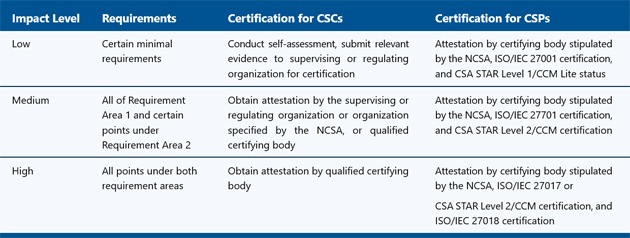
The stipulations of the Cloud Cybersecurity Standards vary depending on the data or information systems’ level of impact. The requirements for each level are summarized in the table below.
For more information on the draft Cloud Cybersecurity Standards, or on any aspect of cybersecurity and cloud-related laws in Thailand, please contact Athistha (Nop) Chitranukroh at [email protected] and Thammapas Chanpanich at [email protected].

RELATED INSIGHTS​ 

July 9, 2025
On June 16, 2025, the National Assembly of Vietnam adopted Law No. 75/2025/QH15 amending and supplementing a number of articles of the 2012 Advertising Law, with an effective date of January 1, 2026. The amended Advertising Law was enacted to further refine the legal framework for advertising activities in the modern era. Online Advertising Under the amended Advertising Law, “online advertising” is defined to encompass not only advertising on electronic newspapers and electronic information pages (as provided under the 2012 Advertising Law) but also advertising on other electronic venues, including social media, online applications, and digital platforms with internet connection. The amended Advertising Law also imposes new requirements for online advertising, including: Identification signs: Advertisements must have clear identifiable signs in numbers, letters, symbols, images, or sounds to distinguish them from non-advertising content. Control features: For advertisements not in fixed areas, there must be easily recognizable features and icons that allow recipients to turn off the advertisement, notify the service provider of violating advertising content, and refuse to view inappropriate advertising content. Linked content: Content in the links embedded in advertisements must comply with the law. Advertising service providers and publishers must have measures to check and monitor the linked content. Advertising on social media: Organizations and enterprises providing social media services must offer users features to distinguish advertising content from other content. Signage for sponsored content: When advertising, users of social media services must use signs to differentiate advertising or sponsored content from other content they provide. In response to the above requirements for online advertising, the amended Advertising Law sets out obligations of advertisers, advertising service providers, advertising publishers, and advertising conveyors in relation to online advertising. Among these, it is notably the responsibility of individuals and organizations engaging in online advertising to prevent and remove violating
July 1, 2025
Now halfway through 2025, Thailand continues to advance in the realm of data privacy, with the ambitious goal of achieving zero data breaches. The Personal Data Protection Committee (PDPC), an independent government body established by the Personal Data Protection Act (PDPA), is taking a more proactive approach, having published several rulings and orders to enhance data protection measures and clarify compliance expectations for businesses. Here is a look back at Thailand’s data privacy developments in the first half of the year. Strengthening Law Enforcement and New Guidance for Compliance Enforcement of existing data protection laws and regulations has taken a step forward this year. Some of the specific initiatives include: Increased enforcement by the PDPC. A key trend to watch from the first half of 2025 is the PDPC’s active enforcement of the PDPA as it intensifies oversight through compliance orders and public warnings against noncompliant organizations while ramping up efforts to prevent and halt the illegal trading of personal data by actively monitoring emerging societal issues. Call center scams and cyber fraud control. Thailand published an amendment to the Emergency Decree on Measures for the Prevention and Suppression of Technological Crimes to strengthen measures against technological crimes, particularly targeting call center scams and cyber fraud. Orders from the Expert Committee. Several orders issued by the Expert Committee under the PDPA were announced in the first half of this year. These include directives for data controllers to take corrective actions to comply with the PDPA, as well as initiatives to raise awareness of data privacy within organizations, reflecting the regulator’s focus on promoting organizational awareness and compliance. A guideline report summarizing the Expert Committee’s decisions and orders was also published to serve as a reference for compliance. Public issue monitoring. The PDPC has been taking a more proactive approach
June 27, 2025
Three American giants are actively protecting their intellectual property rights against generative AI, as two legal battles commence on both sides of the Atlantic. In the UK, Seattle-based media company Getty Images accuses UK-based Stability AI of multiple IP infringements. In the US, The Walt Disney Company and Universal Studios are teaming up against Midjourney, an AI startup, with their main ground being copyright infringement. Both cases are centered around questions legal minds have been posing since the introduction of generative AI: Is the output of generative AI an infringement? And who is ultimately responsible for the output, the platform or the user? Getty Images v. Stability AI Getty initially filed a claim in the High Court in 2023, which resulted in Stability applying for reverse summary judgment on the grounds that Getty had no real prospect of success, arguing that their operations took place outside the UK. However, the High Court judge hearing the case decided that the claims brought by Getty did have a real prospect of succeeding in court. Despite this, Stability saw a small victory when the court ruled that the representative action brought by Getty would not succeed due to the difficulties in identifying who qualified for the class. The proposed class was comprised of 50,000 rightsholders who alleged their rights were also infringed. Stability was successful in arguing that identifying these individuals would be challenging due to the unclear definition of the class. This current trial is centered around four main grounds: Copyright infringement. Getty accuses Stability of using content that Getty owns or has an exclusive license for when training their model, Stable Diffusion, resulting in the generated output containing substantial parts of that content. Getty is also alleging secondary copyright infringement, arguing that Stability is importing an article into the UK
June 26, 2025
Vietnam’s new Personal Data Protection Law (PDPL) was passed by the National Assembly on June 26, 2025, and will enter into force on January 1, 2026. The PDPL introduces several new concepts, exemptions, and obligations in comparison with the current Decree No. 13/2023/ND-CP on personal data protection (PDPD), while other contents remain essentially the same. The relationship between the PDPD and the PDPL has not been clearly addressed; however, it is expected that the government will issue a new decree providing necessary guidance on certain requirements under the PDPL, and the PDPD will remain in effect until it is replaced by this new decree. Some key points of the new PDPL include the following: Personal data will be further defined by lists of basic personal data and sensitive personal data to be issued by the government. The consent-centric approach of the PDPD remains in place, along with additional exemptions for certain data processing activities. The requirements for the data processing impact assessment (DPIA) and transfer impact assessment (TIA) remain unchanged. However, there are new exemptions for the TIA, including for the processing and storing in the cloud of employee data, and when the data subject is the person sending its own data outside of Vietnam. Consent obtained under the PDPD remains valid under the PDPL. DPIAs and TIAs submitted under the PDPD are valid under the PDPL but may need to be updated to be in line with the requirements of the PDPL. Administrative fines depend on the type of violation. The fine for sale and purchase of personal data will be 10 times the revenue from the sale or VND 3 billion (about USD 115,000), whichever is higher. The fine for cross-border transfer violations is 5% of the violator’s revenue of the preceding year or VND 3 billion,
