
You are using an outdated browser and your browsing experience will not be optimal. Please update to the latest version of Microsoft Edge, Google Chrome or Mozilla Firefox. Install Microsoft Edge

May 15, 2024

Thailand Issues Draft Cybersecurity Standards for Cloud Services

On May 1, 2024, Thailand’s National Cyber Security Committee (NCSC) published the draft NCSC Notification Re: Cloud Cybersecurity Standards for a public hearing period, which was open until May 14, 2024. These standards have been drafted to drive the country’s cloud-first policy with the aim of minimizing risks from cyber threats to cloud services utilized by government agencies, supervising or regulating organizations, and critical information infrastructure (CII) organizations.

The key points of the draft Cloud Cybersecurity Standards are below.

Scope

  • The standards apply to government agencies, supervising or regulating organizations, and CII organizations under the Cybersecurity Act B.E. 2562 (2019), as well as cloud service providers (defined below).
  • The standards prescribe cloud system cybersecurity measures for cloud service customers (defined below) and providers only to the extent that the service is provided to the in-scope organizations outlined above.

Definitions

  • Cloud service customers (CSCs): In-scope organizations that have a formal contractual agreement to use cloud services provided by a cloud service provider.
  • Cloud service providers (CSPs): Persons who enable cloud services to be used by a cloud service customer, responsible for maintaining infrastructure, platforms, and software that enable provision of the cloud services and for managing these resources to ensure their accessibility, security, and scalability for their cloud service customers.

Application

  • In-scope organizations that will use or have been using cloud services must comply with the Cloud Cybersecurity Standards by taking into account their data or technology information systems’ level of impact, as specified in the previously issued Notification of the NCSC Re: Standards for Defining the Security Category for Data and Information Systems B.E. 2566 (2023).
  • The impact level related to personal data is to be rated as being at least at the medium level, and the minimum standards for that level specified in the draft Cloud Cybersecurity Standards must be adopted.
  • In-scope organizations must report their implementation of the Cloud Cybersecurity Standards to the National Cyber Security Agency (NCSA) within 30 days of completing the implementation.
  • The draft Cloud Cybersecurity Standards will come into force one year from their publication in the Government Gazette.

Structure

The requirements in the Cloud Cybersecurity Standards are divided into two areas, (1) cloud security governance and (2) cloud infrastructure and operations:

Requirement Area 1: Cloud Security Governance

  • Information security policies
  • Organization of information security
  • External supplier relationships
  • Compliance

Requirement Area 2: Cloud Infrastructure Security and Operations  

  • Human resource security
  • Asset management
  • Access control
  • Cryptography
  • Physical and environmental security
  • Operational security
  • Communication security
  • System acquisition, development, and maintenance
  • External supplier relationships
  • Information security incident management

Impact Levels and Requirements

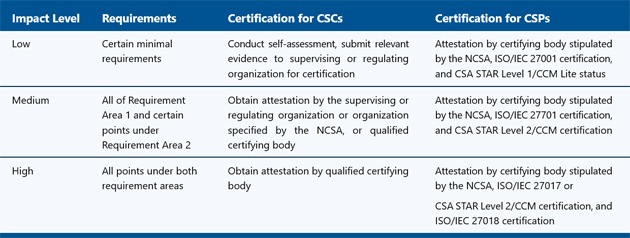
The stipulations of the Cloud Cybersecurity Standards vary depending on the data or information systems’ level of impact. The requirements for each level are summarized in the table below.
For more information on the draft Cloud Cybersecurity Standards, or on any aspect of cybersecurity and cloud-related laws in Thailand, please contact Athistha (Nop) Chitranukroh at [email protected] and Thammapas Chanpanich at [email protected].

RELATED INSIGHTS​ 

July 24, 2025
Thai authorities have escalated efforts to block unlawful cross-border digital asset business operators. On June 19, 2025, the Ministry of Digital Economy and Society (MDES) issued a notification empowering it to ban internet access to operations or services offered by digital asset business operators who lack licenses from the Thailand Securities and Exchange Commission (SEC) under the Emergency Decree on Digital Asset Businesses B.E. 2561 (2018). This ban, issued under the 2023 Royal Decree on Measures for the Prevention and Suppression of Technology Crime, particularly aims to block Thai users’ access to services offered by unlicensed offshore digital asset providers via their own apps or websites or through public social media platforms. Compliance Requirements The notification requires internet service providers and social media platforms selected by MDES to immediately impose internet access restrictions on identified apps, websites, and IP addresses of illegal operators upon receiving MDES orders. Takedown Orders There are two tracks for competent officials at MDES to issue orders to operators: If the competent official is notified by the SEC of licensing noncompliance by a particular digital asset business operator, the competent official can issue a takedown order to the operator upon approval from the permanent secretary of MDES. If the competent official independently discovers, or receives a complaint from any third party other than the SEC, that a digital asset business operator may have violated licensing requirements, the competent official can ask the SEC to verify and confirm the relevant facts and noncompliance before seeking approval from the permanent secretary of MDES to issue the takedown order. Streamlined Enforcement Prior to this notification, the SEC could obtain takedown orders only from Thai courts under the 2007 Computer Crime Act to take down or block access to unlicensed digital asset platforms and apps. This was a relatively
July 24, 2025
Vietnam’s Ministry of Public Security recently released a draft version of the 2025 Cybersecurity Law, which is intended to replace both the existing 2018 Cybersecurity Law and the 2015 Law on Network Information Security (LNIS). This consolidation reflects a broader effort by the Vietnamese government to streamline and centralize the legal framework governing cybersecurity, data protection, and information security to be under the sole authority of the Ministry of Public Security, moving away from the previous sharing of responsibility with the former Ministry of Information and Communications (which ceased operations earlier this year and merged with the Ministry of Science and Technology). This shift aims to eliminate overlaps and improve enforcement efficiency. The draft law is built upon the foundation of principles and provisions of both the 2018 Cybersecurity Law and the 2015 LNIS, while also introducing a wide range of amendments and new regulations. By merging the two laws, the government seeks to reduce legal fragmentation and ensure consistency in definitions, obligations, and enforcement mechanisms across related domains like data protection, IT system classification, and cybercrime prevention. The newly introduced amendments include enhanced obligations for service providers, stricter controls on information transmission, classification of IT systems, designation and protection of nationally important information systems, and sector-specific violations and compliance requirements. Highlights of the draft law are discussed below. Definition and Obligations of Service Providers The draft law clearly defines and significantly broadens the scope of entities considered “service providers” under its jurisdiction. This now includes businesses and individuals offering products or services in cyberspace, including both infrastructure and content online services, such as: Internet service providers (ISPs) and providers of telecommunications, hosting, servers, domain names, VPNs, proxy services, and cloud computing; Providers of social networks, websites, and online gaming; Financial institutions, banks, foreign bank branches in Vietnam, e-wallet
July 23, 2025
On July 4, 2025, Thailand’s Electronic Transactions Development Agency (ETDA) issued two significant notifications that introduce new compliance requirements for ride-hailing platforms operating in the country. The notifications formally designate these platforms as high-impact digital services under section 18(3) of the Royal Decree on Digital Platform Service Businesses and impose a comprehensive set of additional operational obligations. These measures are designed to address regulatory gaps and enhance oversight of digital platforms providing public passenger vehicle or motorcycle ride-hailing services. First, the Notification on the Designation of Ride-Hailing Platforms under section 18(3) formally designates all ride-hailing platforms that have notified the ETDA of their operations as high-impact digital platform services under section 18(3) of the royal decree. Unlike high-risk marketplace platforms, which are named individually, any ride-hailing platform that has notified the ETDA of its operations is automatically subject to these new requirements. Next, the Notification on Additional Obligations for Ride-Hailing Platforms imposes further obligations on ride-hailing platforms, supplementing the general requirements under section 21 of the royal decree. These notifications will come into force 90 days from their publication in the Government Gazette. New Compliance Obligations The new regulatory framework introduces a range of operational, technical, and reporting requirements for ride-hailing platforms, particularly concerning the issues described below. Vehicle and Driver Compliance Operators must: Ensure that all vehicles used on the platform are registered as public vehicles in accordance with Department of Land Transport requirements Verify all drivers hold valid public driving licenses Collect service fees in compliance with applicable fare regulations under the Vehicle Law Digital Platform Features and User Verification Operators must implement robust digital platform features for both drivers and riders, including: Comprehensive identity verification and confirmation processes for drivers and riders, utilizing both face-to-face and non-face-to-face methods, including biometric and digital ID checks Real-time GPS
July 17, 2025
On July 9, 2025, Thailand issued a notification that introduces comprehensive operational requirements for digital platform service providers operating as goods marketplaces, effective December 31, 2025 (i.e., 180 days after its publication in the Government Gazette). The regulation’s official name is Notification of the Electronic Transactions Committee Re: Other Actions for Digital Platform Service Operators in the Category of Marketplace for Goods with Specific Characteristics under Section 18(2) of the Royal Decree on the Operation of Digital Platform Service Businesses that are Subject to Prior Notification B.E. 2565 (2022), B.E. 2568 (2025). Scope of Application The notification applies exclusively to goods marketplace operators formally designated by the Electronic Transactions Development Agency (ETDA), which on the same day designated 19 platforms that had previously notified the ETDA of their operations. The goods requiring enhanced oversight by these operators are limited to those regulated by the Thai Food and Drug Administration (FDA) and the Thai Industrial Standards Institute (TISI). Development from Earlier Draft An earlier draft of the notification had included a requirement for offshore platforms to establish a local entity, but this requirement was removed from the final notification. Key Obligations Despite the removal of the local entity requirement, the notification imposes a range of additional obligations on designated goods marketplace operators: Transparency. Operators must implement robust transparency measures, including clear, accessible, and understandable disclosures to users in Thai. These disclosures must cover all relevant terms and conditions, comprehensive product information, and complaint management procedures. Operators must also submit an annual compliance report to the ETDA within 60 days after the end of their accounting period, including statistics on regulated goods. Business user registration and identity verification. Before permitting the sale or advertisement of regulated goods, operators must collect and verify business user information, including contact details, identification documents, registration
