You are using an outdated browser and your browsing experience will not be optimal. Please update to the latest version of Microsoft Edge, Google Chrome or Mozilla Firefox. Install Microsoft Edge

July 7, 2021

Thailand Introduces Online Ride-Hailing Services Regulations

Thailand’s Transport Ministry has issued new rules for ride-hailing services, aiming to strictly regulate the types of vehicle that can be registered, the number of registered vehicles per user, and the fees that are levied and collected. These rules are laid out in the Ministerial Regulation Re: Ride-Hailing Service Vehicle via an Electronic System B.E. 2564 (2021), which was published in the Royal Gazette on June 23, 2021.

Under the regulation, a personal vehicle transporting no more than seven passengers can be subsequently registered as a “ride-hailing service vehicle via an electronic system.” An individual is only allowed to register one private vehicle under the regulation. The vehicle registrations are classified as follows:

  • Small vehicles with a maximum engine power of 50–90 kilowatts;
  • Medium vehicles with a maximum engine power of 91–120 kilowatts; or
  • Large vehicles with a maximum engine power of more than 120 kilowatts.

In the case of an electric vehicle, it must be able to travel at a speed of at least 90 km/h.

Each ride-hailing vehicle must be covered by a service-providing communication system operated by an electronic service provider (e.g., a ride-hailing app) that has been endorsed and approved by the Department of Land Transport (DLT). This system must communicate the following details:

  • Car and driver information;
  • Driver’s identity system;
  • Pre-calculated fare;
  • Car tracking system;
  • Time and location validation system; and
  • Complaint and emergency system.

All data records must be retained for at least one month for examination purposes.

The regulation further prescribes that the vehicle must display a sign indicating that it is a ride-hailing service vehicle operating via an electronic system, and the vehicle must be the same color as appears in the personal vehicle registration certificate prior to its registration as a ride-hailing vehicle.

Registration under the regulation is valid for nine years. The ride-hailing vehicle registration plate’s size, specifications, and color are identical to the criteria for registering personal vehicles carrying no more than seven people, meaning that the same vehicle registration plate can be used for the ride-hailing vehicle. The condition of the ride-hailing vehicle must also be examined annually, as prescribed by ministerial regulations under the Vehicle Act B.E. 2522 (1979), and both the interior and exterior must be kept clean and tidy.

Service Fees

The regulation empowers the minister of transport to prescribe the fees for ride-hailing vehicles; the current fees are outlined in the table below.
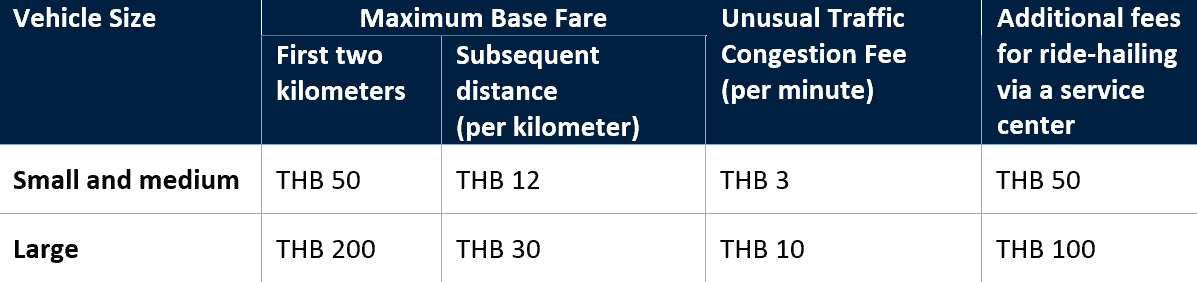
All fees must be shown to the passenger before the provision of any service, and only this same amount can be charged and collected.

For more details about this regulation, or about any aspect of transportation and technology laws in Thailand, please contact Charuwan Charoonchitsathian at [email protected] or +66 2056 5657, or Panchanit Trakarnvanich at [email protected] or +66 2056 5531.

RELATED INSIGHTS​ 

May 25, 2026
Thailand published new rules on May 1, 2026, establishing clear procedures for how the Anti-Money Laundering Office (AMLO) handles digital assets seized during criminal and money laundering investigations. Taking effect the following day, the Regulation of the Anti-Money Laundering Board on the Custody and Management of Seized or Frozen Assets (No. 3) B.E. 2569 applies to digital asset businesses, cryptocurrency holders, and anyone subject to asset seizure under Thailand’s anti-money laundering laws. For the first time, authorities now have a detailed roadmap for transferring seized digital property from private or foreign control into secure state custody. Digital asset businesses holding customer assets under investigation must be prepared to comply with these rules compelling repatriation of such assets in enforcement actions. Expanded Definition of Digital Assets The regulation defines digital assets to include not only those covered by Thailand’s existing digital asset business law but also any other property that can be stored using the same methods as digital assets. This broad formulation means the custody rules will apply to emerging blockchain-based assets and tokenized property that may not yet fall within the statutory definition of a digital asset business, giving authorities flexibility as the technology evolves. Mandatory Transfer to Domestic Custody When digital assets are held with service providers outside Thailand, AMLO will first attempt to transfer them to an account the office maintains with a licensed domestic digital asset business operator. If the domestic operator does not support that particular asset, the office will instead move the assets to its own cold wallet (offline, internet-isolated storage system). If neither option is feasible, the seizing official will report the situation to the Anti-Money Laundering Committee for alternative instructions. A similar hierarchy governs assets held in an accused party’s private wallet or by any third party that is not a
May 22, 2026
On May 8, 2026, the Thai government held a press conference to announce a coordinated, multiagency initiative to strengthen oversight and enforcement over products sold on online platforms. The initiative involves the Office of the Consumer Protection Board, the Thai Industrial Standards Institute, the Electronic Transactions Development Agency, the Thailand Consumers Council, the Consumer Protection Police Division, and major online platform operators. With this appointment, the government has signaled a deliberate shift from a predominantly reactive enforcement framework toward a more proactive regulatory and monitoring approach for online commerce and digital platform services. Legal and Regulatory Reform The government is accelerating a proposed Product Liability Law that would introduce new statutory frameworks for defective or substandard products, along with amendments to food safety and consumer protection legislation. The draft law has already been approved by the cabinet; the Council of State and relevant authorities will further draft the law and subsequently issue it for public hearings prior to enactment. Authorities also plan to expand enforcement measures against noncompliant businesses and distributors. In particular: The implementation of stricter “know your merchant” (KYM) identity verification requirements for online sellers. Expanded mandatory standards and regulatory oversight for high-risk products, such as power banks, electrical appliances, food products, and household goods. Increased monitoring of online product listings, and coordination with platform operators to remove unsafe, counterfeit, misleading, or otherwise noncompliant products. Additional monitoring and enforcement measures targeting online scams and illegal goods distributed through digital platforms, including e-cigarettes, which authorities identified as a growing concern due to increasing online distribution channels and potential health impact on young consumers. Strengthening Consumer Complaint Mechanisms The government announced increased cooperation with the Thailand Consumers Council and other agencies to facilitate complaint handling, market monitoring, and policy recommendations. Enhanced interagency coordination will aim to ensure that consumer
May 19, 2026
Thailand’s telecommunications regulator has introduced a range of new compliance obligations for telecom licensees aimed at preventing and suppressing technology crime. On May 15, 2026, the National Broadcasting and Telecommunications Commission (NBTC) published in the Government Gazette Notification on Measures for Prevention and Suppression of Technology Crime No. 2, which amends the original NBTC notification dated August 24, 2025. The amendment derives its authority from the Emergency Decree on Measures for Prevention and Suppression of Technology Crime B.E. 2566 (2023), as amended in 2025, and took effect on May 16, 2026. SIM Card Registration Cap for Non-Thai Nationals Persons without Thai nationality are now limited to a maximum of three SIM cards per person per service provider. Identity verification must be done primarily via passport. For those without a passport, acceptable alternatives include travel documents or certificates of identity issued by foreign governments, accompanied by additional Thai government-issued documents, as well as pink ID cards (for persons without Thai nationality) and white ID cards (for persons without registration status). Registration must be done in person at a branch or authorized dealer. Service providers must develop their identity verification systems and obtain NBTC approval before deployment. SIM Activation Deadline and SIM Box Prohibition Both Thai and non-Thai service users must activate their registered SIM within 60 days of registration. If they fail to do so, they must re-verify their identity in person before activation, confirming they are the same person who originally registered. Service providers must prohibit SIM box and gateway devices capable of supporting four or more SIMs from connecting to their mobile networks unless the device has received a license under the Radio Communications Act. Blacklist Enforcement Service providers must refuse registration of additional mobile numbers for persons listed on a technology crime-related database maintained by the Royal
May 13, 2026
Thailand has prescribed more stringent labeling specifications for traditional and electric vehicles (EVs), requiring manufacturers and importers for sale to display clear, accurate product information on vehicle labels. The requirements, which took effect on March 21, 2026, are set out in a notification issued under Thailand’s consumer protection framework. Background and Scope Under Thailand’s Consumer Protection Act (CPA), products manufactured for sale or imported into Thailand must generally comply with the CPA’s broad labeling requirements, unless the Label Committee prescribes more specific and stringent requirements for certain products. Accordingly, prior to the issuance of this notification, traditional autos and EVs were subject only to the general labeling requirements. Following the issuance of this Label Committee notification, traditional autos and EVs are now for the first time specifically subject to a dedicated regulatory framework for labeling. The requirements apply to private passenger vehicles and private trucks that have not yet been registered, including those powered by an internal combustion engine, electric power, or a combination of both. Label Requirements Labels must be displayed in Thai or with a Thai translation, and must be clearly visible and legible. Text must be proportional to the label area, with a minimum character height of 2 millimeters. All covered vehicles must display the following: Product name, trade name, or trademark Brand and model Manufacturer or importer information Size, weight, and load-bearing capacity Warranty conditions Drive system, usage instructions, and safety precautions Manufacturing date Price Additional Requirements for EVs EVs must also display the following: Type of electric vehicle (e.g., HEV, PHEV, BEV, or FCEV) Maximum electric motor power and rated continuous output power Battery type and capacity Battery warranty conditions or a clear statement that no warranty is provided Estimated driving range per full battery charge Electrical system safety standard Electricity consumption rate These