You are using an outdated browser and your browsing experience will not be optimal. Please update to the latest version of Microsoft Edge, Google Chrome or Mozilla Firefox. Install Microsoft Edge

July 7, 2021

Thailand Introduces Online Ride-Hailing Services Regulations

Thailand’s Transport Ministry has issued new rules for ride-hailing services, aiming to strictly regulate the types of vehicle that can be registered, the number of registered vehicles per user, and the fees that are levied and collected. These rules are laid out in the Ministerial Regulation Re: Ride-Hailing Service Vehicle via an Electronic System B.E. 2564 (2021), which was published in the Royal Gazette on June 23, 2021.

Under the regulation, a personal vehicle transporting no more than seven passengers can be subsequently registered as a “ride-hailing service vehicle via an electronic system.” An individual is only allowed to register one private vehicle under the regulation. The vehicle registrations are classified as follows:

  • Small vehicles with a maximum engine power of 50–90 kilowatts;
  • Medium vehicles with a maximum engine power of 91–120 kilowatts; or
  • Large vehicles with a maximum engine power of more than 120 kilowatts.

In the case of an electric vehicle, it must be able to travel at a speed of at least 90 km/h.

Each ride-hailing vehicle must be covered by a service-providing communication system operated by an electronic service provider (e.g., a ride-hailing app) that has been endorsed and approved by the Department of Land Transport (DLT). This system must communicate the following details:

  • Car and driver information;
  • Driver’s identity system;
  • Pre-calculated fare;
  • Car tracking system;
  • Time and location validation system; and
  • Complaint and emergency system.

All data records must be retained for at least one month for examination purposes.

The regulation further prescribes that the vehicle must display a sign indicating that it is a ride-hailing service vehicle operating via an electronic system, and the vehicle must be the same color as appears in the personal vehicle registration certificate prior to its registration as a ride-hailing vehicle.

Registration under the regulation is valid for nine years. The ride-hailing vehicle registration plate’s size, specifications, and color are identical to the criteria for registering personal vehicles carrying no more than seven people, meaning that the same vehicle registration plate can be used for the ride-hailing vehicle. The condition of the ride-hailing vehicle must also be examined annually, as prescribed by ministerial regulations under the Vehicle Act B.E. 2522 (1979), and both the interior and exterior must be kept clean and tidy.

Service Fees

The regulation empowers the minister of transport to prescribe the fees for ride-hailing vehicles; the current fees are outlined in the table below.
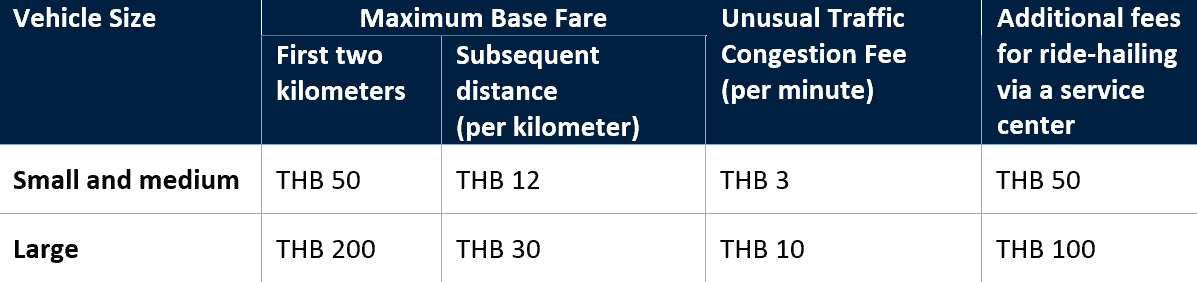
All fees must be shown to the passenger before the provision of any service, and only this same amount can be charged and collected.

For more details about this regulation, or about any aspect of transportation and technology laws in Thailand, please contact Charuwan Charoonchitsathian at [email protected] or +66 2056 5657, or Panchanit Trakarnvanich at [email protected] or +66 2056 5531.

RELATED INSIGHTS​ 

July 21, 2026
On July 6, 2026, Myanmar’s Ministry of Finance and Revenue introduced revised procedures governing the importation and exportation of goods and vehicles, replacing the framework that had been in place since 2017. The revised procedures were introduced in Notification No. 115/2026, which establishes updated compliance requirements and penalties for importers and exporters, covering licensing, declarations, product specifications, prior arrival of goods, and imports or exports made without the required licenses or permits. Scope Unlike its predecessor (Notification No. 6/2017), which focused primarily on import-related noncompliance, the new notification regulates both import and export activities and introduces a separate penalty schedule for export violations. Exporters are now required to ensure that their exports comply with the approvals stated in export licenses and permits, match the information declared in export declarations, and are supported by the required licenses, permits, and accompanying documents. Import Compliance and Penalties The new notification imposes several compliance requirements on importers. Importers must ensure that the country of origin, branding, labeling, and other product information are consistent with the relevant import license or permit, import declaration, and the imported goods. For vehicles and machinery, the model year must match the year approved by the Ministry of Commerce. Importers must also ensure that goods are not imported before the issuance or after the expiry of the import license or permit, and that the imported quantity does not exceed the approved amount. Failure to comply with these requirements may result in regulatory action. As for the notification’s revised penalties for noncompliance with import licensing requirements, imports made without the required import license, permit, or import declaration may be subject to fines ranging from one to three times the assessable value (AV) of the goods, depending on the category of goods involved. Certain vehicles and machinery, as well as specific
July 21, 2026
Thailand’s Ministry of Digital Economy and Society (MDES) published a notification establishing an expedited court-ordered takedown mechanism for online content in cases of “urgent necessity.” The notification, which was issued on July 17, 2026, under the Computer Crime Act B.E. 2550 (2007), as amended, took effect the following day. It significantly expands the categories of content subject to rapid government-initiated removal. Content Categories Subject to Takedown The notification defines “urgent necessity” (section 20, paragraph 5, of the Computer Crime Act) as circumstances where any delay in suppressing computer data may impact national security, religion, the monarchy, good morals, social culture, or public order. In this regard, it establishes four broad categories of content: Computer Crime Act offenses. National security offenses. IP and other criminal offenses, where it is contrary to public order or good morals and a competent officer has requested its suppression. Content contrary to public order or good morals, a broad residual category encompassing 14 subcategories approved by the Computer Data Screening Committee. The fourth category is the most expansive. Its 14 subcategories include: Content defaming, mocking, satirizing, or devaluing the monarchy. Online gambling advertising or facilitation. Offering illegal firearms for sale. Offering baraku (hookah) products or e-cigarettes for sale. Offering cannabis inflorescences or processed cannabis products for sale. Advertising or soliciting prostitution. Content inciting violence, hatred, or social division. Unauthorized overseas employment advertising. Offering boiled kratom juice for sale. Online sale or advertising of alcoholic beverages. Content satirizing or degrading Buddhism. Money lending at interest rates exceeding legally prescribed limits. Advertising or disseminating information about surrogacy services. Forgery of documents, cards, or official documents. Enforcement Procedure In cases of urgent necessity, a competent official assigned by the MDES permanent secretary must file a petition with supporting evidence to the court with jurisdiction, requesting an order to
July 20, 2026
On July 16, 2026, Thailand’s Personal Data Protection Committee (PDPC) published a notification in the Government Gazette establishing detailed rules governing data subjects’ right of access under section 30 of the Personal Data Protection Act B.E. 2562 (2019) (PDPA). The notification will take effect 60 days after publication—mid-September 2026—giving data controllers a limited window to bring their processes into compliance. Scope The notification covers requests to access or obtain copies of personal data and requests for disclosure of the source of data collected without consent. Data subjects may exercise their rights directly or through authorized representatives. Key Requirements Important requirements set by the notification include the following: Required request channels. Controllers must provide at least two request channels: direct submission at the business location and registered mail. Electronic channels are optional but, if offered, may also be used for fulfilling requests. Request contents. Requests must be in writing or in electronic form and include the data subject’s name, the preferred access method, details of the data requested, and the requester’s signature. Controllers may request additional identifying information as needed. Identity and authority verification. Controllers may require official identity documents for verification. Authorized representatives must provide authorization documents and identity documents for both the data subject and the representative. Alternative verification methods (e.g., digital authentication) are permitted if they do not unreasonably obstruct data subjects’ rights. Review and response timelines. Controllers must review requests within 15 days. If the request is incomplete, the controller must notify the requester and allow at least 15 days to correct deficiencies. If not corrected, the request may be treated as abandoned. Once verified, controllers must fulfill requests within 30 days, extendable by another 30 days for large-volume or complex requests with notice to the requester. Methods for providing access or copies. Controllers may fulfill
July 16, 2026
Thailand’s Office of the Personal Data Protection Committee (PDPC) published a series of draft guidance documents for public consultation on July 7, 2026. Issued under the Personal Data Protection Act B.E. 2562 (2019) (PDPA), the drafts address a range of compliance issues and offer insight into the regulator’s current enforcement priorities. This article examines two of those drafts: one on lawful bases for processing personal data, and another on marketing and direct marketing. Together, they reflect the Office of the PDPC’s evolving expectations on lawful-basis selection, accountability, and the use of personal data in marketing. Organizations operating in Thailand should assess the practical implications now, before the guidance is finalized. Lawful Bases: A Structured Selection Process The draft guidance on lawful bases introduces a systematic five-step process for selecting an appropriate lawful basis for each processing activity. Organizations are expected to: Identify the processing activity involved. Assess the appropriate lawful basis. Evaluate whether the data is necessary for the processing. Conduct a legitimate interest assessment (LIA) where applicable. Ensure transparency through privacy notices. The guidance provides practical explanations and examples for each lawful basis under section 24 of the PDPA—including archiving, research, statistics, vital interests, contractual necessity, legal obligation, public task, legitimate interests, and consent—as well as the bases applicable to sensitive personal data under section 26. The aim is to promote more consistent and accurate lawful-basis selection across public- and private-sector organizations. A recurring theme throughout the guidance is that organizations should select the lawful basis that most accurately reflects the actual purpose and circumstances of the processing activity. The guidance cautions against treating consent as a default or catch-all basis where another lawful basis is more appropriate. For processing based on legitimate interests, organizations should conduct and document an LIA. Processing involving sensitive personal data may require