You are using an outdated browser and your browsing experience will not be optimal. Please update to the latest version of Microsoft Edge, Google Chrome or Mozilla Firefox. Install Microsoft Edge

July 7, 2021

Thailand Introduces Online Ride-Hailing Services Regulations

Thailand’s Transport Ministry has issued new rules for ride-hailing services, aiming to strictly regulate the types of vehicle that can be registered, the number of registered vehicles per user, and the fees that are levied and collected. These rules are laid out in the Ministerial Regulation Re: Ride-Hailing Service Vehicle via an Electronic System B.E. 2564 (2021), which was published in the Royal Gazette on June 23, 2021.

Under the regulation, a personal vehicle transporting no more than seven passengers can be subsequently registered as a “ride-hailing service vehicle via an electronic system.” An individual is only allowed to register one private vehicle under the regulation. The vehicle registrations are classified as follows:

  • Small vehicles with a maximum engine power of 50–90 kilowatts;
  • Medium vehicles with a maximum engine power of 91–120 kilowatts; or
  • Large vehicles with a maximum engine power of more than 120 kilowatts.

In the case of an electric vehicle, it must be able to travel at a speed of at least 90 km/h.

Each ride-hailing vehicle must be covered by a service-providing communication system operated by an electronic service provider (e.g., a ride-hailing app) that has been endorsed and approved by the Department of Land Transport (DLT). This system must communicate the following details:

  • Car and driver information;
  • Driver’s identity system;
  • Pre-calculated fare;
  • Car tracking system;
  • Time and location validation system; and
  • Complaint and emergency system.

All data records must be retained for at least one month for examination purposes.

The regulation further prescribes that the vehicle must display a sign indicating that it is a ride-hailing service vehicle operating via an electronic system, and the vehicle must be the same color as appears in the personal vehicle registration certificate prior to its registration as a ride-hailing vehicle.

Registration under the regulation is valid for nine years. The ride-hailing vehicle registration plate’s size, specifications, and color are identical to the criteria for registering personal vehicles carrying no more than seven people, meaning that the same vehicle registration plate can be used for the ride-hailing vehicle. The condition of the ride-hailing vehicle must also be examined annually, as prescribed by ministerial regulations under the Vehicle Act B.E. 2522 (1979), and both the interior and exterior must be kept clean and tidy.

Service Fees

The regulation empowers the minister of transport to prescribe the fees for ride-hailing vehicles; the current fees are outlined in the table below.
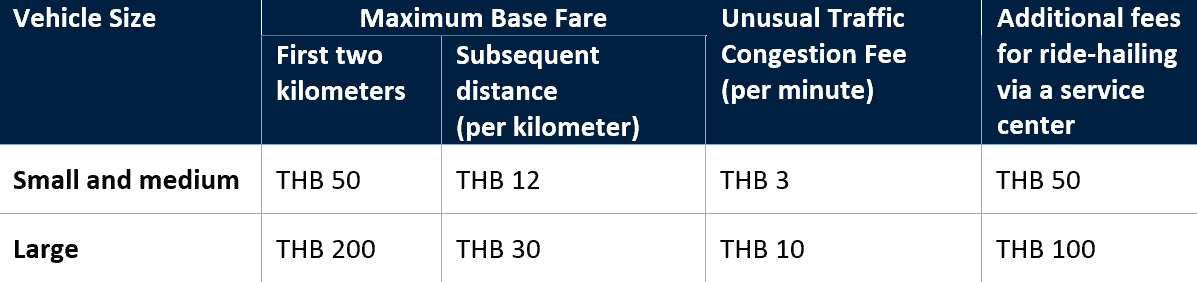
All fees must be shown to the passenger before the provision of any service, and only this same amount can be charged and collected.

For more details about this regulation, or about any aspect of transportation and technology laws in Thailand, please contact Charuwan Charoonchitsathian at [email protected] or +66 2056 5657, or Panchanit Trakarnvanich at [email protected] or +66 2056 5531.

RELATED INSIGHTS​ 

January 6, 2026
On December 30, 2025, Thailand’s Electronic Transactions Development Agency (ETDA) notified digital marketplace operators of a consolidated list of “high‑risk products” that are subject to strict monitoring on digital platforms. The list was jointly prepared by the Thai Industrial Standards Institute (TISI) and the Food and Drug Administration (FDA) to guide platform compliance in the initial phase of implementation of the Electronic Transaction Committee’s Notification on Other Measures for Marketplace for Goods with Specific Characteristics under Section 18(2) of the 2022 Royal Decree on Digital Platform Businesses Requiring Notification B.E.2568 (2025). The notice is addressed to operators of digital platform services that function as product marketplaces with specific characteristics laid out in the notification. The ETDA states that the TISI and the FDA are closely monitoring the high‑risk product categories on digital platforms, and the published list serves as the baseline reference for platform screening during the initial phase of the notification’s implementation. High‑Risk Product List The list aggregates categories of products that are illegal to sell online or are otherwise tightly regulated under Thai law, with an emphasis on health-related products, controlled substances, medical devices, and a wide range of industrial products that require certification or compliance with specified Thai Industrial Standards, as detailed below. Prohibited and tightly controlled health products. This includes all categories of modern medicines subject to control other than general household remedies; all categories of controlled herbal products except for over-the-counter herbal products; narcotics; psychotropic substances; and medical devices requiring use in medical facilities or a physician’s prescription. Selected industrial products requiring heightened controls. The list highlights dozens of TISI-regulated items commonly sold online. Examples include pacifiers, rice cookers, electrical wire, food wrap film, crayons, washing machines and dryers, air conditioners, electric cookers and air fryers, water heaters, microwave ovens, LED luminaires, hair dryers
January 5, 2026
On December 31, 2025, the government of Vietnam promulgated Decree No. 356/2025/ND-CP detailing and guiding the implementation of the new Personal Data Protection Law (PDPL) that was issued in June 2025. The new decree, like the PDPL, entered into force on January 1, 2026, with the previous Decree No. 13/2023/ND-CP on personal data protection ceasing effect on the same day. Some key points of the new decree include the following: Comprehensive lists of basic and sensitive personal data are provided, which will require companies to review again their existing documents and data type classification to ensure compliance. New timelines are established for responding to specific data subject requests. These timelines are more reasonable and longer than the previous 72-hour requirements. Additional consent guidelines are provided, prohibiting default consent or ambiguous instructions that confuse data subjects about giving or withholding consent. Mandatory content for data transfer agreements/clauses in particular cases is provided. This covers, among other things, (i) the legal basis for the transfer of personal data; (ii) responsibilities for personal data protection during the transfer and processing of personal data; (iii) responsibilities for ensuring the exercise of the rights of personal data subjects; and (iv) responsibilities for coordination and compliance of the parties in cases where violations of personal data protection regulations are detected. The qualifications and responsibilities of data protection officers (DPOs) and data protection departments include, among others, having been trained and fostered in legal knowledge and professional skills regarding personal data protection. There are no specific provisions governing the qualifications or requirements for organizations that provide data protection training or education. New mandatory templates and requirements are provided in relation to data processing impact assessment and data transfer impact assessment, and for cases in which companies need to re-submit assessments to the regulator. Stricter requirements are
December 30, 2025
On December 17, 2025, Laos’ Ministry of Industry and Commerce (MOIC) issued a notice introducing a new digital system that allows e-commerce businesses to obtain required certificates and licenses through an online, application-based platform. Notice No. 3988, which will take effect on February 1, 2026, introduces the E-Trust platform, a downloadable application that allows e-commerce businesses to remotely obtain acknowledgement certificates and business operating licenses. New Digital Registration Options Under the previous framework established by the Decree on E-commerce (2021), businesses were required to complete registration exclusively through paper-based submissions. The new system now offers businesses two registration options: Traditional paper-based process at the Division of E-commerce Management within the MOIC; or Electronic registration and renewal through the E-Trust platform. This change is expected to streamline procedures, reduce administrative burdens, and enhance accessibility for businesses operating outside Vientiane. The E-Trust platform facilitates compliance for both individuals and legal entities required to submit applications and renewals for required certificates and licenses. The development is particularly beneficial for businesses located in remote provinces, as it eliminates the need for physical travel and significantly accelerates processing times. Compliance Requirements and Penalties Businesses must obtain or renew the required certificates and licenses to avoid sanctions under the Decision on Fines and Other Measures for Violation of the Decree and Regulations on E-commerce (No. 2828/MOIC, dated November 11, 2025). Penalties for noncompliance may include monetary fines and other enforcement measures.
December 26, 2025
Thailand has granted ride-sharing platforms additional time to comply with new regulatory requirements, extending the compliance deadline to March 31, 2026 (replacing the previous deadline of October 2, 2025). The postponement was made official on December 18, 2025, when Thailand’s Electronic Transactions Development Agency (ETDA) published the second Notification Regarding Supervision of Ride-Hailing Platforms Classified as High-Impact Digital Platform Services under the Royal Decree on Digital Platform Service Businesses. The notification provides additional time for ride-sharing platforms and drivers to transition to full regulatory compliance. The extension replaces the effective date provision of the earlier notification and applies specifically to ride-hailing activities. Background The postponement responds to feedback from operators and driver groups regarding challenges converting private vehicles into legally registered public vehicles, including complex registration procedures, high compliance costs, and operational delays. The Department of Land Transport (DLT) is concurrently reforming its vehicle registration and driver verification processes to streamline operations. Given these issues, the Electronic Transactions Committee has deferred enforcement to provide an adjustment period for operators and drivers to meet compliance requirements. Ongoing Obligations While the effective date has been deferred, the substantive obligations imposed on ride-sharing platforms remain fully intact. Operators must continue preparing to comply with the additional duties applicable to high-impact digital platform services, beyond the general requirements under the digital platform services framework. Operators are expected to use the extended transition period to finalize operational and compliance readiness ahead of enforcement on March 31, 2026. Key focus areas include: Integration with DLT vehicle-registration systems Deployment of robust driver and passenger identity verification mechanisms Updates to platform terms of service, driver-onboarding standards, and internal operational policies Preparation for ETDA reporting obligations and future audit and review processes Next Steps While the postponement replaces the previous effective date with the new March 31, 2026,