You are using an outdated browser and your browsing experience will not be optimal. Please update to the latest version of Microsoft Edge, Google Chrome or Mozilla Firefox. Install Microsoft Edge

July 7, 2021

Thailand Introduces Online Ride-Hailing Services Regulations

Thailand’s Transport Ministry has issued new rules for ride-hailing services, aiming to strictly regulate the types of vehicle that can be registered, the number of registered vehicles per user, and the fees that are levied and collected. These rules are laid out in the Ministerial Regulation Re: Ride-Hailing Service Vehicle via an Electronic System B.E. 2564 (2021), which was published in the Royal Gazette on June 23, 2021.

Under the regulation, a personal vehicle transporting no more than seven passengers can be subsequently registered as a “ride-hailing service vehicle via an electronic system.” An individual is only allowed to register one private vehicle under the regulation. The vehicle registrations are classified as follows:

  • Small vehicles with a maximum engine power of 50–90 kilowatts;
  • Medium vehicles with a maximum engine power of 91–120 kilowatts; or
  • Large vehicles with a maximum engine power of more than 120 kilowatts.

In the case of an electric vehicle, it must be able to travel at a speed of at least 90 km/h.

Each ride-hailing vehicle must be covered by a service-providing communication system operated by an electronic service provider (e.g., a ride-hailing app) that has been endorsed and approved by the Department of Land Transport (DLT). This system must communicate the following details:

  • Car and driver information;
  • Driver’s identity system;
  • Pre-calculated fare;
  • Car tracking system;
  • Time and location validation system; and
  • Complaint and emergency system.

All data records must be retained for at least one month for examination purposes.

The regulation further prescribes that the vehicle must display a sign indicating that it is a ride-hailing service vehicle operating via an electronic system, and the vehicle must be the same color as appears in the personal vehicle registration certificate prior to its registration as a ride-hailing vehicle.

Registration under the regulation is valid for nine years. The ride-hailing vehicle registration plate’s size, specifications, and color are identical to the criteria for registering personal vehicles carrying no more than seven people, meaning that the same vehicle registration plate can be used for the ride-hailing vehicle. The condition of the ride-hailing vehicle must also be examined annually, as prescribed by ministerial regulations under the Vehicle Act B.E. 2522 (1979), and both the interior and exterior must be kept clean and tidy.

Service Fees

The regulation empowers the minister of transport to prescribe the fees for ride-hailing vehicles; the current fees are outlined in the table below.
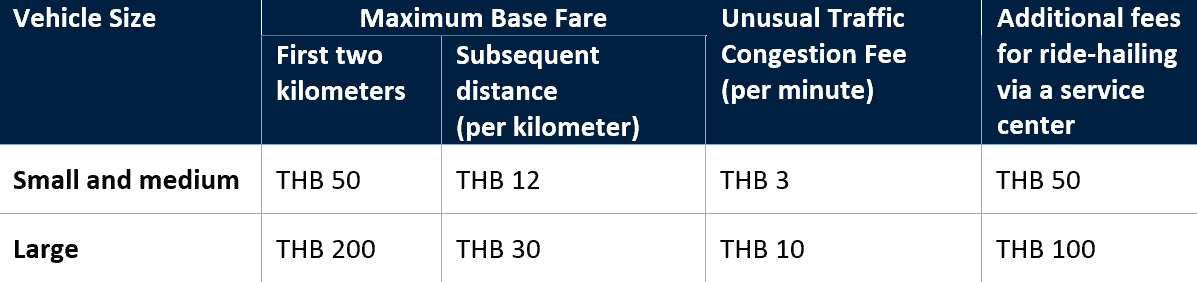
All fees must be shown to the passenger before the provision of any service, and only this same amount can be charged and collected.

For more details about this regulation, or about any aspect of transportation and technology laws in Thailand, please contact Charuwan Charoonchitsathian at [email protected] or +66 2056 5657, or Panchanit Trakarnvanich at [email protected] or +66 2056 5531.

RELATED INSIGHTS​ 

June 25, 2026
On June 18, 2026, Thailand’s Office of the Personal Data Protection Committee (PDPC) published two notifications in the Government Gazette establishing Thailand’s first formal certification framework for personal data protection standards under the Personal Data Protection Act B.E. 2562 (2019) (PDPA). The notifications, which took immediate effect, introduce a voluntary certification framework aimed at promoting accountability, strengthening organizational data protection governance, and aligning Thailand more closely with international frameworks that recognize certification as a key compliance tool. Certification Criteria The first notification sets out the assessment criteria for organizations seeking certification. Applicants must undergo an evaluation against a framework comprising four assessment categories, 10 focus areas, and 128 assessment criteria covering key elements of a privacy management program. These include: Organizational oversight and internal policies and procedures. Human resource development, including staff training and awareness programs. Clearly defined operational processes and procedures covering data subject rights, transparency obligations, records of processing activities, and lawful basis management, as well as contractual safeguards such as data-processing and data-sharing agreements and risk assessments, including Data Protection Impact Assessments. Technical measures encompassing data security controls and breach response capabilities Based on the assessment results, organizations may be awarded either a PDPA Compliance Certificate or a higher-level PDPA Certificate accompanied by a certification mark. Application and Assessment Process The second notification establishes the application and assessment process for obtaining certification. Eligible applicants include government agencies and private-sector entities that demonstrate sufficient privacy governance maturity and meet the prescribed eligibility requirements. Applicants must submit their applications along with supporting documentation for review. Upon receiving an application, the Office of the PDPC will conduct a detailed evaluation, which may include both documentary review and on-site inspections. Incomplete applications may be rejected, though applicants are typically given a limited period to correct deficiencies before a final decision
June 23, 2026
On May 26, 2026, Thailand’s Department of Land Transport (DLT) published for public consultation a draft amendment to the Ministerial Regulation on Electronic Ride-Hailing Vehicles that would, for the first time, allow juristic persons (legal entities) to register vehicles as electronic ride-hailing cars—a right that currently belongs exclusively to natural persons, limited to one person per one vehicle. If finalized in its current form, the regulation would significantly expand the supply side of Thailand’s ride-hailing market by enabling corporate fleet operators to enter the space. The public comment period is open through June 24, 2026. Key Principles Under the Draft Regulation Under the proposed amendment, juristic persons that maintain a fleet of at least 50 vehicles will be permitted to register vehicles as electronic ride-hailing cars. This represents a fundamental shift from the current framework, which restricts registration to individual natural persons on a one-person-one-car basis. Vehicle Specifications Corporate-owned ride-hailing vehicles must meet the following requirements: Be brand new from the factory, or no more than two years old from first registration with no more than 20,000 km of use. Not be a vehicle that has been reconstructed or repaired after involvement in a serious accident affecting safety—a standard consistent with public transport vehicles (RorYor. 6). Be classified as small, medium, or large in accordance with ministerial or director-general specifications. The vehicles may be equipped with safety devices such as interior or exterior cameras (video/photo recording) and can retain the original factory color of the vehicle body (no mandatory color change is required). License Plates Corporate ride-hailing vehicles will use license plates of the same size, characteristics, and color as those for private passenger vehicles not exceeding seven seats (RorYor. 1), rather than public transport plates. Potential Impact The government has stated that the regulation is intended to: Promote
June 23, 2026
On May 14, 2026, Thailand published a ministerial regulation in the Government Gazette to prescribe measures for prevention and suppression of technology crimes. The regulation creates a comprehensive procedural framework for returning money and digital assets to victims of technology crimes. It will take effect 90 days after publication (in mid-August 2026), giving affected entities a limited window to prepare. Mandatory Reporting Obligations for Financial Institutions When a deposit account, e-money account, or digital asset wallet is frozen in connection with a technology crime, the relevant financial institution or business operator must report transaction data to the Anti-Money Laundering Office (AMLO) via AMLO’s designated electronic system. Required data elements include account numbers (sender and receiver), names, identification or passport numbers, legal entity registration numbers, phone numbers, remaining balance, damage amount, transaction reference numbers, and the bank case ID. Institutions that already share data through the information-sharing system under the emergency decree are deemed to have satisfied this reporting obligation, creating an incentive for platform participation. When the Royal Thai Police or the Department of Special Investigation seize or freeze assets related to technology crimes, they must provide AMLO with investigation reports, complaint evidence, money-trail data, and account statements. Notification and Claims Process Once the AMLO secretary-general approves verified reports of a technology crime, the account information of persons connected to the crime will be published in the Government Gazette, triggering a 90-day window for victims to file claims and for related persons to file objections. Officers will also publish details on AMLO’s electronic media and send registered mail to identified victims, which will be deemed received after 7 days domestically or 15 days internationally. Victims have 90 days from the date the crime is published in the Government Gazette to file claims through AMLO’s electronic system. Claims must include
June 15, 2026
The surge in AI development has led to a desperate demand for large, high-quality training data. However, real-world data can be expensive to collect, difficult to access, and often subject to strict privacy and regulatory constraints. Synthetic data, which consists of artificially generated records that replicate the statistical properties of real-world data without reproducing specific individuals’ information, provides an appealing solution by generating artificial datasets at scale without relying on identifiable personal information. It combines speed, cost efficiency, and regulatory compliance, making it a sensible alternative for organizations seeking to reduce risks while maintaining data utility. When properly anonymized, synthetic datasets may fall outside the scope of laws such as the EU’s General Data Protection Regulation (GDPR) or Thailand’s Personal Data Protection Act (PDPA), reducing compliance burdens while still supporting high-quality model training. However, relying on synthetic data without rigorous legal due diligence could be a strategic mistake. It replaces one set of known risks (scraping, direct privacy liability) with a new set of complex liabilities. The narrative that synthetic data is a “silver bullet” for privacy and IP compliance is dangerous and could be misleading. While synthetic data addresses data scarcity, it also introduces new legal uncertainties. Legal counsel should anticipate downstream risks arising from compromised data sources. Models trained on unlawfully obtained data may need to be decommissioned, even if their outputs appear lawful. What is synthetic data? Synthetic data refers to artificially generated information created using AI techniques such as deep learning and generative models. Instead of copying real records, it reproduces the statistical patterns and relationships found in the original dataset. Synthetic data generally falls into three categories: Fully synthetic data – Entirely new data points generated from learned patterns. The model studies the structure of the original data and produces records that resemble real-world