You are using an outdated browser and your browsing experience will not be optimal. Please update to the latest version of Microsoft Edge, Google Chrome or Mozilla Firefox. Install Microsoft Edge

July 7, 2021

Thailand Introduces Online Ride-Hailing Services Regulations

Thailand’s Transport Ministry has issued new rules for ride-hailing services, aiming to strictly regulate the types of vehicle that can be registered, the number of registered vehicles per user, and the fees that are levied and collected. These rules are laid out in the Ministerial Regulation Re: Ride-Hailing Service Vehicle via an Electronic System B.E. 2564 (2021), which was published in the Royal Gazette on June 23, 2021.

Under the regulation, a personal vehicle transporting no more than seven passengers can be subsequently registered as a “ride-hailing service vehicle via an electronic system.” An individual is only allowed to register one private vehicle under the regulation. The vehicle registrations are classified as follows:

  • Small vehicles with a maximum engine power of 50–90 kilowatts;
  • Medium vehicles with a maximum engine power of 91–120 kilowatts; or
  • Large vehicles with a maximum engine power of more than 120 kilowatts.

In the case of an electric vehicle, it must be able to travel at a speed of at least 90 km/h.

Each ride-hailing vehicle must be covered by a service-providing communication system operated by an electronic service provider (e.g., a ride-hailing app) that has been endorsed and approved by the Department of Land Transport (DLT). This system must communicate the following details:

  • Car and driver information;
  • Driver’s identity system;
  • Pre-calculated fare;
  • Car tracking system;
  • Time and location validation system; and
  • Complaint and emergency system.

All data records must be retained for at least one month for examination purposes.

The regulation further prescribes that the vehicle must display a sign indicating that it is a ride-hailing service vehicle operating via an electronic system, and the vehicle must be the same color as appears in the personal vehicle registration certificate prior to its registration as a ride-hailing vehicle.

Registration under the regulation is valid for nine years. The ride-hailing vehicle registration plate’s size, specifications, and color are identical to the criteria for registering personal vehicles carrying no more than seven people, meaning that the same vehicle registration plate can be used for the ride-hailing vehicle. The condition of the ride-hailing vehicle must also be examined annually, as prescribed by ministerial regulations under the Vehicle Act B.E. 2522 (1979), and both the interior and exterior must be kept clean and tidy.

Service Fees

The regulation empowers the minister of transport to prescribe the fees for ride-hailing vehicles; the current fees are outlined in the table below.
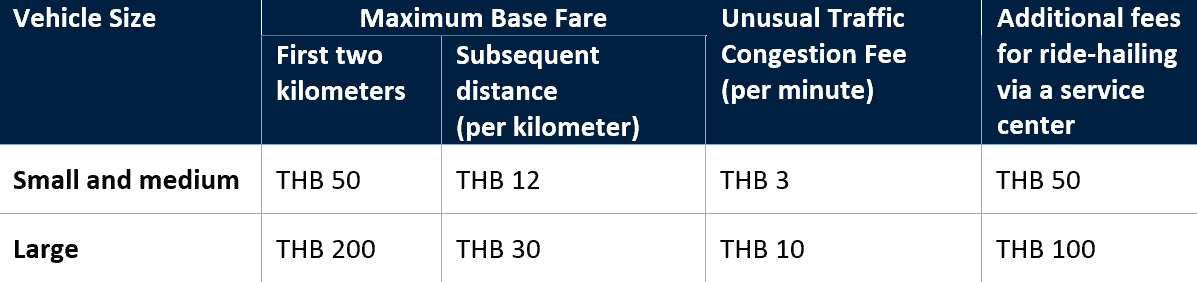
All fees must be shown to the passenger before the provision of any service, and only this same amount can be charged and collected.

For more details about this regulation, or about any aspect of transportation and technology laws in Thailand, please contact Charuwan Charoonchitsathian at [email protected] or +66 2056 5657, or Panchanit Trakarnvanich at [email protected] or +66 2056 5531.

RELATED INSIGHTS​ 

July 15, 2025
Thailand has established new safe harbor rules that require social media platforms to remove specified content within 24 hours of government notification. On July 5, 2025, the Notification of the Electronic Transactions Commission on Measures to Prevent Technological Crimes for Social Media Service Providers was issued and took effect. This followed a hearing in May 2025 where only a select group of social media and online communication platform operators were invited to attend and comment on draft rules that could exempt social media platform operators from joint liability under the amended Emergency Decree on Measures for the Prevention and Suppression of Technological Crimes in cases involving victims of technological crimes. Safe Harbor Rules The notification stipulates procedures that must be followed in order to receive the protection of the safe harbor rules. Upon being notified by the Division of Prevention and Suppression of Cybercrime, Office of the Permanent Secretary of the Ministry of Digital Economy and Society (MDES) of the presence of false or misleading information that may lead to the commission of a technological crime, social media service providers must immediately take down the specified content, with a maximum allowable turnaround time of 24 hours from the time of receiving the notification. Social media service providers are required to promptly report the outcome of each takedown to the MDES Division of Prevention and Suppression. This shift in Thailand’s regulatory approach to social media content moderation establishes clear government oversight mechanisms while providing platforms with liability protection for compliance. As the new rules took immediate effect, social media platforms need to ensure that they have adequate systems and processes in place to comply with the requirements.
July 11, 2025
Vietnam’s recent embrace of “regulatory sandboxes” reflects a deliberate policy choice to balance the need for robust oversight with an equally pressing imperative to catalyze innovation. A sandbox is a controlled, time-bound framework in which businesses may pilot emerging technologies, products, or business models under relaxed or tailor-made regulatory requirements, thereby allowing regulators to observe risks in real time while innovators validate commercial viability without bearing the full weight of the traditional compliance regime. By issuing sandbox regulations, the government of Vietnam is signaling its commitment to accelerating digital transformation, attracting investment, and developing a knowledge-based economy, all while safeguarding financial stability, consumer protection, and national security. This strategy is embodied in a suite of instruments that together establish sector-specific sandboxes: Decree No. 94/2025/ND-CP on the Regulatory Sandbox in the Banking Sector (Fintech Sandbox Decree), effective July 1, 2025. Law on Digital Technology Industry (DTI Law), effective January 1, 2026, and Law on Science, Technology and Innovation (STI Law), effective October 1, 2025. Resolution No. 222/2025/QH15 on International Financial Centers (IFC Resolution), effective September 1, 2025. In addition, a draft resolution on the pilot implementation of the crypto-asset market (Draft Crypto Pilot Resolution) is expected to introduce a dedicated sandbox for crypto-asset service providers later this year, further underscoring Vietnam’s holistic, forward-looking approach to regulating emerging technologies. Below is a brief summary of all the regulatory sandboxes, who they are open for, and what businesses are attracted. Fintech Sandbox Decree Under the Fintech Sandbox Decree, besides credit institutions and foreign bank branches, fintech companies operating in Vietnam can apply for a Certificate of Sandbox Participation issued by the State Bank of Vietnam to operate any of the following services in Vietnam: Credit scoring: A solution applicable to information technology systems of credit institutions, branches of foreign banks, and fintech
July 11, 2025
On June 10, 2025, Thailand’s Supreme Administrative Court accepted for consideration a pivotal lawsuit concerning the regulatory obligations of administrative agencies over internet-based television broadcasting services, commonly referred to as over-the-top (OTT) services. This court’s decision in the case may set important precedents for how OTT platforms are regulated, especially regarding consumer protections and advertising practices. Background A user of an OTT television application initiated legal action against the National Broadcasting and Telecommunications Commission (NBTC) and related officials, alleging that the lack of clear regulatory criteria and oversight allowed OTT operators to broadcast general television content while compelling users to view advertisements before and during programming. The plaintiff argued this constituted consumer exploitation and claimed that the responsible authorities neglected or delayed their statutory duties under the Act on the Organization to Assign Radio Frequencies and Regulate Broadcasting, Television, and Telecommunications Services B.E. 2553 (2010). Initially, the Central Administrative Court declined to accept the lawsuit. However, on appeal, the Supreme Administrative Court determined that the claim fell within its jurisdiction, noting that OTT television services—defined under section 4 of the governing act—are subject to the same regulatory framework as traditional television services, regardless of the transmission method (frequency, cable, internet, or other system). Implications for OTT Services The key implications for OTT services concern the following issues: Regulatory oversight: The court recognized that OTT television services are explicitly covered under Thailand’s broadcast regulatory regime. Regulatory agencies may be compelled to establish clear operational rules and oversight mechanisms for OTT providers. Consumer protections: The plaintiff’s claim that excessive or unavoidable in-program advertising constitutes consumer exploitation was acknowledged as a matter of public interest. This may prompt stricter advertising standards for OTT platforms. Licensing requirements: The case raises the prospect that OTT operators may be required to obtain licenses from the
July 10, 2025
For companies and individuals doing business in Vietnam, a common question is whether electronic signatures (e-signatures) are legally recognized under Vietnamese law. This matter is governed by Law No. 20/2023/QH15 on Electronic Transactions issued on June 22, 2023 (ETL 2023) and its guiding legal documents such as Decree No. 23/2025/ND-CP dated February 21, 2025, and Circular 06/2024/TT-BTTTT dated July 1, 2024 (Circular 06). Recognition of Validity of E-signatures in Vietnam As a general principle, the ETL 2023 confirms that an e-signature cannot be denied legal validity solely due to its electronic form. The law categorizes e-signatures into three types: Type 1: Specialized e-signatures for organizations Type 2: Public digital signatures for individuals and organizations Type 3: Specialized digital signatures for government agencies Among these types, only secure specialized e-signatures (a secure e-signature of type 1) and digital signatures (type 2) are explicitly granted the same legal validity as handwritten (wet) signatures. This distinction is particularly important in legal disputes and for transactions with government agencies. (For more details, please refer to our previous article.) Domestic e-signatures A domestic organization can choose to use secure specialized e-signatures (type 1) and/or digital signatures (type 2) while a Vietnam-based individual can choose digital signatures (type 2) for their transactions—particularly for those involving government agencies and transactions of high value and complexity which require stronger legal protection. Specialized e-signatures (type 1) can be created by the organizations themselves, and additionally must be “secure” to be explicitly recognized as having the same legal validity as handwritten signatures. For clarity, “secure” specialized e-signatures are those certified (granted a safety certificate) by the Ministry of Science and Technology (MST). (This was formerly the responsibility of the Ministry of Information and Communications, which was merged with MST under Vietnam’s 2025 administrative restructuring.) Digital signatures (type 2) are