You are using an outdated browser and your browsing experience will not be optimal. Please update to the latest version of Microsoft Edge, Google Chrome or Mozilla Firefox. Install Microsoft Edge

July 7, 2021

Thailand Introduces Online Ride-Hailing Services Regulations

Thailand’s Transport Ministry has issued new rules for ride-hailing services, aiming to strictly regulate the types of vehicle that can be registered, the number of registered vehicles per user, and the fees that are levied and collected. These rules are laid out in the Ministerial Regulation Re: Ride-Hailing Service Vehicle via an Electronic System B.E. 2564 (2021), which was published in the Royal Gazette on June 23, 2021.

Under the regulation, a personal vehicle transporting no more than seven passengers can be subsequently registered as a “ride-hailing service vehicle via an electronic system.” An individual is only allowed to register one private vehicle under the regulation. The vehicle registrations are classified as follows:

  • Small vehicles with a maximum engine power of 50–90 kilowatts;
  • Medium vehicles with a maximum engine power of 91–120 kilowatts; or
  • Large vehicles with a maximum engine power of more than 120 kilowatts.

In the case of an electric vehicle, it must be able to travel at a speed of at least 90 km/h.

Each ride-hailing vehicle must be covered by a service-providing communication system operated by an electronic service provider (e.g., a ride-hailing app) that has been endorsed and approved by the Department of Land Transport (DLT). This system must communicate the following details:

  • Car and driver information;
  • Driver’s identity system;
  • Pre-calculated fare;
  • Car tracking system;
  • Time and location validation system; and
  • Complaint and emergency system.

All data records must be retained for at least one month for examination purposes.

The regulation further prescribes that the vehicle must display a sign indicating that it is a ride-hailing service vehicle operating via an electronic system, and the vehicle must be the same color as appears in the personal vehicle registration certificate prior to its registration as a ride-hailing vehicle.

Registration under the regulation is valid for nine years. The ride-hailing vehicle registration plate’s size, specifications, and color are identical to the criteria for registering personal vehicles carrying no more than seven people, meaning that the same vehicle registration plate can be used for the ride-hailing vehicle. The condition of the ride-hailing vehicle must also be examined annually, as prescribed by ministerial regulations under the Vehicle Act B.E. 2522 (1979), and both the interior and exterior must be kept clean and tidy.

Service Fees

The regulation empowers the minister of transport to prescribe the fees for ride-hailing vehicles; the current fees are outlined in the table below.
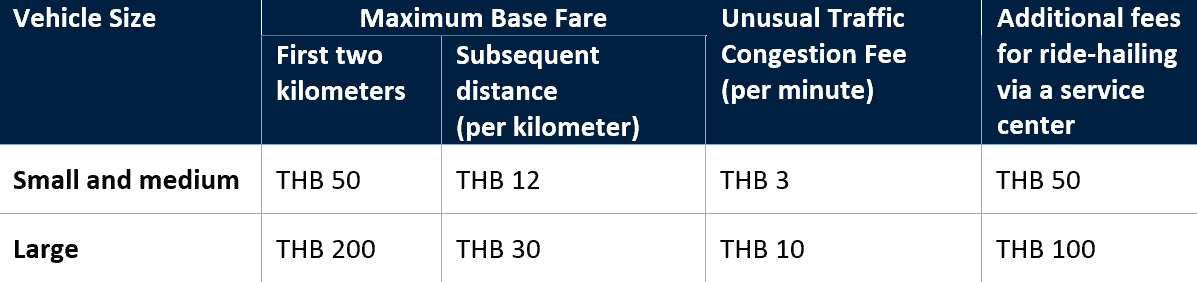
All fees must be shown to the passenger before the provision of any service, and only this same amount can be charged and collected.

For more details about this regulation, or about any aspect of transportation and technology laws in Thailand, please contact Charuwan Charoonchitsathian at [email protected] or +66 2056 5657, or Panchanit Trakarnvanich at [email protected] or +66 2056 5531.

RELATED INSIGHTS​ 

September 2, 2025
Thailand’s National Space Policy Committee (NSPC) has proposed new regulations that would permit foreign satellite operators to provide services within the country. The draft announcement responds to rapid advancements in digital and space technologies that have led to new global satellite operators expanding their services worldwide, including into Thailand. These include low-Earth-orbit (LEO) satellite constellations offering high-speed internet, nonterrestrial network (NTN) technologies that integrate terrestrial and satellite communications, and direct-to-device (D2D) technologies that transmit signals directly from satellites to mobile devices without relying on terrestrial networks. The draft aims to replace the existing announcement, which was issued in 2021, to better align with current national policies on foreign satellite usage. The draft announcement was published for public consultation on August 20, 2025, with the comment period concluding on September 3, 2025. Applying for Authorization Two types of operators may apply for authorization: Thai operators who intend to use foreign satellites owned by World Trade Organization (WTO) member countries to provide satellite communication services to third parties; and Foreign operators of satellites owned by WTO member countries who intend to operate a business providing satellite communication services within Thailand. Applications for approval must be submitted to the National Broadcasting and Telecommunications Commission (NBTC) according to the NBTC’s established procedures. In considering whether to permit foreign satellites to provide services within Thailand, the relevant authority will take into account technical justifications, economic benefits, social benefits, and national security considerations. Determining Satellite Ownership The determination of which country qualifies as the owner of a satellite is based primarily on the country that holds the satellite network filing rights registered with the International Telecommunication Union (ITU). The satellite network filing includes details regarding frequency usage, orbital positions, and technical specifications of the satellite operations. It serves as a regulatory tool used by the
August 25, 2025
Artificial intelligence (AI), semiconductors, and digital assets are considered critical drivers of Vietnam’s future economic growth and are fundamental to the nation’s digital transformation targets. These sectors form the core of Vietnam’s strategy to build a robust, globally competitive digital economy. This strategic direction gained substantial momentum with the issuance of the Law on Digital Technology Industry (DTI Law) on June 14, 2025. The DTI Law was designed to attract investment, stimulate innovation, cultivate high-quality human resources, and ensure the responsible, secure, and sustainable growth of digital technologies like AI and digital assets, harmonizing Vietnam’s digital industry with international standards while safeguarding public interests and national security. Several key provisions of the DTI Law took effect on July 1, 2025, and the law will become fully effective on January 1, 2026. The government is delegated to provide further necessary guidelines and details for implementation of the law. Artificial Intelligence (AI): Principle-Driven and Risk-Based Regulations Under the DTI Law, there are seven core principles guiding the development, provision, and use of AI which are applicable to AI developers, providers and deployers. These principles favor values-based governance over purely technical prescriptions, and include the following: Taking a human-centered approach that upholds ethical values, inclusivity, flexibility, equality, and non-discrimination. Ensuring transparency, accountability, and explainability, with AI systems remaining under human control. Maintaining cybersecurity and system safety. Adherence to data protection and privacy regulations. Having the ability to control AI algorithms and models. Effective risk management throughout the entire lifecycle of AI systems. Compliance with consumer protection laws and other relevant legal frameworks. AI system management follows a risk-based approach, with the law categorizing systems into high-risk, high-impact, and other groups. High-risk AI systems are those that, in certain applications, may pose significant threats or harm to individuals or the public interest while
August 21, 2025
On August 19, 2025, the Trade Competition Commission of Thailand (TCCT) released its draft Guidelines on the Consideration of Unfair Trade Practices and Conduct Constituting Monopoly, Reducing Competition, or Restricting Competition in Multi-Sided Platform Businesses in the Category of Digital Platforms for the Sale of Goods or Services (E-commerce). A public comment period on the guidelines is open until September 18. The draft provides the first detailed framework for how the TCCT will interpret and enforce the substantive provisions under the Trade Competition Act against digital platforms, which have a unique network effect and require complex competition analysis. This development will profoundly impact the operations of e-commerce platforms, sellers, and associated service providers in Thailand. The guidelines primarily target e-commerce digital platform business operators, which are defined as follows: E-commerce digital platform: A medium facilitating the sale, purchase, or exchange of goods or services, including any operations to create transactions or interactions between business operators via an electronic transaction system, regardless of whether service fees are charged. E-commerce digital platform business operator: A service provider of a digital platform for the sale of goods or services who acts as an intermediary facilitating the sale of goods or services, including any operations to create transactions or interactions through an electronic transaction system by receiving orders for goods or services transacted via an electronic system, whether in the form of an e-marketplace, a social marketplace, or any other form that connects purchase orders for goods or services with business operators through an electronic system. Prohibited Conduct The guidelines classify potentially anticompetitive conduct and unfair trade practices into two categories: price-related and non-price-related conduct. 1. Price-related conduct The TCCT is targeting pricing strategies that can harm competition. Key prohibited behaviors include: Price below cost: Setting prices below the average total cost without