You are using an outdated browser and your browsing experience will not be optimal. Please update to the latest version of Microsoft Edge, Google Chrome or Mozilla Firefox. Install Microsoft Edge

July 7, 2021

Thailand Introduces Online Ride-Hailing Services Regulations

Thailand’s Transport Ministry has issued new rules for ride-hailing services, aiming to strictly regulate the types of vehicle that can be registered, the number of registered vehicles per user, and the fees that are levied and collected. These rules are laid out in the Ministerial Regulation Re: Ride-Hailing Service Vehicle via an Electronic System B.E. 2564 (2021), which was published in the Royal Gazette on June 23, 2021.

Under the regulation, a personal vehicle transporting no more than seven passengers can be subsequently registered as a “ride-hailing service vehicle via an electronic system.” An individual is only allowed to register one private vehicle under the regulation. The vehicle registrations are classified as follows:

  • Small vehicles with a maximum engine power of 50–90 kilowatts;
  • Medium vehicles with a maximum engine power of 91–120 kilowatts; or
  • Large vehicles with a maximum engine power of more than 120 kilowatts.

In the case of an electric vehicle, it must be able to travel at a speed of at least 90 km/h.

Each ride-hailing vehicle must be covered by a service-providing communication system operated by an electronic service provider (e.g., a ride-hailing app) that has been endorsed and approved by the Department of Land Transport (DLT). This system must communicate the following details:

  • Car and driver information;
  • Driver’s identity system;
  • Pre-calculated fare;
  • Car tracking system;
  • Time and location validation system; and
  • Complaint and emergency system.

All data records must be retained for at least one month for examination purposes.

The regulation further prescribes that the vehicle must display a sign indicating that it is a ride-hailing service vehicle operating via an electronic system, and the vehicle must be the same color as appears in the personal vehicle registration certificate prior to its registration as a ride-hailing vehicle.

Registration under the regulation is valid for nine years. The ride-hailing vehicle registration plate’s size, specifications, and color are identical to the criteria for registering personal vehicles carrying no more than seven people, meaning that the same vehicle registration plate can be used for the ride-hailing vehicle. The condition of the ride-hailing vehicle must also be examined annually, as prescribed by ministerial regulations under the Vehicle Act B.E. 2522 (1979), and both the interior and exterior must be kept clean and tidy.

Service Fees

The regulation empowers the minister of transport to prescribe the fees for ride-hailing vehicles; the current fees are outlined in the table below.
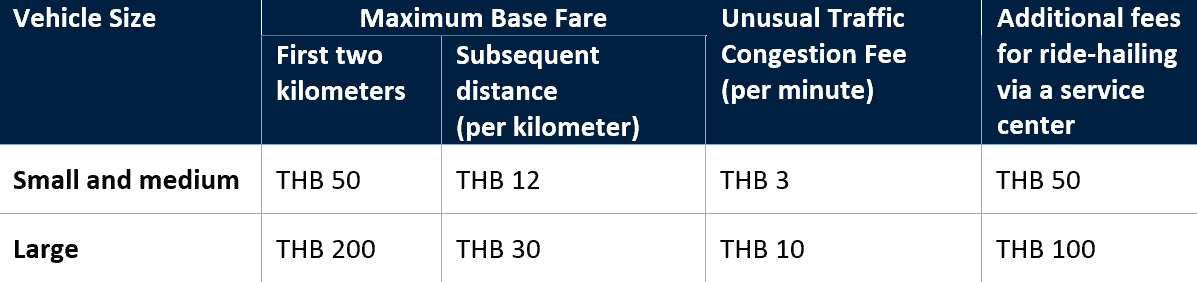
All fees must be shown to the passenger before the provision of any service, and only this same amount can be charged and collected.

For more details about this regulation, or about any aspect of transportation and technology laws in Thailand, please contact Charuwan Charoonchitsathian at [email protected] or +66 2056 5657, or Panchanit Trakarnvanich at [email protected] or +66 2056 5531.

RELATED INSIGHTS​ 

December 26, 2025
The Bank of Thailand (BOT) has released the Guidelines for Digital Fraud Management, which took effect on December 17, 2025, incorporating certain amendments to the draft guidelines issued in March 2025. These official guidelines aim for end-to-end digital fraud prevention, with a particular focus on mule accounts, to enhance trust and security in Thailand’s financial system. The guidelines apply to “financial service providers,” including: Financial institutions and special financial institutions under the Financial Institution Business Act; and Operators of Inter-institutional Fund Transfer System e-money services and e-fund transfer services under the Payment Systems Act. Besides commercial banks and e-money operators that offer fund-transfer services, other providers may adopt requirements based on risk proportionality and baseline standards set out in the guidelines (for instance, an e-money operator that does not offer e-fund transfer services could consider implementing a fraud monitoring and detection system according to the risk level of its service). The guidelines establish the following key requirements: Policy and oversight. Directors and senior executives of financial service providers must adopt appropriate “end-to-end” fraud management policies and KPIs to manage digital fraud, covering prevention, monitoring, detection, management, resolution, and support for affected customers. The fraud management policy must be regularly reviewed, and whenever there is a situation or change that significantly affects the efficiency of the fraud management. Any significant update to the policy must first be approved by the board of the financial service provider. The BOT also encourages providers to collaborate in establishing industry standards aligned with applicable laws and regulations to ensure consistency and best practices across the sector. Fraud management processes. Financial service providers must establish a clear framework for managing digital fraud throughout the customer lifecycle—from customer onboarding to service termination—covering at least the following processes: Know your customer (KYC) and customer due diligence (CDD):
December 15, 2025
Thailand is taking steps to energize its startup scene by drafting the Startup Promotion Law. This draft law aims to remove obstacles, open new funding opportunities, and provide coordinated government support. The goal is to make it easier for Thailand-based startups to grow and compete on a global stage. Why Is This Law Needed? For many years, Thai startups have operated under traditional company law frameworks that were not designed with high-growth businesses or with fundraising opportunities in mind. Restrictions on issuing bonds, offering shares to outside investors, and repurchasing shares for employee incentive programs made it challenging for emerging companies to access capital and accelerate their growth. The draft Startup Promotion Act seeks to remove these obstacles and foster a more competitive, entrepreneur-friendly environment in Thailand. Who’s in Charge? Two main organizations will oversee the startup ecosystem: Startup Promotion Committee: This group, to be appointed by the National Science, Research, and Innovation Policy Council, will set national strategies, policies, and budget; design promotional campaign and incentives; and propose further legislative amendments to promote startups. National Innovation Agency (NIA): Under the draft act, the NIA will be the main contact for startups and will serve as the secretariat office of the Startup Promotion Committee, coordinating data, advising startups, maintaining the public registry, and providing funding and investment (grants, repayable grants, loans, and equity) under committee criteria and, where applicable, cabinet approval. What Startups Are Eligible for Benefits? To be officially recognized and access benefits, a company must: Be a private limited company less than 10 years old at the time of application. Existing companies that already exceed the 10-year threshold may still apply for startup statues within one year of the law’s enactment, as long as they otherwise still qualify for the new regime. Have average annual revenue not
December 12, 2025
Tilleke & Gibbins has updated the Cambodia, Myanmar, Thailand, and Vietnam chapters in Multilaw’s Global Data Protection Guide, which collects expert advice from Multilaw member firms in 90 jurisdictions around the world (including a Laos chapter, which is also authored by Tilleke & Gibbins). The guide provides answers to key issues concerning the fast-developing data protection and privacy laws around the world, and helps data protection officers and in-house counsel understand how the regulatory regime for data protection can affect their organizations in various jurisdictions. Each section of the guide identifies the main laws that govern data protection in that jurisdiction, and gives a detailed overview of the legal principles in place as well as the enforcement authorities responsible for overseeing compliance. The guide also covers issues related to data subject rights, data protection officers, impact assessments, data breach notification requirements, and cross border data transfers. The use of personal data in marketing is also considered, with specific information on electronic marketing rules, cookies, and marketing to businesses and consumers. Multilaw, of which Tilleke & Gibbins is a longtime member, is a global network of carefully selected independent law firms able to provide expert legal advice in complex environments around the globe. The full guide is available for free on the Multilaw website.
December 11, 2025
On December 10, 2025, the National Assembly of Vietnam passed a new Cybersecurity Law, which will take effect on July 1, 2026. The new Cybersecurity Law was developed based on the consolidation of the 2018 Cybersecurity Law and the 2015 Law on Network Information Security. While the final approved version of the new Cybersecurity Law has not yet been published, according to official reports, the following notable requirements are confirmed to be included: The new Cybersecurity Law dedicates a specific article to prohibited acts related to cybersecurity, under which it strictly prohibits posting or disseminating information online that propagandizes against the Socialist Republic of Vietnam. The law also prohibits, among other things, (i) the appropriation, trading, seizure, or intentional disclosure of information classified as state secrets, work secrets, business secrets, personal secrets, family secrets, and private life; (ii) intentionally eavesdropping, recording, or filming online conversations without authorization; and (iii) the use of artificial intelligence (AI) or new technologies to conduct prohibited acts. The Ministry of Public Security (MPS) has the authority to require enterprises providing telecommunications, internet, and online services, as well as system administrators, to remove information violating cybersecurity laws from systems under their management. The MPS is also assigned responsibility for ensuring information security in cyberspace and data security, establishing mechanisms for IP address identity management, verifying digital account registration information, and issuing warnings and sharing information on cybersecurity threats. Information systems are classified into five levels (similar to the 2015 Law on Network Information Security) based on the degree of harm to national security and social order if an incident occurs. The MPS is the lead agency assisting the government in state management of cybersecurity. The Ministry of National Defense is responsible for managing military information systems, and the Government Cipher Committee manages cryptographic and cipher