You are using an outdated browser and your browsing experience will not be optimal. Please update to the latest version of Microsoft Edge, Google Chrome or Mozilla Firefox. Install Microsoft Edge

July 7, 2021

Thailand Introduces Online Ride-Hailing Services Regulations

Thailand’s Transport Ministry has issued new rules for ride-hailing services, aiming to strictly regulate the types of vehicle that can be registered, the number of registered vehicles per user, and the fees that are levied and collected. These rules are laid out in the Ministerial Regulation Re: Ride-Hailing Service Vehicle via an Electronic System B.E. 2564 (2021), which was published in the Royal Gazette on June 23, 2021.

Under the regulation, a personal vehicle transporting no more than seven passengers can be subsequently registered as a “ride-hailing service vehicle via an electronic system.” An individual is only allowed to register one private vehicle under the regulation. The vehicle registrations are classified as follows:

  • Small vehicles with a maximum engine power of 50–90 kilowatts;
  • Medium vehicles with a maximum engine power of 91–120 kilowatts; or
  • Large vehicles with a maximum engine power of more than 120 kilowatts.

In the case of an electric vehicle, it must be able to travel at a speed of at least 90 km/h.

Each ride-hailing vehicle must be covered by a service-providing communication system operated by an electronic service provider (e.g., a ride-hailing app) that has been endorsed and approved by the Department of Land Transport (DLT). This system must communicate the following details:

  • Car and driver information;
  • Driver’s identity system;
  • Pre-calculated fare;
  • Car tracking system;
  • Time and location validation system; and
  • Complaint and emergency system.

All data records must be retained for at least one month for examination purposes.

The regulation further prescribes that the vehicle must display a sign indicating that it is a ride-hailing service vehicle operating via an electronic system, and the vehicle must be the same color as appears in the personal vehicle registration certificate prior to its registration as a ride-hailing vehicle.

Registration under the regulation is valid for nine years. The ride-hailing vehicle registration plate’s size, specifications, and color are identical to the criteria for registering personal vehicles carrying no more than seven people, meaning that the same vehicle registration plate can be used for the ride-hailing vehicle. The condition of the ride-hailing vehicle must also be examined annually, as prescribed by ministerial regulations under the Vehicle Act B.E. 2522 (1979), and both the interior and exterior must be kept clean and tidy.

Service Fees

The regulation empowers the minister of transport to prescribe the fees for ride-hailing vehicles; the current fees are outlined in the table below.
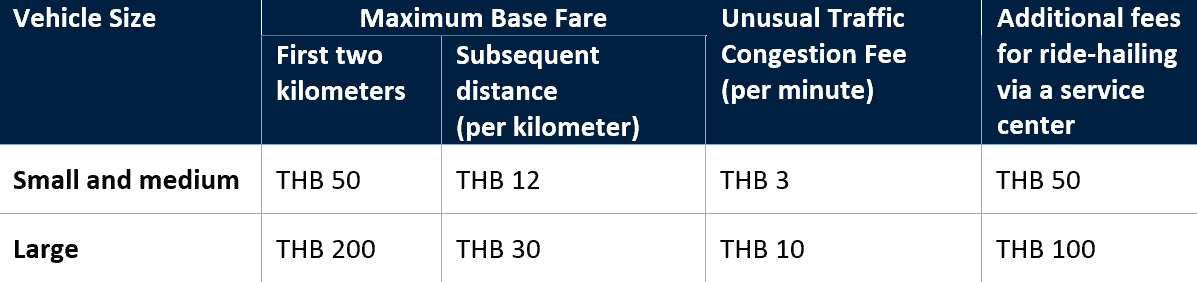
All fees must be shown to the passenger before the provision of any service, and only this same amount can be charged and collected.

For more details about this regulation, or about any aspect of transportation and technology laws in Thailand, please contact Charuwan Charoonchitsathian at [email protected] or +66 2056 5657, or Panchanit Trakarnvanich at [email protected] or +66 2056 5531.

RELATED INSIGHTS​ 

March 13, 2026
Vietnam’s Law on Intellectual Property (IP Law) has undergone continuous amendment in recent years, with the latest amendment issued at the end of 2025. Among the amended and supplemented provisions, the regulation that has perhaps attracted the most attention is a provision relating to the use of protected IP objects by artificial intelligence (AI) systems. Specifically, Article 7 of the 2025 IP Law introduces a completely new Clause 5, which reads in full as follows: “Organizations and individuals are permitted to use texts and data relating to intellectual property objects that have been lawfully published, and which the public is allowed to access, for the purposes of scientific research, experimentation, and training of artificial intelligence systems, provided that such use will not unreasonably affect the legitimate rights and interests of the authors and intellectual property rights holders in accordance with this Law. With respect to texts and data that are objects protected by copyright and related rights, the use of the texts and data as set forth herein must also be in accordance with the regulations of the Government.” Analyzing this newly added provision in the context of how it was conceived, as well as the challenges that still lie ahead, can provide some interesting insights. From Aspirations to Flight in Science and Technology From the end of 2024 and throughout 2025—the 50th anniversary of the country’s reunification—Vietnam witnessed numerous sweeping changes in many areas, including legislative development. It could be said that no sessions of the National Assembly have ever adopted as many laws, resolutions, and major policies as this one. The aspirations of the highest-level leadership have been concretized into major law and policy projects, which were drafted, developed, and passed at record speed. All of this was aimed at building a foundation for Vietnam to achieve
March 12, 2026
Thailand’s AI legislative framework took another step forward when the Office of the Consumer Protection Board (OCPB) issued a notification establishing guidelines for AI-generated advertising that may cause material misunderstanding about products or services. The notification, which is already in effect, was issued under the Consumer Protection Act B.E. 2522 (1979) and its amendments, which prohibit advertising that is unfair to consumers or may cause harm to society, including false or exaggerated statements and statements that may cause material misunderstanding about products or services. The notification addresses emerging advertising practices, including the use of images edited using software or AI to attract consumer interest or build credibility. The OCPB noted that such advertising may result in consumers misunderstanding the essential characteristics, condition, or usage of products, which violates consumer rights and causes damage. Key Requirements on AI-Generated or Digitally Manipulated Advertising Content For advertisements using still images or videos created or edited with software programs or AI tools that may cause the depicted product or service to differ from the actual product sold or service provided—which may cause misunderstanding regarding the condition, quality, quantity, or other essential aspects of the products or services—advertisers and business operators must comply with the following requirements: Prior authorization. Obtain approval from relevant regulatory authorities where required by law. Accurate representation. Ensure that the advertised size, quantity, volume, number, or composition matches the actual product or service being sold, whether in still images or videos. Mandatory AI disclosure labels. Display clear disclosures when AI or software is used to create or edit images, such as: “Real image or simulation edited using AI” “Photo from actual location or simulation edited using AI” “Photo from actual product or edited simulation” “Image created by AI” “Video created by AI” Clarity of disclosure. Ensure disclosures are clearly visible,
March 10, 2026
Thailand’s Ministry of Finance and Securities and Exchange Commission (SEC) have issued regulations broadening the criteria for determining who qualifies as a “major shareholder” of licensed securities and digital asset business operators. Under relevant SEC regulations, major shareholders of a regulated entity must obtain regulatory approval and undergo screening by the SEC. The revised framework introduces both shareholding-based and control-based tests to determine which shareholders require regulatory approval for a wider range of indirect ownership structures and de facto control. The Ministry of Finance notification took effect on February 21, 2026, while the SEC’s clarifying rules took effect on March 4, 2026. These changes aim to enhance transparency around beneficial ownership and strengthen regulatory oversight of entities operating in Thailand’s capital markets. Expanded Definition Under the revised framework, a “major shareholder” now includes persons who directly or indirectly hold more than 10% of the voting rights in a regulated company, as well as persons who exercise control over the regulated company or its shares. This system of two separate tests, based on both shareholding and control, differs from the prior regime, which focused primarily on shareholding thresholds and applied a more limited method for determining indirect shareholdings. The two tests (detailed below) operate independently of each other, and any person identified by either of the tests will be deemed a major shareholder. Shareholding-Based Test Broadens Indirect Ownership Attribution For the shareholding-based test, the SEC recognizes two existing methods for identifying indirect ownership, together with a new proportional attribution method. Any person captured under these methods, which are described below, will be regarded as a major shareholder of the regulated company and must obtain SEC approval as a major shareholder. First, the existing framework continues to apply to both first-tier and chain ownership structures. Approval is required for (1) first-tier
March 9, 2026
Over the past several years, numerous automobile manufacturers have brought electric vehicles (EVs) to the market and received positive feedback from consumers in Thailand and around the world. EVs have gained popularity due to their lower maintenance costs, reduced energy expenses, and environmental benefits. However, reports have emerged of EVs causing problems such as battery fires, autopilot malfunctions leading to accidents, and safety systems such as brakes engaging automatically under inappropriate conditions. Even when these situations do not cause injury to drivers or passengers, they raise significant concerns for EV manufacturers, importers, and sellers operating in Thailand. These problems may seriously impact businesses if the products are identified as unsafe under Thailand’s Product Liability Act (PLA), officially known as the Liability for Damages Arising from Unsafe Products Act. Under this law, authorities or courts can order business operators to recall products from the market or prohibit their export, import, or sale. To manage and mitigate the risk of being found liable for damages due to an unsafe product under the PLA, EV business operators should be aware of the scope of the law. Potentially Liable Parties The PLA identifies several types of entrepreneurs and business operators—both individuals and entities—as “potentially liable parties” (PLPs) who may be held liable under the law. In the EV context, this could include vehicle manufacturers, battery suppliers, software developers whose systems are integrated into the vehicle, and local importers or distributors. Specifically, the PLA covers: Manufacturers or hirers Importers Sellers of goods for which the manufacturer, hirer, or importer cannot be identified Any other party who uses the name, trade name, trademark, or statements associated with the alleged unsafe products, or acts in a manner that causes them to be perceived as a manufacturer, hirer, or importer Definition of “Product” and “Unsafe Product” The