You are using an outdated browser and your browsing experience will not be optimal. Please update to the latest version of Microsoft Edge, Google Chrome or Mozilla Firefox. Install Microsoft Edge

December 19, 2025

Thailand Increases Social Security Base Wages and Benefits

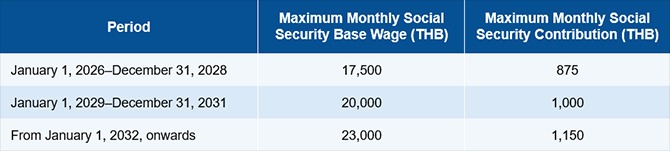
On December 12, 2025, Thailand’s Ministry of Labor published a ministerial regulation prescribing the minimum and maximum wages used as a base for calculating social security contributions. The regulation, which takes effect on January 1, 2026, sets a flat minimum base wage of THB 1,650 per month and a phased increase of the maximum base wage over the following six years, as outlined in the table below.
Impact on Social Security Benefits

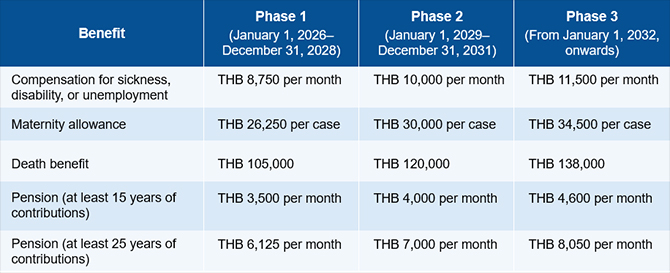
Not only will monthly contributions increase as a result of the adjustment to the maximum wages used as a base for calculating social security contributions, but the maximum benefits available to insured persons will also be enhanced, as shown in the next table.
Employer Obligations

From January 1, 2026, employers must correctly withhold wages and remit social security contributions for both the employer’s and employees’ portions in compliance with the revised thresholds. Failure to comply may expose employers to penalties under the Social Security Act B.E. 2533 (1990).

Employers should ensure that payroll systems are updated as necessary to reflect these changes to the wage ceiling used for social security contribution calculations.


RELATED INSIGHTS​ 

September 13, 2021
Businesses in Vietnam recognize the need to vaccinate their workers in order to keep their factories and workplaces open. In this article, we explore whether employers may require their employees to be vaccinated, as well as associated disclosure and privacy issues under Vietnamese law.
September 13, 2021
With COVID-19 cases continuing to pose a significant threat throughout Thailand, many employers have ordered their employees to work exclusively from home in order to minimize their chances of contracting the virus. However, this luxury is not afforded to all employees—some are unable to work from home due to the nature of their work, and consequently they are placed in the precarious position of being exposed to possible infection. Thailand’s Social Security Office (SSO) understood these risks early in the pandemic and, in March 2020, issued guidelines through the Workmen’s Compensation Fund Office on employees’ entitlement to claim benefits from the workers’ compensation fund (WCF) if they contract the virus as a result of their work. The WCF provides medical-related assistance and compensation to employees who directly suffer from a work-related injury or sickness (subject to certain conditions). Falling ill with COVID-19 during the performance of work duties may constitute suffering work-related sickness, thereby allowing employees to claim compensation from the WCF by submitting the Kor Thor 16 form, a medical certificate, treatment records, records of the employee’s working hours, and other relevant documentation. Upon receiving a claim, the SSO will investigate by collecting facts and evidence from the employer, the infected employee and his or her colleagues, and any witnesses. The official will examine the employee’s duties and working conditions in detail, taking into consideration any relevant information, such as evidence regarding the employee’s travel or movements prior to falling sick. Once all the facts and evidence are gathered, the matter will be submitted to a medical subcommittee responsible for determining whether the employee’s onset of COVID-19 is due to his or her work. If the subcommittee finds that the employee’s contraction of the virus did indeed result from the performance of his or her work duties, the
August 26, 2021
Around the world, COVID-19 is continuing to threaten the health of millions, interrupt daily life, and throttle business activity. In Thailand, the latest wave of infections has been more intense than any since the beginning of the pandemic, and many businesses have been forced to close down once again. There are reasons for hope though—chief among them the increasing pace of vaccinations. Not only are the vaccines effective at preventing serious health issues, they are helping keep both employees and customers safe in business settings so that commerce, trade, and tourism can resume once again. Many in Thailand have already been vaccinated, and struggling employers are looking ahead to safely resuming full business activities, from reopening offices for employees who have been working from home, to welcoming customers and clients back to an environment that minimizes the risk of COVID-19 exposure. In anticipation of such a return to business at full capacity, many Thai employers are taking note of companies and organizations overseas boosting COVID-19 safety in workplaces by mandating vaccines and other measures, and asking whether such mandates could be imposed here in Thailand. The main legal concept to consider here is the provision in the Labor Protection Act B.E. 2541 (1998), which authorizes employers to issue “lawful and just” orders to employees. For an order to be “lawful and just,” it must be proportionate to the circumstance. In the current context of the COVID-19 pandemic, employers can refer to the Communicable Diseases Act B.E. 2558 (2015), as well as other local regulations, to provide grounds when asserting that their risk-mitigation orders are proportionate, lawful, and just. It is doubtful that a Thai court would rule that the circumstances we find ourselves in now would justify an employer requiring employees to be vaccinated, but this legal standard can