You are using an outdated browser and your browsing experience will not be optimal. Please update to the latest version of Microsoft Edge, Google Chrome or Mozilla Firefox. Install Microsoft Edge

December 19, 2025

Thailand Increases Social Security Base Wages and Benefits

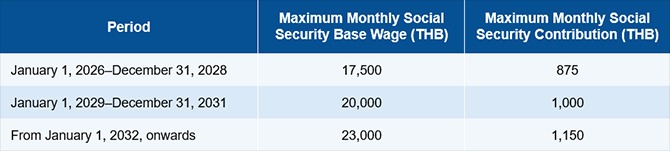
On December 12, 2025, Thailand’s Ministry of Labor published a ministerial regulation prescribing the minimum and maximum wages used as a base for calculating social security contributions. The regulation, which takes effect on January 1, 2026, sets a flat minimum base wage of THB 1,650 per month and a phased increase of the maximum base wage over the following six years, as outlined in the table below.
Impact on Social Security Benefits

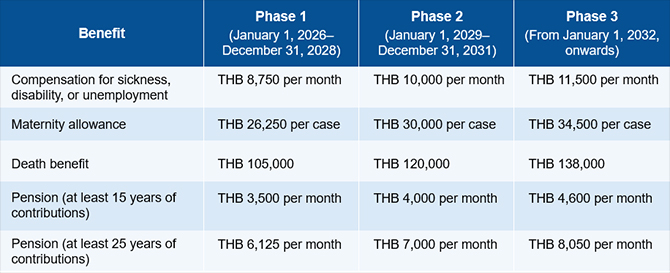
Not only will monthly contributions increase as a result of the adjustment to the maximum wages used as a base for calculating social security contributions, but the maximum benefits available to insured persons will also be enhanced, as shown in the next table.
Employer Obligations

From January 1, 2026, employers must correctly withhold wages and remit social security contributions for both the employer’s and employees’ portions in compliance with the revised thresholds. Failure to comply may expose employers to penalties under the Social Security Act B.E. 2533 (1990).

Employers should ensure that payroll systems are updated as necessary to reflect these changes to the wage ceiling used for social security contribution calculations.


RELATED INSIGHTS​ 

January 19, 2023
The Thai parliament has passed the so-called Work from Home Bill—formally known as Labour Protection Act (No. 8) B.E. 2566 (2023)—which amends the country’s Labour Protection Act (LPA) to reflect current circumstances. The accompanying legislative remark states that the proposed amendments to the LPA will provide additional options for work arrangements between employers and employees, upgrade the level of labor protection, increase work stability, and improve quality of life for employees in Thailand. The legislation adds a single section to the LPA providing that an employer and an employee “may agree in the employment contract” that the employee is allowed “to bring work . . . to perform at home or at the residence of the employee or anywhere that the employee can work remotely through information technology, if the nature of the work permits.” The provision further provides that employers are responsible for ensuring that remote work agreements are in writing, either physically or electronically, and may include the following details: Period of the agreement; Normal working hours, rest periods, and overtime work; Criteria for overtime work, holiday work, and various types of leave; Scope of work and control or supervision by the employer; and Responsibility for arranging supplies and equipment, including necessary costs relating to the work. The amended LPA gives employees who work from home the right to refuse contact from the employer or the supervisor beyond working hours. In addition, employers must treat remote employees equally to on-premise employees. The most notable question surrounding this legislation is whether employers must allow employees to work remotely. The phrase “may agree” suggests that employers do not have to agree to allow an employee to work remotely. Another important aspect of the amendment is that there is no criminal punishment attached to it, which suggests that the legislation
October 28, 2022
Tilleke & Gibbins employment specialists in Myanmar have contributed an updated Myanmar chapter to Employment and Employee Benefits Global Guide, a Thomson Reuters Practical Law online publication that provides an overview of employment and employee benefits in jurisdictions worldwide. The Myanmar chapter was written by members of Tilleke & Gibbins’ Yangon office, including Yuwadee Thean-ngarm, director; Nwe Oo, senior associate; Sher Hann Chua, consultant; and Kyaw Min Tun, consultant. The chapter covers a wide range of key employment topics, including employment status, background checks, regulation of the employment relationship, minimum wage, working hours and holidays, illness and injury of employees, discrimination and harassment, termination of employment, resolution of employer-employee disputes, redundancy/layoffs, employee representation and consultation, business transfer and insolvency, employee relocation, health and safety obligations, taxation of employment income, intellectual property issues, and more. Practical Law, produced by Thomson Reuters, is the world’s leading legal resource for business lawyers, publishing a huge range of guides for hundreds of jurisdictions and practice areas. The Employment and Employee Benefits Global Guide covers 46 jurisdiction around the world, with Tilleke & Gibbins also providing the Vietnam chapter of the guide. To view the latest version of the Myanmar chapter, please visit the Practical Law website.
October 10, 2022
Thailand’s recent removal of cannabis from the list of narcotics represents a significant development for the country, and it has some human resources teams wondering whether they should prepare certain measures in order to prevent detrimental incidents from happening in their organizations. For example, some employees could still be under the influence of cannabis because they used it before coming to work. In the past, this was rarely a consideration as cannabis was clearly banned. Using cannabis or possessing cannabis inside the employer’s premises subjected employees to criminal liability including imprisonment and fines. However, now that the government has removed cannabis from the narcotics list under the Narcotics Act, such incidents are more likely to occur. This likelihood has led to concern among many employers about how they can prevent or handle these incidents. An employer does have the right to prohibit any employee from bringing cannabis inside its premises, as it is the property of the employer. The employer has the management right to do this, particularly as an employee’s use of cannabis may very well disturb other employees. But if the employer would like to set penalties for breaching the prohibition, the picture is more complicated. Employers’ Work Rules Under the Labour Protection Act (LPA), an employer who has at least 10 employees must have Thai-language work rules. These work rules must include the following items: Specification of working days, regular working hours, and rest periods; Holidays and rules for taking holidays; Rules concerning overtime work and work on holidays; Arrangements for payment of wages (i.e., schedule and location); Overtime pay, holiday pay, and holiday overtime pay; Leave and rules for taking leave; Discipline and disciplinary actions; Submission of grievances; and Termination of employment, severance pay and special severance pay. To issue or amend work rules (e.g.,
October 7, 2022
On October 3, 2022, Thailand’s Ministry of Labour issued an announcement canceling the prohibition on lockouts and strikes, which had been in place since the onset of the COVID-19 pandemic. While this cancellation does not apply to ongoing labor disputes already being considered under the interim arrangements, it will apply to all other labor disputes from October 5, 2022, when it was published in the Government Gazette. Lockouts and strikes are basic rights of employers and employees under the Labour Relations Act B.E. 2518 (1975). However, these rights can be suspended—as they have been since May 8, 2020, when the Ministry of Labour announced that all labor disputes that could not be resolved through negotiation must be presented to the Labour Relations Committee in lieu of organizing strikes or lockouts. The announcement referred to the necessity of such special administration during the COVID-19 situation in order to prevent possible negative impacts on both employers and employees. On September 30, 2022, Thailand ended its COVID-19 emergency decree and dissolved the country’s Centre for COVID-19 Situation Administration. In light of this, the Ministry of Labour decided to end the requirement that unresolved labor disputes be sent to the Labour Relations Committee. The ministry’s cancellation of the prohibition will once again allow employers and employees to organize lockouts and strikes under the Labour Relations Act, starting October 5, 2022. For more details on this development, or for assistance with employment-related questions or disputes in Thailand, please contact Tilleke & Gibbins at [email protected] or +66 2056 5555.