You are using an outdated browser and your browsing experience will not be optimal. Please update to the latest version of Microsoft Edge, Google Chrome or Mozilla Firefox. Install Microsoft Edge

December 19, 2025

Thailand Increases Social Security Base Wages and Benefits

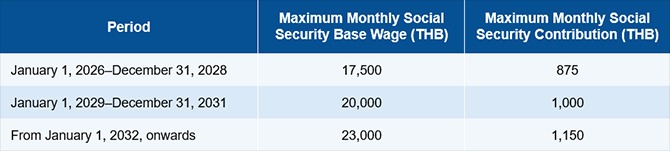
On December 12, 2025, Thailand’s Ministry of Labor published a ministerial regulation prescribing the minimum and maximum wages used as a base for calculating social security contributions. The regulation, which takes effect on January 1, 2026, sets a flat minimum base wage of THB 1,650 per month and a phased increase of the maximum base wage over the following six years, as outlined in the table below.
Impact on Social Security Benefits

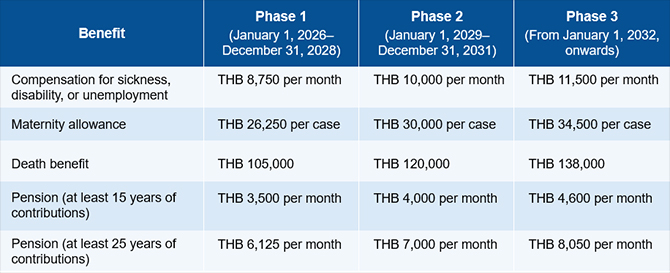
Not only will monthly contributions increase as a result of the adjustment to the maximum wages used as a base for calculating social security contributions, but the maximum benefits available to insured persons will also be enhanced, as shown in the next table.
Employer Obligations

From January 1, 2026, employers must correctly withhold wages and remit social security contributions for both the employer’s and employees’ portions in compliance with the revised thresholds. Failure to comply may expose employers to penalties under the Social Security Act B.E. 2533 (1990).

Employers should ensure that payroll systems are updated as necessary to reflect these changes to the wage ceiling used for social security contribution calculations.


RELATED INSIGHTS​ 

October 20, 2023
On September 18, 2023, the Vietnamese government issued Decree No. 70/2023/ND-CP (“Decree 70”) amending and supplementing certain provisions of Decree No. 152/2020/ND-CP (“Decree 152”), which regulates foreign workers working in Vietnam and the recruitment and management of Vietnamese workers working for foreign entities in Vietnam. While Decree 70 relaxes some conditions relating to foreign workers, the general goal of protecting and prioritizing domestic labor over foreign labor remains. The major changes introduced in Decree 70 are summarized below. 1. Amended Definitions and Requirements for Worker Classifications Decree 70 introduces several changes to the requirements for foreign workers to be classified as “experts” and “technical workers.” Under Decree 152, foreign workers needed to hold bachelor’s degrees or receive training directly related to their intended job positions in Vietnam. However, under Decree 70, experts are only required to have a university degree or higher and at least three years of relevant work experience suitable for their intended positions in Vietnam. Similarly, it is no longer necessary for technical workers to have training in a specific technical field to be eligible to work in Vietnam. Instead, a technical worker is defined as someone who has undergone at least one year of training and possesses at least three years of working experience suitable for their intended job position. Additionally, Decree 70 clarifies and expands the scope of the term “executive director”. Accordingly, an executive director can be (i) the head of a branch, representative office, or business location of an enterprise (which helps clarify the previous definition of “executive director” in Decree 152); or (ii) an individual who oversees at least one field within an agency, organization, or enterprise while being under the direct supervision of the head of that agency, organization, or enterprise. 2. Application for Work Permit The general procedure for
October 12, 2023
Myanmar has made important amendments to its minimum wage framework by increasing the minimum compensation for workers in both the public and private sectors. Background In May 2018, the National Committee for Setting the Minimum Wage determined that all workers in Myanmar should receive a minimum wage of MMK 4,800 per day (approx. USD 2.29), equivalent to MMK 600 per hour for an eight-hour workday. This rule applied to all workers, without differentiation in location or job. Government Workers and Organizations In September 2023, the Ministry of Planning and Finance announced that daily workers in government departments and organizations are entitled to receive an additional benefit of MMK 1,000 on top of their existing daily wage, which was already MMK 4,800. Consequently, they could earn a total of MMK 5,800 per day for eight hours of work. Private-Sector Workers On October 9, 2023, the national committee announced an increase of minimum wages for employees in the private sector. According to Notification No. 2/2023, workers at private-sector employers with more than 10 employees are now entitled to minimum compensation of MMK 5,800 per day (approx. USD 2.77)—an additional MMK 1,000 per eight-hour workday over the previously established minimum wage. The changes took effect on October 1, 2023. For more details about these changes, or any aspect of employee compensation or employment law in Myanmar, please contact Tilleke & Gibbins at [email protected].
August 18, 2023
On August 16, 2023, Laos’ Prime Minister’s Office issued Notice No. 1502/PMO, which increases the minimum wage for all workers in Laos. This increase is a continuation of the stepped increases in the minimum wage that began in mid-2022. The recent notice increases the minimum monthly wage from LAK 1,300,000 (approx. USD 66) to LAK 1,600,000 (approx. USD 82), in accordance with an agreement reached in the government’s ordinary session in July 2023. The new minimum wage rate will take effect on October 1, 2023. This is the third minimum wage increase in Laos since June 2022. Two of the main factors responsible for this heightened frequency of minimum wage increases are the depreciation of the Lao kip against foreign currencies and inflation in the price of goods for daily consumption. These stepped increases also show the government’s proactive approach toward addressing the cost-of-living crisis in Laos and its effect on low-wage workers. For more details on the new minimum wage, or on any other labor and employment matters in Laos, please contact Dino Santaniello at [email protected] or +856 21 262 355.
July 7, 2023
Tilleke & Gibbins is pleased to announce the release of Employment Law Basics in Southeast Asia. This publication serves as an indispensable resource for businesses navigating the complex landscape of employment law in Cambodia, Laos, Myanmar, Thailand, and Vietnam. Authored by Tilleke & Gibbins’ regional team of employment law specialists, the guide provides a detailed overview of key employment law topics essential for businesses operating or planning to expand their operations in Southeast Asia. From employment contracts to termination procedures, each topic is examined in depth to ensure businesses are well-equipped to comply with local regulations and protect their interests. Key topics covered in the guide include: Employment contracts Probationary period Minimum wage Social security and statutory payments Working hours Leave and holidays Work rules Termination Foreign employees Data protection Remote work AI and automation Our guide offers multinational corporations establishing a presence in the region and local enterprises alike practical insights and actionable advice tailored to the unique regulatory environments in Cambodia, Laos, Myanmar, Thailand, and Vietnam. To access the full guide, please download the PDF below.