You are using an outdated browser and your browsing experience will not be optimal. Please update to the latest version of Microsoft Edge, Google Chrome or Mozilla Firefox. Install Microsoft Edge

December 19, 2025

Thailand Increases Social Security Base Wages and Benefits

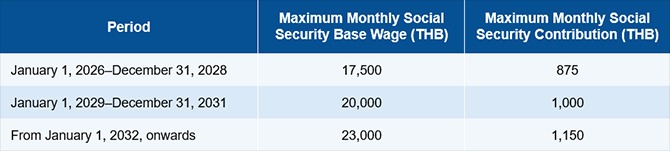
On December 12, 2025, Thailand’s Ministry of Labor published a ministerial regulation prescribing the minimum and maximum wages used as a base for calculating social security contributions. The regulation, which takes effect on January 1, 2026, sets a flat minimum base wage of THB 1,650 per month and a phased increase of the maximum base wage over the following six years, as outlined in the table below.
Impact on Social Security Benefits

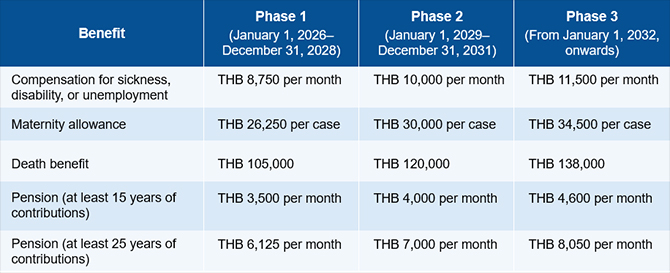
Not only will monthly contributions increase as a result of the adjustment to the maximum wages used as a base for calculating social security contributions, but the maximum benefits available to insured persons will also be enhanced, as shown in the next table.
Employer Obligations

From January 1, 2026, employers must correctly withhold wages and remit social security contributions for both the employer’s and employees’ portions in compliance with the revised thresholds. Failure to comply may expose employers to penalties under the Social Security Act B.E. 2533 (1990).

Employers should ensure that payroll systems are updated as necessary to reflect these changes to the wage ceiling used for social security contribution calculations.


RELATED INSIGHTS​ 

October 8, 2014
International Employment Law, Second Edition (Release 3, 2014) provides an overview of employment law in 35 countries worldwide. The Thailand chapter of the guide, written by Chinachart Vatanasuchart, partner in Tilleke & Gibbins’ corporate and commercial group, examines the following issues within the context of the Civil and Commercial Code, the Labor Protection Act, and other legislation:
September 5, 2014
Businesses in Thailand, particularly manufacturers, have used workers employed as subcontractors through agreements with third parties to meet fluctuating demand, reduce labor costs, and otherwise benefit from the flexibility that subcontracted employees provide.
June 26, 2014
The latest edition of How to Hire and Fire, a guide to the rules and regulations governing employment relationships around the world, has been published by Multilaw. Chinachart Vatanasuchart, a partner in Tilleke & Gibbins’ corporate and commercial department, contributed the Thailand chapter of the guide, in which he expounds on important issues related to labor and employment law in Thailand. The chapter covers the following main topics:
June 26, 2014
Michael K. Lee, Annika Svanberg, and Kien Trung Trinh, lawyers in the Vietnam corporate and commercial group at Tilleke & Gibbins, have authored the Vietnam chapter to Multilaw’s How to Hire and Fire 2014, a guide to labor and employment law in 98 jurisdictions worldwide. They delve into such issues as the forums for adjudicating employment disputes, legal requirements for employment agreements, secrecy and confidentiality, ownership of inventions, and outsourcing and sub-contracting.