You are using an outdated browser and your browsing experience will not be optimal. Please update to the latest version of Microsoft Edge, Google Chrome or Mozilla Firefox. Install Microsoft Edge

December 19, 2025

Thailand Increases Social Security Base Wages and Benefits

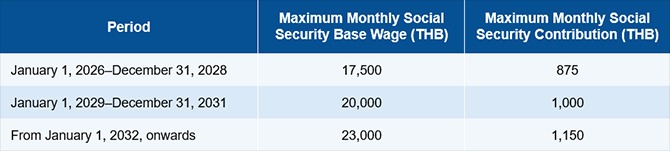
On December 12, 2025, Thailand’s Ministry of Labor published a ministerial regulation prescribing the minimum and maximum wages used as a base for calculating social security contributions. The regulation, which takes effect on January 1, 2026, sets a flat minimum base wage of THB 1,650 per month and a phased increase of the maximum base wage over the following six years, as outlined in the table below.
Impact on Social Security Benefits

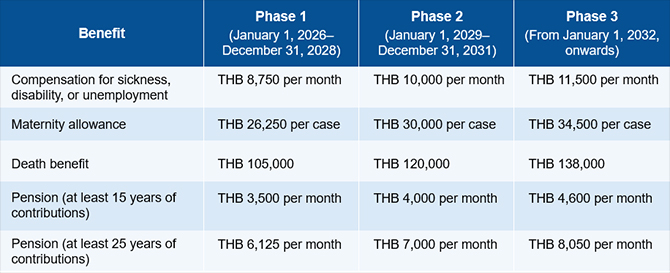
Not only will monthly contributions increase as a result of the adjustment to the maximum wages used as a base for calculating social security contributions, but the maximum benefits available to insured persons will also be enhanced, as shown in the next table.
Employer Obligations

From January 1, 2026, employers must correctly withhold wages and remit social security contributions for both the employer’s and employees’ portions in compliance with the revised thresholds. Failure to comply may expose employers to penalties under the Social Security Act B.E. 2533 (1990).

Employers should ensure that payroll systems are updated as necessary to reflect these changes to the wage ceiling used for social security contribution calculations.


RELATED INSIGHTS​ 

December 2, 2025
Investing in Mainland Southeast Asia is Tilleke & Gibbins’ essential guide for investors looking to do business in this vibrant region, whether it’s starting operations as a newly established entity or expanding into new territories or business models.
November 20, 2025
Lawyers from Tilleke & Gibbins’ labor and employment team have contributed a new Vietnam chapter to Thomson Reuters Practical Law’s Employment and Employee Benefits Global Guide. The guide provides a high-level comparative overview of employment laws and regulations across various jurisdictions around the world. Tilleke & Gibbins also contributed the Myanmar chapter of the guide. The Vietnam chapter covers a wide range of typical employment matters, such as limitations on working hours, paid leave requirements, minimum wage, and health and safety obligations. In addition, the guide provides insight on various topics of special interest to foreign investors doing business in Vietnam, including the following: Mandatory contents of a labor contract; Visas and permits required for expatriate employees; Employers’ obligations for protecting employees’ privacy and personal data; Procedural requirements for the dismissal of an employee; Employer and parent company liability. To view the latest version of the Employment and Employee Benefits Vietnam chapter, please visit the Practical Law website and enroll in the free Practical Law trial to gain full access.
November 12, 2025
Thailand has amended the Labor Protection Act to significantly expand family leave benefits and strengthen employment protections, effective December 7, 2025. The Labor Protection Act (No. 9) B.E. 2568 (2025), published in the Government Gazette on November 7, 2025, provides enhanced maternity and paternity benefits, introduces new childcare leave provisions, and extends labor protections to certain public sector contractors. Key changes introduced by the amendments are detailed below. Extended Maternity Leave Female employees are now entitled to up to 120 days of maternity leave per pregnancy, increased from 98 days. Employers must pay full wages for 60 days, increased from the current 45 days. New Childcare Leave for Health Complications Female employees who have taken maternity leave are entitled to an additional 15 days of leave to care for newborns with health complications, disabilities, or conditions that could lead to future medical risks. This leave requires a medical certificate and is compensated at 50% of the employee’s regular wage. New Paternity Leave Male employees are now entitled to 15 days of paid paternity leave to support their spouse or partner during childbirth. This new leave allowance may be taken before or within 90 days after childbirth, with employers required to pay full wages for all 15 days. Protection for Public Sector Contractors The law extends protection to individuals engaged under service contracts with government agencies, including central, regional, and local administrations, state enterprises, and public organizations. When such workers are supervised or controlled in a manner similar to employees, the contracting government agencies must provide them with rights and benefits equivalent to those under the Labor Protection Act, including remuneration, weekly holidays, public holidays, annual leave, sick leave, regulated working hours, and rest periods. New Annual Reporting Requirement All employers with 10 or more employees must now submit an
October 29, 2025
On September 15, 2025, Thailand’s Senate approved a draft amendment to the Labor Protection Act (LPA), which is currently awaiting publication in the Government Gazette. The amendment, which will take effect 30 days after publication, extends labor protections to certain service contractors working for state entities, enhances maternity and spousal support leave, and updates employer reporting obligations. Expanded Protections for State-Contracted Service Providers The amendment adds a section to the LPA that extends core labor protections to individuals engaged by government bodies under service contracts. This provision covers workers hired by central, regional, and local government agencies; state enterprises governed by the State Enterprise Labor Relations Act; public organizations; and other state agencies when these entities retain individuals under service procurement contracts (or similar arrangements) and exercise supervision, direction, and control over their work. In such cases, the hiring agencies must provide terms no less favorable than those required under the LPA for remuneration, weekly holidays, traditional holidays, annual leave, sick leave, maternity leave, working days and hours, and rest periods. Ministerial regulations will establish specific criteria for implementation. Disputes regarding rights and duties under this provision will fall under Labor Court jurisdiction. This change aligns the treatment of controlled service contractors with that of regular employees, addressing a longstanding coverage gap in the public sector. Enhanced Maternity Leave and New Caregiving Provisions The amendment includes a maternity leave entitlement of up to 120 days per pregnancy (an increase from the previous 98 days), unless otherwise prescribed by royal decree, and also introduces a new postnatal caregiving leave for mothers in complex medical situations who have used their childbirth leave, granting up to 15 additional days to care for children who are at risk of complications, have abnormalities, or have disabilities. This supplemental leave requires support from a medical