You are using an outdated browser and your browsing experience will not be optimal. Please update to the latest version of Microsoft Edge, Google Chrome or Mozilla Firefox. Install Microsoft Edge

December 19, 2025

Thailand Increases Social Security Base Wages and Benefits

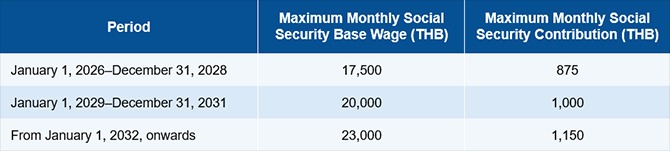
On December 12, 2025, Thailand’s Ministry of Labor published a ministerial regulation prescribing the minimum and maximum wages used as a base for calculating social security contributions. The regulation, which takes effect on January 1, 2026, sets a flat minimum base wage of THB 1,650 per month and a phased increase of the maximum base wage over the following six years, as outlined in the table below.
Impact on Social Security Benefits

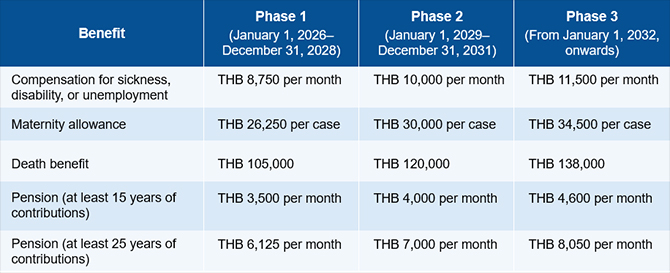
Not only will monthly contributions increase as a result of the adjustment to the maximum wages used as a base for calculating social security contributions, but the maximum benefits available to insured persons will also be enhanced, as shown in the next table.
Employer Obligations

From January 1, 2026, employers must correctly withhold wages and remit social security contributions for both the employer’s and employees’ portions in compliance with the revised thresholds. Failure to comply may expose employers to penalties under the Social Security Act B.E. 2533 (1990).

Employers should ensure that payroll systems are updated as necessary to reflect these changes to the wage ceiling used for social security contribution calculations.


RELATED INSIGHTS​ 

July 28, 2021
Lawyers from Tilleke & Gibbins’ labor and employment team including Kien Trung Trinh, Sarah Galeski, and Nam Ngoc Trinh have written the Vietnam chapter of Practical Law’s Employment and Employee Benefits Global Guide. The 2021 edition of the handbook provides a high-level comparative overview of employment laws and regulations across 32 jurisdictions around the world. Tilleke & Gibbins also contributed the Myanmar chapter of the guide. The Vietnam chapter covers a wide range of typical employment matters, such as limitations on working hours, paid leave requirements, minimum wage, and health and safety obligations. In addition, the guide provides insight on a number of topics of special interest to foreign investors doing business in Vietnam, including the following: Mandatory contents of a labor contract; Visas and permits required for expatriate employees; Employers’ obligations for protecting employees’ privacy and personal data; Procedural requirements for the dismissal of an employee; Employer and parent company liability. The 2021 edition also includes a special section on Covid-19 related provisions of labor law. To read the Vietnam chapter, click on the link below.
June 22, 2021
The latest updates to the Employment and Employee Benefits Global Guide, a Thomson Reuters Practical Law online publication that provides an overview of employment and employee benefits in jurisdictions worldwide, includes a revised chapter on employment regulations in Myanmar. The Myanmar chapter was written by members of Tilleke & Gibbins’ Yangon office, including Yuwadee Thean-ngarm, director, Nwe Oo, attorney-at-law, and Sher Hann Chua, consultant. The chapter covers a wide range of key employment topics, including employment status, background checks, regulation of the employment relationship, minimum wage, working hours and holidays, illness and injury of employees, discrimination and harassment, termination of employment, resolution of employer-employee disputes, redundancy/layoffs, employee representation and consultation, business transfer and insolvency, employee relocation, health and safety obligations, taxation of employment income, intellectual property issues, and more. Practical Law, produced by Thomson Reuters, is the world’s leading legal resource for business lawyers, publishing a huge range of guides for hundreds of jurisdictions and practice areas. The Employment and Employee Benefits Global Guide covers 42 jurisdiction around the world, with Tilleke & Gibbins also providing the Vietnam chapter of the guide. To view the latest version of the Myanmar chapter, please visit the Practical Law website.