You are using an outdated browser and your browsing experience will not be optimal. Please update to the latest version of Microsoft Edge, Google Chrome or Mozilla Firefox. Install Microsoft Edge

December 15, 2019

Thailand to Increase Minimum Wage across All Provinces

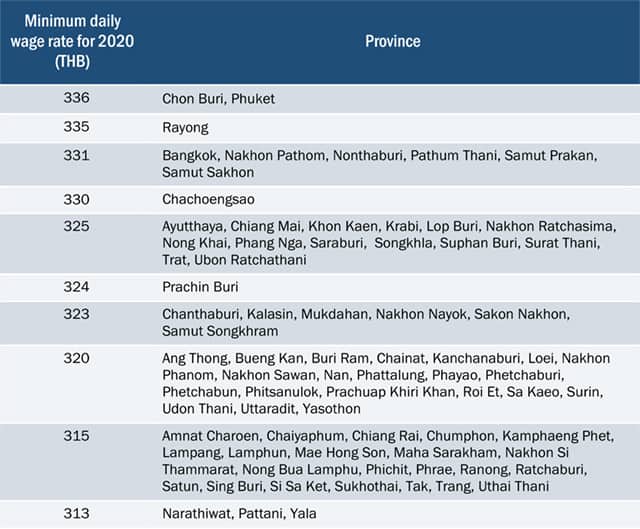
The National Wage Committee of Thailand’s Ministry of Labour has announced a new minimum daily wage, which will take effect on January 1, 2020. The announcement increases the minimum wage by THB 6 per day for workers in nine provinces—Bangkok, Chon Buri, Nakhon Pathom, Nonthaburi, Pathum Thani, Phuket, Prachin Buri, Samut Prakan, and Samut Sakhon—and by THB 5 in all other provinces. 

With these changes, the sliding scale for the minimum daily wage in 2020 will range from THB 313 to THB 336, as detailed in the table below.

If you have any questions about this change, or any other aspect of labor and employment in Thailand, please contact Pimvimol (June) Vipamaneerut at [email protected] or at +66 2056 5588.

RELATED INSIGHTS​ 

September 25, 2025
Tilleke & Gibbins’ labor and employment team in Hanoi and Ho Chi Minh City has contributed the Vietnam chapter to Labor and Employment Disputes 2026. Drawing on the expertise of three of the firm’s employment specialists, the chapter provides practical guidance for navigating employment disputes in Vietnam and covers: Pre-action considerations: key requirements, third-party funding, contingency fee arrangements Issuing a claim: forum, territorial jurisdiction, standing, commencing claims, fees, service, defendants and legal personality, types of claims, time limits, counterclaims Case management: procedure, rules, amendments to claims, adding parties, consolidating proceedings, class and collective actions, evidence, witnesses, tactical considerations Interim relief: availability, requirements Trial: hearings conduct and time frames, confidentiality and public access, media reporting, elements of successful claims and burden of proof Alternative dispute resolution: available types, requirements and expectations, enforcement Collective employment and labor rights: enforcement and standing Remedies and enforcement: available remedies, assessing compensation, enforcement mechanisms Appeals: procedure, time frames, other means of challenge Updates and trends: recent cases and developments, technology developments, other issues The Vietnam chapter is available for download below. Tilleke & Gibbins also contributed the Cambodia and Thailand chapters to Labor and Employment Disputes 2026. Readers can also gain 30 days of complementary access to the full Labor and Employment Disputes 2026 guide and the rest of Lexology Panoramic’s varied offerings through this link.

September 25, 2025
In the Thailand contribution to Labor and Employment Disputes 2026, four members of Tilleke & Gibbins’ Bangkok labor and employment team outline key aspects of dispute resolution in Thailand. Their analysis, part of Lexology Panoramic’s comparative guide covering jurisdictions worldwide, addresses the following areas: Pre-action considerations: key requirements, third-party funding, contingency fee arrangements Issuing a claim: forum, territorial jurisdiction, standing, commencing claims, fees, service, defendants and legal personality, types of claims, time limits, counterclaims Case management: procedure, rules, amendments to claims, adding parties, consolidating proceedings, class and collective actions, evidence, witnesses, tactical considerations Interim relief: availability, requirements Trial: hearings conduct and time frames, confidentiality and public access, media reporting, elements of successful claims and burden of proof Alternative dispute resolution: available types, requirements and expectations, enforcement Collective employment and labor rights: enforcement and standing Remedies and enforcement: available remedies, assessing compensation, enforcement mechanisms Appeals: procedure, time frames, other means of challenge Updates and trends: recent cases and developments, technology developments, other issues The complete Thailand chapter can be downloaded below. Tilleke & Gibbins also contributed the Cambodia and Vietnam chapters to Labor and Employment Disputes 2026. Readers can also gain 30 days of complementary access to the full Labor and Employment Disputes 2026 guide and the rest of Lexology Panoramic’s varied offerings through this link.
September 25, 2025
Four of Tilleke & Gibbins’ labor and employment specialists in Phnom Penh have authored the Cambodia chapter of Labor and Employment Disputes 2026, the latest edition of Lexology Panoramic’s global guide to handling labor and employment disputes. The chapter provides practical insights on a wide range of dispute resolution issues, including: Pre-action considerations: key requirements, third-party funding, contingency fee arrangements Issuing a claim: forum, territorial jurisdiction, standing, commencing claims, fees, service, defendants and legal personality, types of claims, time limits, counterclaims Case management: procedure, rules, amendments to claims, adding parties, consolidating proceedings, class and collective actions, evidence, witnesses, tactical considerations Interim relief: availability, requirements Trial: hearings conduct and time frames, confidentiality and public access, media reporting, elements of successful claims and burden of proof Alternative dispute resolution: available types, requirements and expectations, enforcement Collective employment and labor rights: enforcement and standing Remedies and enforcement: available remedies, assessing compensation, enforcement mechanisms Appeals: procedure, time frames, other means of challenge Updates and trends: recent cases and developments, technology developments, other issues The full Cambodia chapter is available for download below. Tilleke & Gibbins also contributed the Thailand and Vietnam chapters to Labor and Employment Disputes 2026. Readers can also gain 30 days of complementary access to the full Labor and Employment Disputes 2026 guide and the rest of Lexology Panoramic’s varied offerings through this link.
September 2, 2025
On August 26, 2025, the Thai cabinet approved a one-year postponement of mandatory contributions to the Employee Welfare Fund. Originally scheduled to take effect on October 1, 2025, the enforcement date has been deferred to October 1, 2026. The decision to delay the implementation stems from ongoing economic uncertainties in Thailand, driven by several external and domestic factors. These include increased trade tariffs imposed by the United States, the recent rise in the national minimum wage, and continued geopolitical tensions resulting from unresolved disputes with neighboring countries. These challenges have placed significant pressure on both businesses and the labor market, prompting the government to offer temporary relief through this deferral. As a result of the postponement, the following regulations will now come into effect on October 1, 2026: Royal Decree determining the Commencement Period for Savings and Contributions to the Employee Welfare Fund; Ministerial Notification specifying the Rates of Savings and Contributions; and Ministerial Notification outlining the Criteria and Procedures for Employers to Provide Assistance in Cases of Termination of Employment or Death. The Labour Welfare Fund Committee has formally endorsed the postponement. Contribution Rates Unchanged Although the implementation has been delayed, the contribution rates remain unchanged: October 1, 2026–September 30, 2031: Employers and employees each contribute 0.25% of the employee’s wage to the fund. From October 1, 2031, onward: Contributions increase to 0.5% of the employee’s wage for both parties. All other rules and conditions concerning the Employee Welfare Fund remain in full effect.