
You are using an outdated browser and your browsing experience will not be optimal. Please update to the latest version of Microsoft Edge, Google Chrome or Mozilla Firefox. Install Microsoft Edge

December 15, 2019

Thailand to Increase Minimum Wage across All Provinces

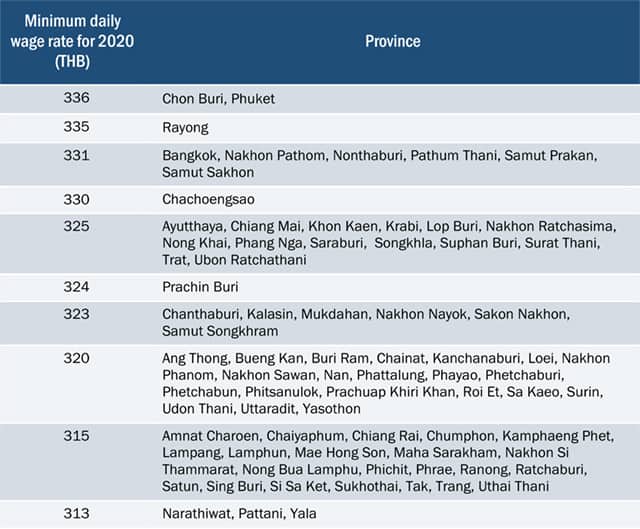
The National Wage Committee of Thailand’s Ministry of Labour has announced a new minimum daily wage, which will take effect on January 1, 2020. The announcement increases the minimum wage by THB 6 per day for workers in nine provinces—Bangkok, Chon Buri, Nakhon Pathom, Nonthaburi, Pathum Thani, Phuket, Prachin Buri, Samut Prakan, and Samut Sakhon—and by THB 5 in all other provinces. 

With these changes, the sliding scale for the minimum daily wage in 2020 will range from THB 313 to THB 336, as detailed in the table below.
If you have any questions about this change, or any other aspect of labor and employment in Thailand, please contact Pimvimol (June) Vipamaneerut at [email protected] or at +66 2056 5588.

RELATED INSIGHTS​ 

November 27, 2013
Following adoption of the new Labor Code (in force since May 1, 2013), the government of Vietnam recently issued Decree 102/2013/ND-CP (Decree 102) elaborating the Labor Code’s provisions on foreign nationals working in the country. Under Decree 102, which took effect on November 1, 2013, employers using foreign workers will be required to submit an annual “foreign labor demand report” to the local authorities.
October 21, 2013
As part of the Vietnamese government’s efforts to overhaul its labor legislation, it adopted Decree 102/2013/ND-CP on September 5, 2013 (Decree 102), elaborating on the provisions of the new Labor Code (in force since May 1, 2013) on foreign workers in Vietnam. Decree 102 will be effective as of November 1, 2013. We discuss some of the key points below.Employer Reporting Requirements
October 4, 2013
Under Thai law, there are no requirements that employment contracts be made in writing. For some employers, this may create the perception that they can simply reach a cursory agreement with an employee on a few basic issues, such as job role and salary, and work out any other issues as they arise. In reality, this could not be further from the truth.
September 10, 2013
The importance of understanding employment law, both for employers and employees, can never be emphasized enough. There are statutes and regulations in place which, if not followed, may lead to severe consequences for the violating party. To help employers and employees avoid potentially costly legal ramifications, partner Michael K. Lee and attorney-at-law Huong Thi Thanh Nguyen have coauthored the Vietnam chapter of How to Hire and Fire (3rd Edition), published by Multilaw.