
You are using an outdated browser and your browsing experience will not be optimal. Please update to the latest version of Microsoft Edge, Google Chrome or Mozilla Firefox. Install Microsoft Edge

December 15, 2019

Thailand to Increase Minimum Wage across All Provinces

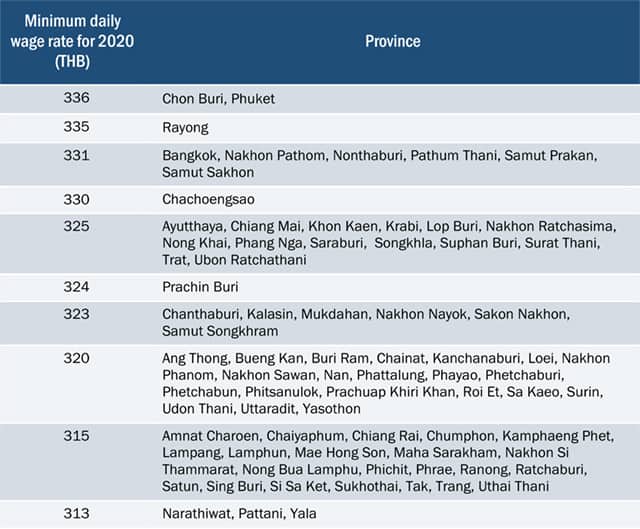
The National Wage Committee of Thailand’s Ministry of Labour has announced a new minimum daily wage, which will take effect on January 1, 2020. The announcement increases the minimum wage by THB 6 per day for workers in nine provinces—Bangkok, Chon Buri, Nakhon Pathom, Nonthaburi, Pathum Thani, Phuket, Prachin Buri, Samut Prakan, and Samut Sakhon—and by THB 5 in all other provinces. 

With these changes, the sliding scale for the minimum daily wage in 2020 will range from THB 313 to THB 336, as detailed in the table below.
If you have any questions about this change, or any other aspect of labor and employment in Thailand, please contact Pimvimol (June) Vipamaneerut at [email protected] or at +66 2056 5588.

RELATED INSIGHTS​ 

July 19, 2018
Partner Kien Trung Trinh, from Tilleke & Gibbins’ Hanoi office, authored the Vietnam chapter of Practical Law’s Employment and Employee Benefits Global Guide 2018. The latest edition of the popular handbook provides a comparative overview of labor law in 30 jurisdictions worldwide, from China to Gibraltar. Tilleke & Gibbins also contributed the Myanmar chapter of the guide.
July 9, 2018
The People’s Court of Ho Chi Minh City was recently requested to overturn an arbitral decision by the Vietnam International Arbitration Center (VIAC) relating to a non-competition clause. In the end, however, the court ruled that VIAC’s decision was correct, thus upholding a non-compete clause signed between a company and its employee. The decision represents one of the first times in Vietnam in which the enforcement of a non-compete clause was tested. Although it is not a legally binding precedent, it does show that non-compete clauses can potentially be upheld in Vietnam.
June 5, 2018
As Thailand gradually transforms into an ageing society, the potential economic and social burden of retiring workers is one issue that is likely to be on the minds of many employees, employers, and policymakers.New amendments to Thailand’s Labor Protection Act have addressed this issue by introducing a retirement regime for the Thai private sector employees, placing severance obligations on employers, enhancing protection for employees, and creating a more effective framework for enforcement of labour laws.
May 25, 2018
The National Committee on Minimum Wage issued Notification 2/2018 (the Notification) on May 14, 2018, which enters into force on the same date and sets the new minimum wage in Myanmar to be MMK 600 (approximately USD 0.45) per hour and MMK 4,800 (approximately USD 3.6) per eight-hour workday, irrespective of the type or location of work. This new minimum wage increase does not apply to small and family-owned businesses with less than 10 employees.