
You are using an outdated browser and your browsing experience will not be optimal. Please update to the latest version of Microsoft Edge, Google Chrome or Mozilla Firefox. Install Microsoft Edge

December 15, 2019

Thailand to Increase Minimum Wage across All Provinces

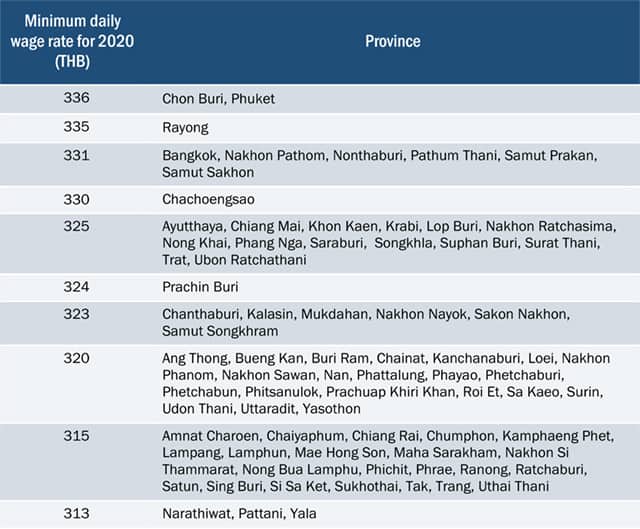
The National Wage Committee of Thailand’s Ministry of Labour has announced a new minimum daily wage, which will take effect on January 1, 2020. The announcement increases the minimum wage by THB 6 per day for workers in nine provinces—Bangkok, Chon Buri, Nakhon Pathom, Nonthaburi, Pathum Thani, Phuket, Prachin Buri, Samut Prakan, and Samut Sakhon—and by THB 5 in all other provinces. 

With these changes, the sliding scale for the minimum daily wage in 2020 will range from THB 313 to THB 336, as detailed in the table below.
If you have any questions about this change, or any other aspect of labor and employment in Thailand, please contact Pimvimol (June) Vipamaneerut at [email protected] or at +66 2056 5588.

RELATED INSIGHTS​ 

July 8, 2019
Kien Trung Trinh, partner and head of Tilleke & Gibbins’ labor and employment practice in Vietnam, wrote the chapter on Vietnam for the latest edition of Practical Law’s Employment and Employee Benefits Global Guide. The 2019 edition of the popular handbook provides a comparative overview of labor law in 31 jurisdictions spanning the globe, from Australia to Mexico. Tilleke & Gibbins also contributed the Myanmar chapter of the guide.
July 2, 2019
Following major developments in Cambodian labor law in 2018 and early 2019, in the past six months Cambodia’s Ministry of Labor and Vocational Training (MLVT) has continued to make substantial clarifications and revisions to employment law in Cambodia that employers should be aware of. The changes fall into three categories:1.  Foreign Workers and Employment Contracts
April 30, 2019
The draft Personal Data Protection Act (PDPA) was approved by the National Legislative Assembly in February 2019, raising concern among business entities over the the need for increased diligence to ensure adherence to the provisions. Running a business often entails handling the personal data of employees, contractors, suppliers, customers, and others. Any personal data collected could be subject to the provisions of the PDPA, and as employee data falls under the PDPA, all businesses, should be prepare to deal with the impact of the PDPA.