
You are using an outdated browser and your browsing experience will not be optimal. Please update to the latest version of Microsoft Edge, Google Chrome or Mozilla Firefox. Install Microsoft Edge

December 15, 2019

Thailand to Increase Minimum Wage across All Provinces

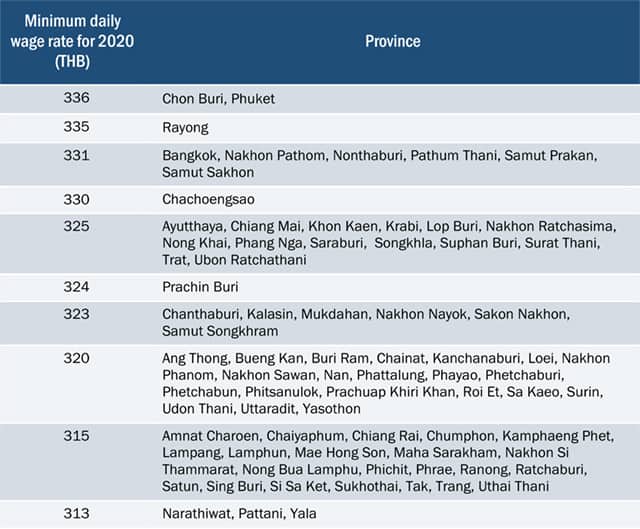
The National Wage Committee of Thailand’s Ministry of Labour has announced a new minimum daily wage, which will take effect on January 1, 2020. The announcement increases the minimum wage by THB 6 per day for workers in nine provinces—Bangkok, Chon Buri, Nakhon Pathom, Nonthaburi, Pathum Thani, Phuket, Prachin Buri, Samut Prakan, and Samut Sakhon—and by THB 5 in all other provinces. 

With these changes, the sliding scale for the minimum daily wage in 2020 will range from THB 313 to THB 336, as detailed in the table below.
If you have any questions about this change, or any other aspect of labor and employment in Thailand, please contact Pimvimol (June) Vipamaneerut at [email protected] or at +66 2056 5588.

RELATED INSIGHTS​ 

March 4, 2020
In November 2019, the National Assembly of Vietnam issued a new version of the Labor Code, which serves as the principal legislation on employment and labor relationships in Vietnam, covering domestic and foreign employers and employees. The changes in the new law are more incremental than sweeping, and generally serve to close loopholes and clarify vague provisions in the existing Labor Code of 2012.
March 2, 2020
In November 2019, the National Assembly of Vietnam issued a new version of the Labor Code, which serves as the principal legislation on employment and labor relationships in Vietnam, covering domestic and foreign employers and employees. The changes found in the new law are more incremental than sweeping, and generally serve to close loopholes and clarify vague provisions in the existing Labor Code of 2012.While the new Labor Code will not take effect until January 1, 2021, employers operating in Vietnam should note the key changes now to facilitate timely implementation.
February 5, 2020
Labor disputes typically arise when one party—often the employee—feels unfairly treated, for reasons that may stretch far beyond the law, and consequently he or she will feel entitled to restitution. Thailand’s labor laws encompass several safeguards that help employers meet a standard of fairness when dealing with dissatisfied or aggrieved employees.
January 28, 2020
Tilleke & Gibbins authors have provided the latest update to the Thailand Q&A section of Doing Business in… , a Q&A-style guide published by Thomson Reuters Practical Law that presents an overview of recent legal developments affecting doing business in 59 jurisdictions worldwide. The Thailand chapter of the guide was written by attorneys from Tilleke & Gibbins and presents an overview of Thailand’s legal system and key laws applicable to foreign companies doing business in the country.