
You are using an outdated browser and your browsing experience will not be optimal. Please update to the latest version of Microsoft Edge, Google Chrome or Mozilla Firefox. Install Microsoft Edge

December 15, 2019

Thailand to Increase Minimum Wage across All Provinces

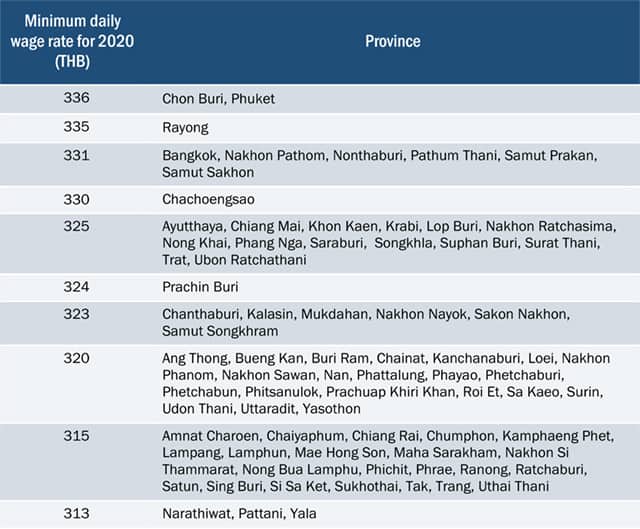
The National Wage Committee of Thailand’s Ministry of Labour has announced a new minimum daily wage, which will take effect on January 1, 2020. The announcement increases the minimum wage by THB 6 per day for workers in nine provinces—Bangkok, Chon Buri, Nakhon Pathom, Nonthaburi, Pathum Thani, Phuket, Prachin Buri, Samut Prakan, and Samut Sakhon—and by THB 5 in all other provinces. 

With these changes, the sliding scale for the minimum daily wage in 2020 will range from THB 313 to THB 336, as detailed in the table below.
If you have any questions about this change, or any other aspect of labor and employment in Thailand, please contact Pimvimol (June) Vipamaneerut at [email protected] or at +66 2056 5588.

RELATED INSIGHTS​ 

March 27, 2020
Due to the economic impact of COVID-19, the Board of the Social Security Office has agreed to reduce the rate for both employee and employer contributions to the Social Security Fund.On March 23, 2020, it was announced that there would be a reduction from a 5% contribution to a 4% contribution, for both employees and employers, for a period of six months, commencing in March and ending in August.
March 27, 2020
On March 4, 2020, the Government of Vietnam issued Decree No. 28/2020/ND-CP Providing Regulations on Administrative Penalties in the Areas of Labor, Social Insurance, and Sending Vietnamese Workers Abroad for Working Under Contract (“Decree 28”). Decree 28 contains 57 articles geared toward protecting Vietnamese workers, including outsourced workers.Decree 28 sets out a number of infractions which employers should be careful to avoid committing and which can result in severe penalties.
March 27, 2020
The adverse impacts of the COVID-19 pandemic have led employers to look for ways to mitigate the losses being wrought by the turmoil. While working remotely from home is a viable option for some, economic slowdown or to the nature of some industries make it unfeasible for others.This article considers the legality of some measures to mitigate employment costs in Laos.Can an employer suspend an employment contract?
March 25, 2020
As Thailand, and the world, face the growing COVID-19 crisis, the impact has begun to spread beyond people’s health and into the economy as a whole. While some businesses may be able to move to remote working practices to minimize economic distress, others may require a physical presence that becomes difficult or impossible to maintain, or may face substantial changes to their operations, resulting in hardship or emergency measures.