You are using an outdated browser and your browsing experience will not be optimal. Please update to the latest version of Microsoft Edge, Google Chrome or Mozilla Firefox. Install Microsoft Edge

December 15, 2019

Thailand to Increase Minimum Wage across All Provinces

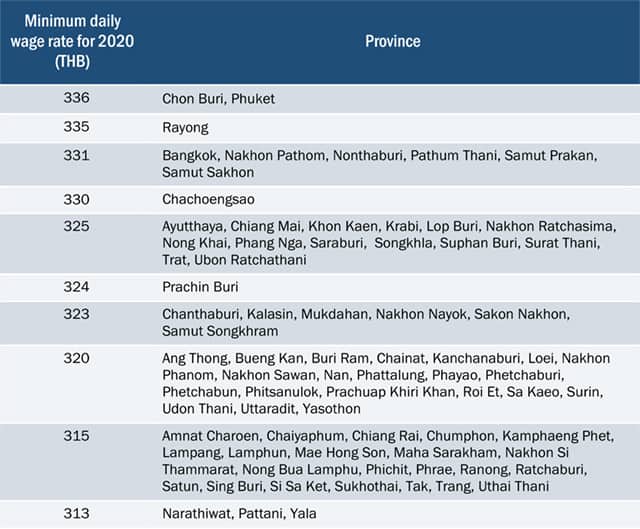
The National Wage Committee of Thailand’s Ministry of Labour has announced a new minimum daily wage, which will take effect on January 1, 2020. The announcement increases the minimum wage by THB 6 per day for workers in nine provinces—Bangkok, Chon Buri, Nakhon Pathom, Nonthaburi, Pathum Thani, Phuket, Prachin Buri, Samut Prakan, and Samut Sakhon—and by THB 5 in all other provinces. 

With these changes, the sliding scale for the minimum daily wage in 2020 will range from THB 313 to THB 336, as detailed in the table below.

If you have any questions about this change, or any other aspect of labor and employment in Thailand, please contact Pimvimol (June) Vipamaneerut at [email protected] or at +66 2056 5588.

RELATED INSIGHTS​ 

October 25, 2021
Michael Ramirez, a counsel in Tilleke & Gibbins’ dispute resolution group in Bangkok, has updated the firm’s contribution to the Global Attorney-Client Privilege Guide, published by Lex Mundi. The newly expanded guide provides information on what constitutes attorney-client privilege in over 70 countries around the world. The Thailand section of the guide contains in-depth information on the function and applications of attorney-client privilege in Thailand (or, as explained in the guide, an equivalent concept enshrined in Thai law), including coverage of the following topics: Privilege in corporations Common interest doctrine Litigation funding Crime-fraud exception Work product doctrine/litigation privilege Other privileges including mediation, accountant-client and settlement negotiation The interactive guide features expert contributions by Lex Mundi member firms from jurisdictions worldwide. Readers can browse the contributions, generate country-specific reports, and compare attorney-client privilege in multiple jurisdictions. For more information, please visit the Lex Mundi website.
October 14, 2021
As part of its membership in Lex Mundi, Tilleke & Gibbins has published an updated edition of its Guide to Doing Business in Thailand for 2021. This guide outlines all of the key factors for starting and operating a business in the Thai market. Issues covered include: Investment incentives Financial facilities Exchange controls Import and export regulations Structures for doing business Requirements for the Establishment of a Business Operation of the Business Cessation or Termination of the Business Labor legislation, relations, and supply Tax Immigration requirements This publication is part of Lex Mundi’s Guides to Doing Business series prepared by member firms in more than 100 jurisdictions worldwide. The guides serve as a useful resource when planning an international business strategy or researching a new market.
September 13, 2021
Businesses in Vietnam recognize the need to vaccinate their workers in order to keep their factories and workplaces open. In this article, we explore whether employers may require their employees to be vaccinated, as well as associated disclosure and privacy issues under Vietnamese law.
September 13, 2021
With COVID-19 cases continuing to pose a significant threat throughout Thailand, many employers have ordered their employees to work exclusively from home in order to minimize their chances of contracting the virus. However, this luxury is not afforded to all employees—some are unable to work from home due to the nature of their work, and consequently they are placed in the precarious position of being exposed to possible infection. Thailand’s Social Security Office (SSO) understood these risks early in the pandemic and, in March 2020, issued guidelines through the Workmen’s Compensation Fund Office on employees’ entitlement to claim benefits from the workers’ compensation fund (WCF) if they contract the virus as a result of their work. The WCF provides medical-related assistance and compensation to employees who directly suffer from a work-related injury or sickness (subject to certain conditions). Falling ill with COVID-19 during the performance of work duties may constitute suffering work-related sickness, thereby allowing employees to claim compensation from the WCF by submitting the Kor Thor 16 form, a medical certificate, treatment records, records of the employee’s working hours, and other relevant documentation. Upon receiving a claim, the SSO will investigate by collecting facts and evidence from the employer, the infected employee and his or her colleagues, and any witnesses. The official will examine the employee’s duties and working conditions in detail, taking into consideration any relevant information, such as evidence regarding the employee’s travel or movements prior to falling sick. Once all the facts and evidence are gathered, the matter will be submitted to a medical subcommittee responsible for determining whether the employee’s onset of COVID-19 is due to his or her work. If the subcommittee finds that the employee’s contraction of the virus did indeed result from the performance of his or her work duties, the